Share:

Legendary director James Cameron voiced concerns about generative AI and the possible use of the technology to replace real actors at the 7th Hainan Island International Film Festival in Sanya, Hainan province on Dec. 9.
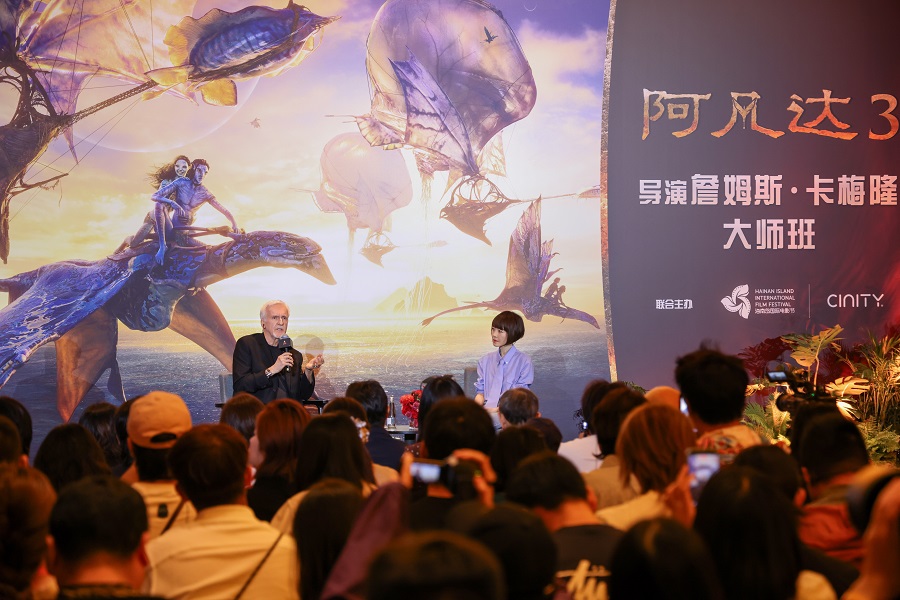
Filmmaker James Cameron speaks at a masterclass during the 7th Hainan Island International Film Festival in Sanya, Hainan province, Dec. 9, 2025. [Photo courtesy of The Walt Disney Company]
As the director of "The Terminator," a film which once envisioned artificial intelligence and a doomsday-like disaster, Cameron now faces the reality of the technology he imagined, and approaches it with caution.
"I think we have to decide what technology is going to be useful as artists and what technology might compromise us as artists," he said.
To make a clear distinction, he said the performance-capture technology used on his films allows for a more authentic and emotional result, noting that the upcoming "Avatar: Fire and Ash," is probably the most emotional of the three "Avatar" movies to date, a feat that makes his team very proud.
"On the other extreme we have new technology that's emerging, using a generative AI where we can completely replace actors, maybe using large language models we can replace writers," he said. "I'm not personally interested in using those tools. I'm not personally interested in any pathway that uses the technology to replace human creativity."
He conceded that generative AI is developing quickly and can help improve workflow, efficiency, and creativity, as long as it adheres to a very high ethical, moral, and practical standard. He said the technology makes it highly possible to replace an actor. However, "I wouldn't do it, but it may be possible practically," he said. "But is it desirable?"
"Does it create that unique character that is basically a meld of two sets of unique human experiences?" he asked. "One is the screenwriter experiencing life in a very unique way, while the actor is bringing their life experience, things that have happened to them, the feelings that they felt, their hurt, their heartbreak, their love, their joy, all of the things that they've gone through."
He argued that uniqueness is core to art, stating a model trained on everything cannot be unique, as it produces only the average or the mediocre, not the special. It also cannot create something never seen before. For example, he said, a generative model can easily produce something that looks like "Avatar," but it could not have done so before the original film existed.
"Ask that model to do it before 'Avatar' existed. It's going to draw a blank. So, it fundamentally still comes back to human creativity," he said.
Cameron then addressed the theatrical experience, acknowledging that while many cinema lovers value it, viewing habits are changing. He noted that streaming has captured much of the former theater audience by offering immediate, convenient access. He went on to talk about the psychological impact of short-form content on audiences and their attention spans. He also clarified that cinemas provide something the home cannot, saying the communal experience and unique moments like a shared laughter are incomparable.
"I think these days when we're distracted by a lot of short-form media, short videos and so on, and also even when we're streaming, we have a remote, we can make anything a short video. We can pause it, go out, talk to somebody, maybe scroll a bit, do multi-screen, talk to our friends. Everything is coming in a fragmented way or in a short-attention-span mode. How do we counter that? Go to the movies," he said.
He described the deliberate choice and preparations of going to the cinema as imposing a focused engagement with the screen. He contrasted this with viewing at home, stating the theatrical experience offers a deeper and more profound focus because it commands sustained emotional investment, without the option to pause or get distracted.
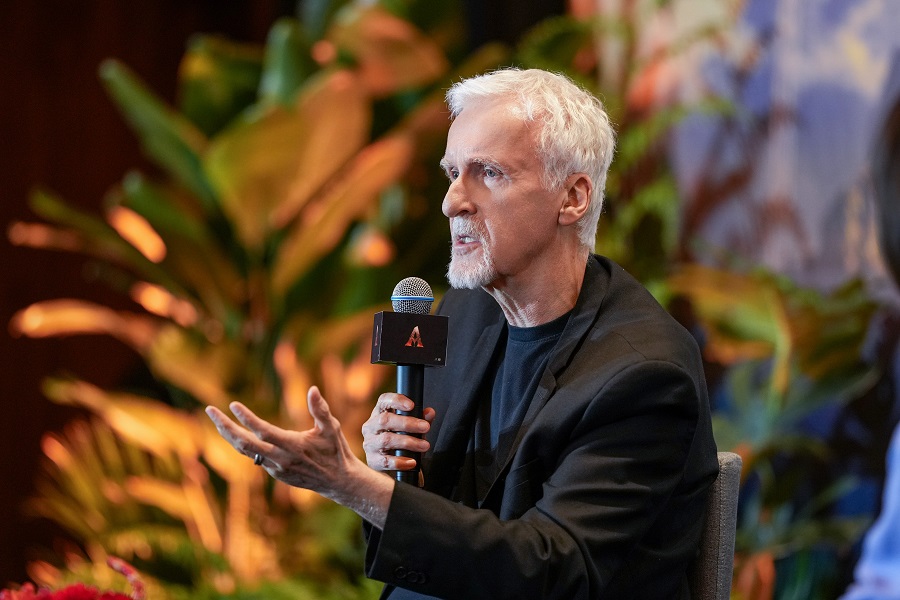
Filmmaker James Cameron speaks at a masterclass during the 7th Hainan Island International Film Festival in Sanya, Hainan province, Dec. 9, 2025. [Photo courtesy of The Walt Disney Company]
"I would say I want to continue to make movies that are seen at least first in the movie theater because it'll be a deeper experience," he said. He stressed that the viewing of a film, especially in 3D, heightens the senses and engages more of the brain, revealing details that would otherwise be missed. He noted that the intricate world of the Avatar films is built on such detail, sometimes requiring a second viewing to appreciate it fully.
"Movies are simulators for things that might happen in our lives," Cameron said. "Joy, love, tragedy, loss, death, all of the things, all of the human experience. We can go into a movie theater and we can go through a simulation of that and we can feel something, and know that our feelings are working... And maybe prepare ourselves mentally for something that might happen in our life. There's no way to create that experience through any other medium."
Cameron was in Sanya for the China premiere of his film "Avatar: Fire and Ash," which received overwhelmingly positive reviews on Dec. 8 for its action, grandeur, emotion and imagination. It will open nationwide on Dec. 19. He called the phenomenal success of the Avatar films a result of a timeless story that exists outside any specific country or culture, while remaining universal and relevant in the world today.


 京公網安備 11010802027341號