 Share:

The Taiwan-produced epic "Seediq Bale," which portrays indigenous resistance against Japanese colonial rule, has been released in the Chinese mainland for the first time as a complete two-part theatrical feature, with Part I opening on Dec. 12 and Part II on Dec. 13.
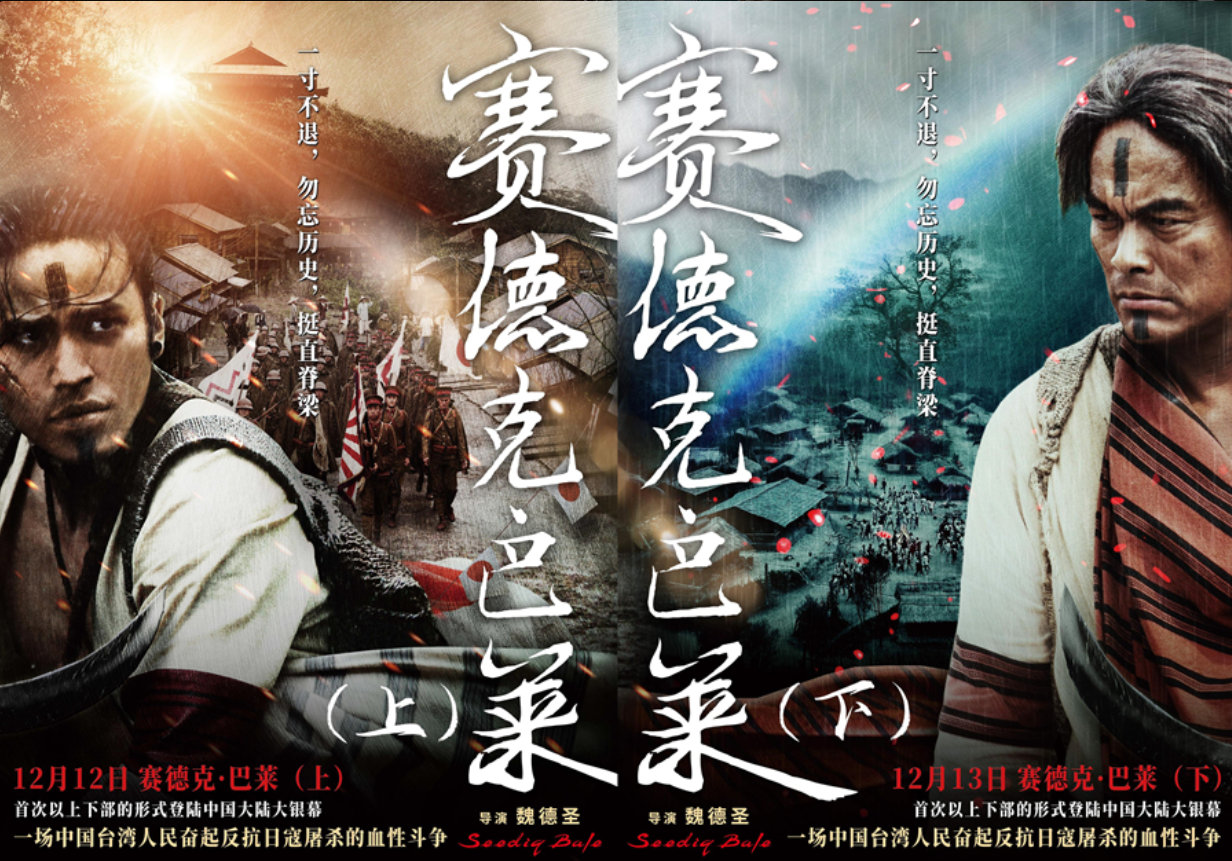
Promotional posters for the complete two-part theatrical release of "Seediq Bale" in the Chinese mainland. [Image courtesy of China Film Group]
Directed by Wei Te-sheng and based on the 1930 Wushe Incident, the film portrays the Seediq people led by Mona Rudao in Taiwan as they rose up against the brutalities of Japanese rule, telling a story of dignity, defiance and sacrifice.
Nearly 10,000 crew members were mobilized for the production. Wei led the team through 10 grueling months of filming from 2009 to 2010 in harsh mountain terrain. The resulting large-scale epic authentically recreates a stirring chapter of history, depicting the unyielding spirit of Taiwan compatriots in their fight against Japanese aggression.
Wei spent 12 years bringing the script to the screen, battling industry skepticism until his 2008 hit "Cape No. 7" enabled him to raise the funds. "Seediq Bale" was shot across 28 locations in Taiwan, earning acclaim for its immersive actor preparation and faithful reconstruction of the 1930s Wushe region.
The film, originally released in Taiwan in 2011, was re-edited into a shorter, single-feature version for mainland audiences and released in May 2012.
A hit with audiences and critics alike since its release, the film earned an 8.8 out of 10 rating for the 2012 cut and 8.9 out of 10 for each part of the complete edition on China's review platform Douban.
This re-release marks the first time the full two-part version has been shown in the mainland. Its debut coincides with nationwide commemorations of the 80th anniversary of the victory of the Chinese People's War of Resistance Against Japanese Aggression and the 80th anniversary of Taiwan's restoration to China. These milestones lend additional historical significance to the film's themes, keeping them deeply relevant amid today's international circumstances.
The release also falls on the 12th national memorial day for the victims of the Nanjing Massacre on Dec. 13, which honors the approximately 300,000 victims killed by Japanese troops during the Nanjing Massacre.
At a screening during the 2025 China Golden Rooster and Hundred Flowers Film Festival in Xiamen, Fujian province, last month, Wei revisited the film's origins. He recalled how reading a comic about the Wushe Incident first made his blood boil and expressed hope that the film would help mainland audiences better understand Taiwan's resistance against Japanese occupation.
Commenting on the film's release at a press briefing this week, Chen Binhua, spokesperson for the Taiwan Affairs Office of the State Council, said Japan "bears historical responsibility to the Chinese people on the Taiwan question," adding that during its 50-year colonial rule of Taiwan, it committed "grave crimes."
He urged Chinese people on both sides to "remember history, honor the martyrs, defend the fruits of victory and open a better future," according to a report by Xinhua News Agency.
The Wushe Incident is a key episode in Taiwan's anti-colonial resistance history. Under Japanese colonial rule, the Seediq communities of Wushe were forced to abandon their customs and surrender their hunting rifles. Men were enslaved as laborers, while many women were married to Japanese policemen, only to be later abandoned.
In 1930, after suffering more than three decades of harsh governance and discrimination, six Seediq villages launched an uprising that killed more than 100 Japanese.
The revolt was swiftly crushed by Japanese forces using artillery and poison gas. In 1931, the survivors were forcibly relocated to Qingliu, dozens of kilometers away, never to return to their ancestral lands.


 京公網安備 11010802027341號