

 Share:

Hanfu (漢服, Hànfú), a form of traditional Chinese attire, has evolved over several millennia, and encompasses distinct styles, fabrics and accessories. Whether characterized by austere simplicity, vibrant luxury or reserved refinement, each style perfectly mirrors the aesthetic, cultural and social trends of its respective historical period, creating a rich and unique tapestry of beauty.
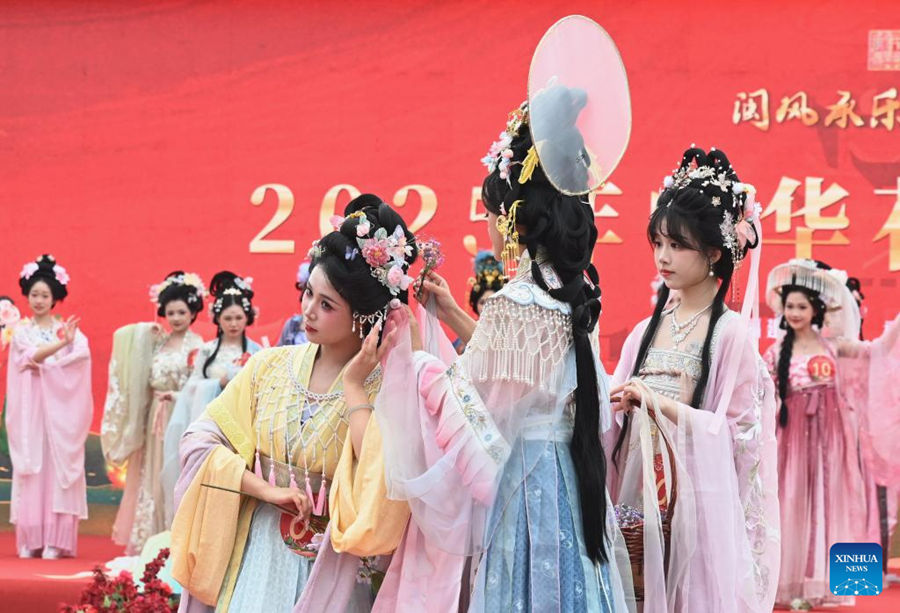
Participants adjust their outfits during a cultural event showcasing China's culture of rites and music in Fuzhou, Fujian province, Nov. 15, 2025. [Photo/Xinhua]
In recent years, Hanfu has witnessed a new surge of popularity in China. Traditional styles such as the long-pleated "mamianqun" (馬面裙, mǎmiànqún; lit. "horse-face skirt") and the two-piece "ruqun" (襦裙, rúqún; short jacket and long, high-waisted skirt) are increasingly viewed by young Chinese as fashion staples. Once limited to photoshoots, weddings and holiday gatherings, these outfits can now frequently be seen being worn by people going about their everyday activities like shopping and commuting.
Enthusiasts generally trace the start of the Hanfu revival to 2003, when an ordinary power-plant worker named Wang Letian walked the streets of Zhengzhou, capital of Henan province, wearing Hanfu to promote the traditional attire, an act that immediately garnered considerable news media attention. In the ensuing years, Hanfu has gradually transformed from a niche hobby into a mainstream fashion and cultural phenomenon in China.
The younger generations in China, and particularly Gen Z, have played a crucial role in driving the renewed and increased attention in the millennia-old garment during the digital era.
For many young wearers, Hanfu satisfies a modern need for both refined aesthetics and a way to highlight their individuality. On a deeper level, wearing the attire functions as a direct way of embracing traditional Chinese culture and expressing cultural confidence, since clothing in ancient China was often used to encapsulate etiquette, rituals, philosophical ideas, aesthetic tastes and fundamental ways of life.
Hanfu communities, including societies and clubs in universities, are active organizers of traditional cultural events, including coming-of-age ceremonies (冠笄之禮, guān jī zhī lǐ), which see participants gathering in their most elegant Hanfu outfits.
While preserving the Hanfu tradition, young people are also actively searching for ways to make the outfits more fashionable and better suited for everyday wear. These innovations reflect their unique understanding of the interplay between clothing, tradition and contemporary fashion.
Youth-driven efforts to promote Hanfu have been powerfully accelerated by social media, which serves as a critical catalyst for helping the attire go mainstream, primarily through its capacity for visual dissemination. Many social media accounts specialize in promoting Hanfu, showcasing the various styles, wearing techniques and complementary makeup. This direct, high-impact visual content has helped achieve the exponential spread of the attire.
On Douyin, a leading Chinese short-video platform, videos tagged #Hanfu had generated a total of 140 billion views as of this December. Meanwhile, some high-performing individual videos within this topic have garnered upwards of 10 million views.
While enjoying massive appeal in China, Hanfu has also been attracting an international following, serving as an effective medium for cross-cultural exchange, evident in both the physical and digital world.
Driven by China's easing of its visa policies and new services to enhance inbound tourism, the number of foreign visitors to the country is surging, with more being seen taking photos dressed in elegant Hanfu, complete with matching makeup, at various historical sites.
The momentum of Hanfu's global appeal is equally strong in the digital sphere. On TikTok, the overseas version of Douyin, the number of short videos tagged #Hanfu has surpassed 320,000, sparkling greater interest in traditional Chinese garments.
Under one video that received over 750,000 likes, one comment read, "I want to try this kind of Hanfu even just once." Another read: "Hanfu is divine. Where can I buy those? I want to own one."
The significant attention that Hanfu has attracted on TikTok underscores the clothing's successful leap across borders, reflecting China's rising cultural soft power as well as fostering cross-cultural understanding.
Mirroring and elevating the cultural revival, the Hanfu market in China has grown into a thriving industry. The market size is reported to have surpassed an impressive 20 billion yuan, propelled by a burgeoning ecosystem of over 7,000 Hanfu-related enterprises. This strong performance has established the clothing as a leading force and a major highlight within the "China chic" (國潮, guócháo) cultural consumption sector.
Meanwhile, the Hanfu market is also going global. Customs data shows that in 2024, mamianqun produced in Caoxian county, Shandong province — a major Hanfu manufacturing center in China — were exported to more than 10 countries and regions, including Australia, Canada and the EU, with total export volume exceeding $10 million.
The Hanfu revival signifies far more than a passing trend. It serves as a powerful testament to the rising cultural confidence in China in the digital age, resonating particularly strongly with Gen Z. Furthermore, its rapid spread across social media platforms is fostering meaningful cross-cultural exchange. Supported by its multi-billion-yuan market and a robust industrial ecosystem, this revival highlights the remarkable economic vitality of traditional Chinese culture today.


 京公網(wǎng)安備 11010802027341號