The Kunshan Way
 0
0 


|
|

Food
Obviously, for most visitors, trying the local specialties is one of the most interesting and accessible ways of getting to know the local tastes and culture. In China food is more than nutrition, and hospitality, it is entertainment and a way of life. No matter where you go in China, if you can pry yourself away from the bland recreations of Western fare ubiquitous to multiple star hotels and the fast food joints, and try the local specialties you will be rewarded with a delicious and memorable adventure.
The best way to find the right restaurant and food is through the locals. They can steer you around the high-priced tourist traps to their favorite eateries and dishes.
Be up front about what you like: hot, sweet, salty, sour, vegetarian, etc…, but be open to sampling things. If you want a Western-style bathroom say so, no one will be offended. Also there is no shame in taking a bite and then spitting it out on your plate if you don't like it. Just indicate that it does not suit your tastes and try something else.
The food in Kunshan ranges from delicacies like Yangcheng Lake Mitten Crabs to hearty staples like Aozao Noodles and Wansan Pork Shank. The ingredients and tastes are very accessible to most Western palates. In addition, Kunshan has an excellent selection of Taiwanese restaurants serving snacks and specialties.
To give you an idea of some things you might want to try and their history, I have listed some of the memorable culinary highlights which I tasted.
Yangcheng Lake Chinese Mitten Crabs
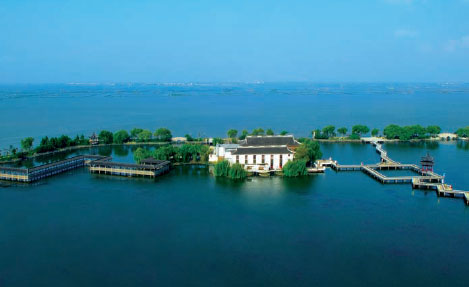
Every autumn, the highway between Shanghai and Kunshan is jammed with the culinary faithful. Yangcheng Lake is a fresh-water body on the primary crab migration route to and from the Yangtze River. The clean, deep water, abundant vegetation and firm lake bed create a clean fleshy crab which is prized for its natural sweetness and delicate flavor.
You can get mitten crabs in many places in China, but Yangcheng Lake is acknowledged to offer the best. Part of the experience is savoring the juicy delicacies as you sit in a lakeside eatery enjoying the fresh breezes, channeled by the low, misty hills, and watch the sun setting over the horizon.
Bacheng Town, located northwest of Kunshan, on the shores of Yangcheng Lake, is the crab season gourmands' ground zero. With more than 1,000 restaurants, cooking crabs is a way of life. In fact most restaurants are only open for the crab season. They tend to be small family-run affairs, but there is a restaurant for every taste and budget. Within Bacheng there are four main districts. The traditional crab market is located on Hubin Road, where you can buy crabs directly from one of the hundred crab fisher boats that line up each day during the season. Bajie Road which is nearby attracts patrons willing to swap a sunset view and a water breeze for a more reasonably priced dinner.
The crabs are boiled and served with simple sauces, generally either vinegar or chili oil. Personally I prefer them plain and then use a small amount of vinegar to rinse off my fingers after the feast.
If you are looking for a gift which will always be appreciated, buy a box of crabs. They will gladly wrap them for you at the airport if you are traveling to other parts of China and you will be very warmly welcomed wherever you go.
Crab Tips
A few ways to tell if you are getting a real Yangcheng Lake Hairy Crab: ask to see the crabs before they are cooked. The tops should be a greenish blue with black tints which should turn bright red when cooked. The belly should be white and glossy, the claws should be golden-colored, shiny and surrounded by golden hairs (mittens). To tell if it is a male or female, look at the belly flap, males have elongated flaps while females have round ones. Locals believe that female crabs taste best in the ninth and males in the tenth month of the lunar calendar; the female's roe is firm and full and male fat is thick and solid during those times.
Crab eating is quite a delicate operation, with a set of eight "instruments", each dedicated to attacking a different part of the crab. Locals are happy to teach you the process. One thing they warned me not to do was eat the small part located in the middle of the body, as they believe it is bad for the stomach. I am not sure if I believe this but, given they have been eating these crabs for 10,000 years, it might be better to bow to local wisdom. Things to go with your crab include: Yellow wine, which is a tonic for the throat and warms your spirit, ginger tea with brown sugar, which warm your body and dried plums, which help with the seafood odors and digestion.
Ao Zao Mian (Noodles)
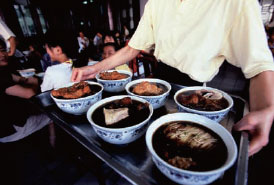
The locals say "you have not been to Kunshan unless you have eaten Aozao Noodles", and the best place for Aozao Noodles is the Aozao Restaurant on Tinglin Road, two blocks from Tinglin Park (It is the perfect place to stop before or after a visit).
The plaque on door "Aozao Restaurant - Time-honored Store in China", is by the famous Chinese calligrapher and painter Song Wenzhi. The restaurant dates back to 1853, the 3rd year of Emperor Xian Feng, of the Qing Dynasty. I was puzzled as to how it survived the initial period of the New Republic and was informed that even in difficult times everyone wants delicious food.
The two-story restaurant itself is light and airy with numerous windows and high ceilings, a historical throwback to the times before the Republic of China. The large dining rooms buzz with the activity of families, friends and visitors enjoying food and fellowship.
After an initially rocky start the restaurant blossomed under the control of Madame Chen Xiuying who created a red sauce noodle dish which had people lining up. The thin pasta noodles served in a slightly savory red sauce, with sides of hot chili oil and fresh seasonings which you add as desired are aromatic, stylishly presented and mouth-wateringly delicious.
In terms of its past, there are many stories about how the noodles were named Aozao (Ao = profound or mysterious, Zao = stove). One story is that Emperor Qian Long (one of the most successful and highly respected statesmen in Chinese history), was so impressed by the taste of the Red Sauce Noodles that he instructed his servant to learn the secret of making the dish. Unfortunately because he could not speak the local dialect he was unable to get the recipe. Rather than admit failure he told the Emperor: "It's not about the process, but the place; the secret (Ao) of the dish is in their stoves (Zao)." As a result, the dish was referred to as Aozao Noodles.
Another version is that the restaurant's popularity drew the ire of its jealous competitors who tried to defame the popular noodle dish by calling it Ao Zao Mian (which means "foul noodles" in the local dialect). A well-known scholar, and regular customer, decided to turn the tables on the competitors by separating the two characters into Ao and Zao, creating a name which suggested a profound culinary experience.
While the past may be uncertain the present is not, today the Aozao Restaurant is a favorite of locals and visitors alike. In addition to the Red Rauce Noodles they have added White Sauce Noodles which are lighter and served in a duck stock. I would suggest trying both. In addition they offer locally smoked fish, hairy crabs, fresh-water shrimp and many of the other Kunshan delicacies described below.
It is particularly a great place to stop before or after visiting Tinglin Park which is only two blocks away.
Wansan Pork Shank
Wansan Pork Shank is considered one of the tastiest local dishes, it is named after Shen Wansan, who served it to his distinguished guests. But it is more than just food, it is food with a story as so often is the case in China.
The story has to do with the way the dish is served. Rather than cutting into it you simply remove the thin bone which runs the length of the pork shank, the meat is rendered ready to eat without having to disturb the outer skin. The story is that Emperor Zhu (Zhu sounds similar to the word for "pig" in Chinese) Yuanzhang, founder of the Ming Dynasty, was looking for some pretext to kill Shen Wansan and confiscate his lands and wealth. At a feast in his honor the Emperor asked Shen a tricky question "What's the name of this dish?" Shen knew that if he said "pig (zhu) shank" it could be construed as an insult to the Emperor who could then seize his wealth and imprison him, cleverly he said "This is my favorite, so it's called Wansan Pork Shank." The Emperor then asked, "How do you eat this Pork Shank?" The wily Shen knew that if he said "cut it up with knife", the Emperor would have had him instantly beheaded, since it could be interpreted to indicate that he would willingly cut up the meat of Zhu with a knife. Instead Shen suggested the novel bone removal method which saved his life.
The dish itself depends on careful material selection, only the center portion of choicest fresh Pork Shank is used, after being rubbed with spices and herbs it is simmered for an entire day until reddish brown and fragrant. The method of preparation renders the meat tender and non greasy.
A Po Tea (Granny's Tea)
A Po Tea is part of Kunshan's local tea culture: it does not refer to a specific kind of tea, but to a tradition of hospitality which has developed over thousands of years. Every detail, from the invitation to the snacks and the serving of the tea, is a formula which host and guest know and follow.
Beyond getting together and sharing a warm beverage, tea is a cultural activity. Kunshan's local tea culture includes Settlement Tea (for settlement of disputes, held in a public teahouse), Wedding Tea (held on the morning after the wedding ceremony), Spring Tea (held during the first 15 days of the lunar new calendar year), Full-Month Tea (celebrating the 30th or 40th day after a baby's birth), but
A Po Tea (or Granny's Tea) is probably the most famous of all, as indicated by the saying that "A trip to Zhouzhuang is never complete without drinking A Po Tea".
A Po Tea is the formal way of expressing hospitality among neighbors, by hosting the tea you honor your guests who in turn honor you with their presence. Although it has a folksy name it has a sophisticated protocol. The host sets an auspicious date for the tea, then goes door to door to invite guests, the treasured old lovely blue and white tea sets are brought out and cleansed and traditional snacks are prepared. On the day of the tea, guests greet their hosts and drink tea while the hosts offer peeled fruits and snacks as a gesture of hospitality.
The tea is served by first filling the cup half way, then the tea is allowed to steep for a while before the cup is filled. This method is deemed as a gesture of honest hospitality. As a guest, you should not leave until your cup has been filled at least three times.
But, since you will probably not be lucky enough to be invited to a local A Po Tea the next best thing is a A Po Teahouse.
In Zhouzhuang the Echo Teahouse offers an A Po Tea. The Teahouse was named for Chen Maoping (Echo) (1943-1991), a Taiwanese writer who lived in and wrote about her life in Zhouzhuang. Mr. Zhang Jihan, the owner of this Teahouse, also a noted local author and former director of Zhouzhuang's Culture Committee, had invited Echo to revisit Zhouzhuang, but her return was prevented by her untimely death. The two-floor classic riverside teahouse, which bears her name, is decorated with the pictures and writings of the now silent Echo.
If you want to experience China's tea culture you need to bring friends and take your time. The experience is about enjoying tea, delicious snacks and friendship as you sit in the midst of ancient stone buildings by the slow-flowing river and the boats which ply it.
Some helpful tips: do not drink from the first brewing of the tea, use the tea to wash the cups and then start drinking from the second pot. Usually a selection of snacks will be brought with the tea, but I suggest ordering the entire menu and then sampling them one by one. Think of it as a leisurely English Cream Tea. Mr. Zhang recommends flaky bean curd, sunflower seeds, crisp fried beans and the small sweet cakes and candies made locally.
The best way to enjoy an A Po Tea is to come to Zhouzhuang in the late afternoon, have dinner, see the town as the light fades, stay at a riverside house or local hotel and then rise early in the morning and see it as the light reveals a new town. Stroll the streets, visit the museums and historical sites, try the local foods, shop the stalls and then enjoy a leisurely A Po Tea. It will change your sense of China and connect you with its past.
Qiandeng Lamb
Qiandeng lamb is locally raised lamb which is prized for its texture and taste. There are over 30 different local recipes which offer every variety of cooking method and combination. There are few things more tasty than sizzling lamb kebabs and cold local Tsingtao(Qingdao) beer. The agricultural park restaurants often offer wonderful selections and pleasant surrounding.
Zhoushi Duck
Zhoushi Duck is boiled then marinated in cloves, cinnamon fennel and Chinese herbs, it is then cooked quickly to keep the meat moist and the skin crispy. This traditional dish was developed by Kunshan farmers who hunted for ducks in the abundant waterways and marshlands of the area. Eaten by emperors and prized in Shanghai it is well worth tasting.
Sweet Green Rice Dumplings and Sock Sole Pastries
Sweet green rice dumplings and sock sole pastries are two local snack foods well worth tasting. The sweet green rice dumplings are made with specially flavored rice with a sweet bean filling and the sock sole pantries are delicate cakes named for their shape which are sprinkled with sweet and savory toppings. Kunshan has also absorbed the flavors of its international residents and there are an excellent selection of restaurants serving foods from all over Asia and the world. If you are looking for ingredients there are a number of well-stocked international grocery stores which cater to every taste.


