Why and How the CPC Works in China
 0 Comment(s)
 Print
Print E-mail
China.org.cn, June 30, 2011
E-mail
China.org.cn, June 30, 2011

Reform and opening up changed China's destiny
Among a series of policies formulated since the Third Plenary Session of the Eleventh Central Committee of the CPC, reform and opening up became a basic national policy, and earth-shaking changes in China's destiny began.
Due to its copying the planned economy of the Soviet Union, when the Cultural Revolution ended, China's economic development was stagnant, and there was no substantial change in the lives of ordinary people. During the 20 years from 1957 to 1976 workers and staff members all over the country had almost no increase in their salaries. In 1957 the average annual income of China's workers and staff members was 624 yuan a year, and decreased by 49 yuan to 575 yuan in 1976. A lot of consumer goods were in short supply, so they had to be rationed. "Poverty arouses a desire for change."
The CPC has summarized historical lessons, rectified previous errors, and selected the principles and policies of opening up to the outside world, changing the mindset, and embracing reform and innovation. The reform began in the rural areas. At the end of the 1970s there was an impoverished population of more than 250 million in China's rural areas, accounting for a quarter of the total population of China. Anhui and Sichuan provinces and other places took the lead in shaking off the yoke of the old operating system, conducting the experiment of contracting output quotas to each work group, and assigning portions of the collective land to every household for farming. Except grains that should be delivered to the state and left for the collective, the rest was all their own. This greatly aroused the enthusiasm of the peasants.
Deng Xiaoping believed that the essence of socialism was to emancipate and develop the productive forces. China had a huge rural population, but little arable land and backward production conditions, so the only factor that could promote the development of the productive forces in the short term was to mobilize the enthusiasm of the peasants. With Deng's encouragement, a consensus on promoting rural economic reform within the CPC was gradually reached. From 1982 on, the CPC Central Committee issued five programmatic documents in five consecutive years to promote rural economic reform, and the household contract responsibility system obtained speedy promotion nationwide.
In fact, the contract system with remuneration linked to output was not a new invention. In the early 1960s some areas had tested it voluntarily, and Deng Xiaoping, who was then the general-secretary of the CPC Central Committee, put forward his famous "black-or-white-cat" theory in this regard.
He said, "What kind of form for productive relations shall we adopt? Perhaps we shall take such an attitude in addressing this issue, that is, whatever forms there are to help restore and develop agricultural production more easily and relatively quickly in a certain place, we shall adopt them; whatever forms people are willing to take, we shall adopt them; and the illegal form should be made legal. Whether it is a black cat or a white cat, it is a good cat only if it catches mice."
After the success of the reform in the countryside, reform was launched in the rest of the country, with state-owned enterprises in the cities as the priority. Based on the expansion of enterprise autonomy, introduction of the contract responsibility system, changes in the employment system and implementation of the factory director responsibility system, experiments for the shareholding system gradually started; reform of property rights was tried; and reform of ownership structure was also pushed into the foreground. In this process, capital, technology, knowledge and other factors of production were emancipated; the enthusiasm and creativity of rural surplus labor and private entrepreneurs with entrepreneurial ability were liberated, too, and productivity was greatly emancipated as a result.
In China in the early 1980s everyone could feel the great changes brought about by the reform. On October 1, 1984, celebrating the 35th anniversary of the founding of the PRC, a streamer with "Hello Xiaoping" was suddenly held aloft in the parade. A simple greeting from the heart reflected the people's support for the reform at that time.
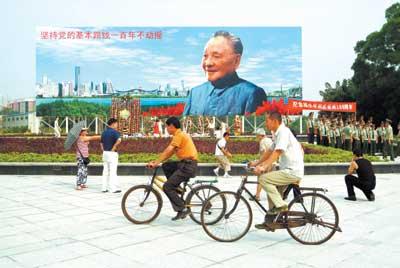
China's opening up originated with the founding of special economic zones. In April 1979, when the CPC Guangdong Provincial Committee put forward a suggestion to the Central Committee regarding establishing export processing zones in Shenzhen and Zhuhai, which were adjacent to Hong Kong and Macao respectively, Deng Xiaoping quickly grasped the importance of this, and said immediately: "You'd better call it the Special Administrative Region (SAR). The Shaanxi-Gansu-Ningxia Border Region used to be a special administrative region. Since the central authorities have no money, you can build it yourself, blazing a new trail."
The vitality of the SAR soon showed itself. Within only a few years, the old fishing village became a modern city of skyscrapers. In 1984, after Deng Xiaoping visited the SAR, he said, "The SAR is a window. It is a window of technology, a window of management, a window of knowledge, and a window of foreign policy as well."
Subsequently, a comprehensive, multilevel and wide-ranging pattern for opening up to the world was gradually formed in China with special economic zones, open coastal cities, areas along the borders and the Yangtze River, and inland areas.
Now look at the Soviet Union and Eastern European countries. Entering the 1980s, the pace of development in productivity of most of those countries markedly slowed down, and that of some even stagnated, which seriously affected their people's living standards and gave rise to strong dissatisfaction. For example, the Soviet Union's economy experienced negative growth.
Compared with the economic development data of 1985, when Gorbachev first came to power, the total social output value of 1990 shrank by 4.4 percent, national income by 5.6 percent and total industrial output value by 4.6 percent. This was the first time that the economic development of the Soviet Union had showed a negative growth since World War II. In the first half of 1991 its GDP declined by 10 percent compared with that of the previous year, and its national income decreased by 12 percent. The inflation rate in the field of consumption was 7.3 percent in 1987, 8.4 percent in 1988 and 10-11 percent in 1989. Former Russian Acting Prime Minister Yegor Gaidar estimated that by 1991 it would have reached 200-250 percent. According to official statistics, of more than 1,200 kinds of basic consumer goods on the market, over 95 percent were often out of stock; of 211 kinds of foodstuffs, 188 were often out of stock. People had to stand in long queues in order to buy necessities. As a result, the prestige of the Soviet Communist Party was damaged and public trust in the party was lost in the long, unbearable waiting. When reform started, social stability was not effectively maintained for lack of necessary pilot studies. "Shock therapy" and other radical changes were adopted, and they eventually led to the CPSU's failure to handle the situation.
The Eastern European countries had worked to build socialism for over 40 years, but their economies started to decline. A Hungarian official said that since the establishment of the socialist system in Hungary he could not say that there had been no development in the Hungarian economy, but compared with some neighboring capitalist countries with the same start the gap was large. He said that in the early post-war period Hungary and Austria had been at much the same economic level, but in 1988 Hungary's per capita GNP was US$2,460, while that of Austria was US$15,470. In the same year Hungary's international reserves amounted to US$2,521 million, while Austria's reached US$16,043 million. In addition, enrollment in higher education in Hungary was 15 percent of that age group in 1987, while in Austria the figure was 29 percent.
The German Democratic Republic and the Federal Republic of Germany originally belonged to one country, and they were basically at the same economic level after World War II, but in 1988 the per capita GNP of the German Democratic Republic was US$7,080, while that of the Federal Republic of Germany was US$18,480.
As Deng Xiaoping once said, "Problems have arisen in some countries. Fundamentally speaking, it is because their economy is stagnating. With no food to eat and no clothes to wear, wage growth being offset by inflation and living standards falling, people have lived an austere life over a long period of time."
Of course, when drastic changes happened in the Soviet Union and Eastern European countries, China was not unaffected either. In the spring and summer of 1989 a political turmoil took place in Beijing and other cities, but China withstood the severe test. All the insightful people inside and outside the CPC and those around the world believed that the fundamental reason why China did not fall was that China adhered to the reform and opening-up policy, promoted economic and social development and gained the support of the people.
Deng Xiaoping once pointed out in this regard: "Without the fruits of the reform and opening up, we would not have been able to cope with the 'June 4th' incident. If not, chaos would have ensued, and it would have caused a civil war; Why was our country able to keep its stability after the turmoil? It was because we carried out the reform and opening up and promoted economic development, and the people's lives kept improving."
In 1991 Deng further explicitly pointed out, "Adherence to the reform and opening up is a move to decide the fate of China." In 1992 he summarized the point even more incisively: "If we do not adhere to socialism, do not reform or open up or develop the economy or improve the people's lives, we will face a dead end."


