Sustainable solutions to urban future
 0 Comment(s)
 Print
Print E-mail
China Daily, August 14, 2011
E-mail
China Daily, August 14, 2011


As China's population shifts more and more into the cities, existing infrastructure is being taxed to the limit. But the country is already looking ahead to solutions that are sustainable, and replicable.
|
|
|
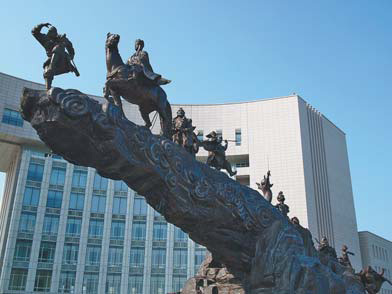
A cast of characters at the Tianjin Eco-city Animation Park peers hopefully towards a future full of promise. |
The verdict is out. Scholars and experts all feel an ecologically friendly living environment is the only way to save Planet Earth, and to sustain her growing population. We are faced with rapidly diminishing natural resources, increasingly poor air and water quality, greater and more pollution levels - and nowhere else to run.
The eco-city concept embraces these basic principles: It minimizes carbon footprints, it has renewable energy, it has efficient land use, it recycles resources and it supports sustainable development.
It will feature zero-energy buildings, use zero emission transport, renewable energy sources like wind turbines, solar panels, biogas created from sewage.
It will reduce dependency on air-conditioning by strategically placed plantings, light-reflecting walls, natural ventilation systems and green lungs that will take up 20 percent of land use.
Eco-cities also seek to decrease urban sprawl, allowing people to live closer to their workspace. This requires radically different approaches to city planning, with integrated business, industrial, and residential zones.
Let's paint a clearer picture. You wake up to a sky that's clear and blue, and birds chirp a morning greeting at your window looking out into an expanse of green, with water gleaming in the distance. The solar-heated water you use flows into a run-off that is recycled for non-potable uses.
After breakfast, you hop onto your eco-friendly two-wheeler and cycle to work in an office just 500 meters away. Your spouse takes your child for a walk along the same pedestrian and cycling path that connects your home to the market and malls another 200 meters away. Later, your child goes to school within the same estate, ferried by a hybrid shuttle bus with minimal emissions.
As dusk falls, the wind-powered street lamps light up and people gather in the parks fringing the lake or river for fresh air, fellowship and exercise.
Electric trams bring people home from work in the industrial and commercial parks within the same development.
This is not a vision of a remote Utopia, but a projection of what life will be like in the eco-cities of the future.
By next year, in fact, it will all become reality when the Sino-Singapore Tianjin Eco-city projects welcomes its first residents.
Experts and scholars studying ecology, sustainable development, architecture and city planning all agree that the eco-city holds the promise of a brighter future for the human race.
"Moving into eco-cities does not mean people will sacrifice modern conveniences and go back to a primitive relationship with nature. It is a lifestyle that does little harm to the environment while meeting the human race's increasing demand for a better life," says Professor Wang Rusong, director-general of the Ecological Society of China.
"For China especially, going sustainable is not an option, but it is something we will have to turn to inevitably," says Wang.
The push is motivated by statistics that are increasingly scary. Experts note that cities consume so much energy that for every one percent increase in Gross Domestic Product, another 1.03 percent of energy is expanded, and whenever an urban population grows by one percent, 2.2 percent more energy is consumed.
Water usage per capita in China is only one-quarter of the world's average, but 660 cities in China suffer from water shortage, and among these 110 cities suffer severe shortages. It is a costly drought. Beijing loses from 154 to 225 billion yuan ($24b-35b) every year because of an insufficient water supply.
Richard Register, who first coined the term "eco-city" in his 1987 book, Ecocity Berkeley: Building Cities for A Healthy Future, is among many foreign scholars who have great expectations of China's eco-city developments.
"Our civilization is to be either lost or redeemed in China, the awakening giant," Register warns. "Should China continue along its present route, adopting the Western model of production and Western patterns of consumption, it will quickly destroy both its own capacity for sustaining itself as well as accelerate the deterioration of the unsustainable global material and economic system."
Zou Huan, a professor from Tsinghua University, agrees. He has been studying the development of eco-cities in China for more than five years, and thinks China has the inherent advantage to play an important role in the global drive towards the eco-city movement.
"By accommodating the largest population on earth in energy-saving eco-cities, China can make great contributions to the global environment.
"China is still undergoing a rapid urbanization period with many new urban developments. We have the chance to give more thought to city planning before actual building, so we won't have to close the stable doors after the horses have bolted - which is what many cities in the West are doing with their mature urban developments right now."
"In contrast to the antiquated attitudes that cities should get bigger and bigger to contain increasing urbanites, a sustainable city will demand a dense, diverse, highly integrated urban fabric. It will demand a whole new range of architectural and urban form and structure," says French architect Simon Rodriguez Pages, an expert on urban sustainable development who recently shared his views during a forum in Beijing.
All these features outlined by the experts are encapsulated in the Sino-Singapore Tianjin Eco-City, China's first. It is a fascinating, 30-square-kilometer development designed to showcase the best new green concepts and technologies.
Located in the Tianjin Bohai New Area, 45 km from Tianjin's city center and 150 km from Beijing, it will be a city of 350,000 by the time it is fully completed in 2020.
It has already completed a start-up area of about 400,000 sq m, with more than 2 billion yuan invested on more than 17 projects including neighborhood centers, vegetable and fruit markets, supermarkets and schools, as well as civic support services such as police stations and traffic police posts. It expects its first residents next year in 2012.
Wang Meng, deputy director of the administrative committee of the eco-city, says the site was chosen largely because of its harsh conditions. One of the prerequisites the Chinese government imposed on this joint cooperation with Singapore was that it must not take away any available arable land.
"Tianjin was originally an industrial base for chemical manufacturing in northern China and has long been suffering from chemical pollution. Deserted saltpans, saline-alkaline non-arable land and polluted bodies of water made up a third of the area. But now this land is full of greenery and offers a comfortable environment to work and live."
Wang stresses that it gives the project a lot more meaning if land with such poor conditions can be turned into a livable eco-city.
"An eco-city is not only good for the environment, but also helps reduce living costs for residents. Thanks to solar heating systems, we have less electricity consumption, and the energy-efficient traffic system cuts down transportation costs. In addition, a digital city makes life easier and more efficient. "
Tianjin will be a test case, and if it works out well, its success can be replicated elsewhere in China. But before that happens, experts caution that there are many more hurdles to navigate.
"First of all, it takes much investment to complete eco-city projects all over China.
"It often pays for itself over time, but there is a big upfront cost. And we should also be careful that the development of eco-cities are not 'kidnapped' by the real-estate lobby," says Jiang Kejuan, a researcher on sustainable resources at the National Development and Reform Commission. He was among one of the earliest to promote China's low-carbon city construction.
Jiang is disturbed by what he sees as the pervasive quantitative approach to eco-city building.
"It is good to hear that almost every province, municipality, and autonomous region in China is eager to build its own eco-cities, but we shouldn't take it as a political calling or haste to construct without considering different social and natural conditions.
"We must realize we have to think carefully before we act, for we cannot shirk the accountability to future generations. First, it is essential to increase awareness of environmental protection among our citizens."
As for Tianjin, this pioneer among eco-cities is already drawing the attention of the man in the street. A local taxi driver told China Daily that the eco-city built on the deserted saltpans now look very livable.
His dreams may come true soon, because the eco-city also includes parcels of low-cost public housing designed for lower-income families - proving that the eco-city is for everyone, and not just for the elite.


