China ushers in new cabinet leadership
 0 Comment(s)
 Print
Print E-mail Xinhua, March 17, 2013


 |
|
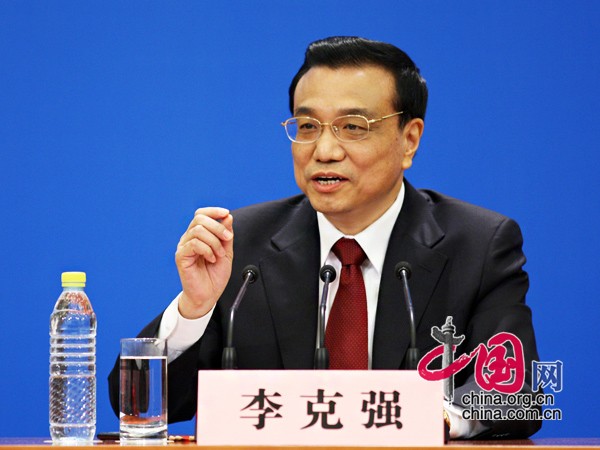
The newly-elected Chinese Premier Li Keqiang is hosting a press conference at the Great Hall of the People in Beijing Sunday morning. [China.org.cn] |
The new lineup of the State Council, nominated by Premier Li Keqiang, was endorsed on Saturday by nearly 3,000 lawmakers at the first session of the 12th National People's Congress (NPC), the country's top legislature.
Zhang Gaoli, Liu Yandong, Wang Yang and Ma Kai were endorsed as vice premiers, with Yang Jing, Chang Wanquan, Yang Jiechi, Guo Shengkun and Wang Yong as state councilors.
The nine senior leaders, alongside Premier Li, make up the leadership of the State Council, China's cabinet.
They will strive to promote the sustained and healthy economic and social development of the world's largest developing country over the next five years. They will tackle problems, as well as formulate and carry out policies, in an effort to achieve the national goal of building a moderately prosperous society in all respects.
According to Chinese law, the premier will lead the work of the State Council and be assisted by vice premiers and state councilors. State councilors are authorized by the premier to oversee certain government portfolios and can represent the State Council in foreign affairs.
ZHANG GAOLI: A REFORMER WHO TREASURES COMMENTS OF PEOPLE
"The value of my work is only determined by the people's opinions." This is the criterion Zhang Gaoli has held himself to throughout his political career.
The 66-year-old first-ranked vice premier, with his background in economics and decades-long experience holding different posts in the country's booming coastal regions, now has the chance to better serve the country by promoting reform and opening up.
Before becoming a member of the Standing Committee of the Political Bureau of the Communist Party of China (CPC) Central Committee at the 18th CPC National Congress held last November, Zhang served as Party secretary of north China's port city of Tianjin for more than five years.
During a discussion with national legislators from Tianjin held on March 6 during the NPC's annual session, the former municipal leader was asked about his work since leaving the city's office in late November.
Zhang said he has been busy with jobs the CPC Central Committee has assigned to him, even busier than in Tianjin.
"One will never know the difficulty of doing unless one has done it himself," Zhang cited a Chinese proverb when commenting on the country's reform and opening up.
"It is only through reform and opening up that China has its present and its future," he said. "Only through reform and opening up can we achieve the Chinese dream of the great rejuvenation of the Chinese nation."
Zhang has given great significance to reform when dealing with challenges and problems in his own work.
In the 1980s, when he was deputy governor in charge of public transport and infrastructure in south China's Guangdong Province, Zhang paved the way for the country's first electricity pricing reforms, a move that helped alleviate a widespread power crunch.
In the 1990s, Zhang negotiated with the nation's nuclear authorities multiple times before creating a provincial scheme for developing nuclear power.
When serving concurrently as Guangdong's provincial leader and Party secretary of Shenzhen, a frontier for China's reform and opening up, Zhang led the city's land transfer reform in 1998 and strengthened cooperation between the province and the neighboring Hong Kong and Macao special administrative regions.
In his 10-year tenure as Guangdong's vice governor and executive vice governor, Zhang presided over and joined negotiations concerning a number of major projects, making contributions to the province's development and opening up.
"Reform and opening up has entered a crucial stage," Zhang told legislators from Tianjin. "We must take active yet prudent steps to promote reforms in taxation, finance, distribution and government administration with greater determination, courage and wisdom."
In discussions with national legislators and political advisors, Zhang took notes while listening and at times chipped in. "Don't repeat what the books say," he said, welcoming them to make comments and suggestions.
While fostering an amiable atmosphere at the panels, Zhang often revealed his rigorous economic training in analysis of various economic issues, citing statistics from home and abroad.
The key for development now lies in policy implementation, as the central government has made the correct decisions and arrangements, he said.
Speaking about China's macro-economy, Zhang said that ensuring sustainable and healthy economic development and a happy and peaceful life for the people will require top efforts to be made to promote economic structural adjustments, technological innovation and the protection of resources and the environment.
He also said that urbanization should be carried out in a steady and orderly way, with attention given to ecological environments and resources. "The key to urbanization should be seen in medium-sized and small cities. Large cities should not expand in a blind manner."
When commenting on taxation and fiscal work, Zhang said the government should be a good "housekeeper" and put the money to good use, backing his points with data, such as China's 2012 fiscal revenues and broad money supply.
On March 4, when he called on a group of political advisors and joined in their discussions, Zhang vowed to unswervingly support the development of the private sector and of small- and medium-sized enterprises, as well as to break down systemic barriers and allow private capital to enter key economic domains, such as energy, railways and finance.
To deliver reforms in a greater depth, one might need to have what Zhang calls "bottom-line thinking."
"We have to be clear with bottom lines and potential risks, as well as strengthen our confidence while preparing for the unexpected," Zhang said at a CPC Central Committee seminar held in January. "We must transform crises into opportunities and make a good start through wholehearted efforts."
When leaving office in Tianjin on Nov. 21 last year, Zhang said he would still welcome supervision from the city's officials and the general public. "If anybody comes to you for a favor in the name of my family, relatives or friends, please never hesitate to refuse him or her," he told his former colleagues.
This is something Zhang has repeatedly stressed while working in Tianjin, Shandong and Guangdong. He has insisted on being clean-handed, low-profile and down-to-earth.
"The value of my work is only determined by the people's opinions," Zhang wrote in an article published by the People's Daily, the flagship newspaper of the CPC.
"We need to be armed with crisis awareness, be pragmatic in our work and be clean. We are from the people and for the people. Without them we would accomplish nothing and should beg their pardon," he wrote.
Zhang's wife, Kang Jie, was his colleague when they were both working at the Guangdong Maoming Petroleum Company. They have a son, who is a deputy company commander and works at the grassroots level of the People's Liberation Army following his graduation from a military academy.
Zhang is fond of reading, playing tennis and Chinese chess in his spare time.
VICE PREMIERS: RESPONSIBLE AND UNDERSTANDING
Zhang Gaoli is a member of the Political Bureau of the 17th CPC Central Committee and a member of the Standing Committee of the Political Bureau of the 18th CPC Central Committee. Liu Yandong and Wang Yang are both members of the Political Bureau of the 17th and 18th CPC Central Committees, while Ma Kai is a member of the Political Bureau of the 18th CPC Central Committee.
All four vice premiers have ordinary work experience. Zhang was once a crane operator and loader at an oil company in Guangdong's city of Maoming. Liu worked in production at the Kaiping Chemical Plant in the city of Tangshan in Hebei Province, as well as at the Beijing Chemical Trial Plant, in the 1970s.
Since his father died when he was still young, Wang Yang started working at a food factory at an early age to help out his family. Ma Kai worked as a middle school teacher for five years.
All four vice premiers hold bachelor's degrees or greater. Zhang graduated from the Xiamen University, while Liu studied in the Department of Chemistry in the Tsinghua University before she earned both a master's degree and a doctorate degree in law in the 1990s from the Department of Sociology of the Renmin University and the College of Administration at the Jilin University, respectively.
Wang Yang holds a master's degree in engineering, while Ma Kai was admitted to the Department of Political Economics of the Renmin University in 1979. He was one of the first master economists to emerge after the Cultural Revolution.
Zhou Tianyong, a professor from the Party School of CPC Central Committee, said the members of this government are facing greater reform-related tasks than those faced by their predecessors, as a series of new domestic and international situations will require the government to continue to improve its ability to govern and create more scientific policies.
Liu Yandong is the only female among the four vice premiers, as well as the fourth female vice premier in the history of the People's Republic of China after former vice premier Wu Yi. Liu is also the first woman to enter the Political Bureau of the CPC Central Committee twice, as well as the first female head of the United Front Work Department of the CPC Central Committee and the first chairwoman of the All-China Youth Federation (ACYF).
When in charge of the ACYF, Liu initiated Project Hope, which has helped to build elementary schools in less-developed areas and rural areas across the country. She also participated in the drafting of the first law designed to protect minors.
Liu associated with a lot of friends in different sectors when she led the United Front Work Department of the CPC Central Committee. Some older non-Communist members can remember her name, even when they are too old to recognize their own family members. Liu went to Tibet nine times, visiting the Sakya Monastery at an altitude of 4,310 meters and exchanging ideas with monks.
Liu visited Hong Kong for five days in 2004, taking part in 29 events and putting forward the idea that "patriotism is the root, unity is the key, development is the priority and self-improvement is the essentials," which is still fresh in the memory of Hong Kong people.
Liu was in charge of education, science, culture, sports and other sectors when she was state councilor from 2008 to 2013. She presided over the draft of a guideline for a mid- and long-term education reform and development plan, promoted the implementation of a nutrition improvement plan for students in rural areas and presided over the creation of suggestions for the deepened reform of the scientific and technological system and accelerating the construction of the state innovation system.
She organized the implementation of a number of important scientific and technological projects in the fields of electronics and information, energy and environmental protection, bio-pharmaceutical science and advanced manufacturing. Liu was also chairwoman of the Chinese side in China-Russia, China-U.S., China-U.K. and China-European high-level cultural exchange mechanisms and chairwoman of the Confucius Institute Headquarters.
As the youngest vice premier, the 58-year-old Wang Yang is the only vice premier born after the founding of the New China. Wang became vice governor of Anhui Province at 38, the youngest vice governor in the country at that time. In 1999, Wang served as deputy head of the National Development and Planning Commission and later deputy secretary-general of the State Council. In 2005, Wang became secretary of the CPC Chongqing Municipal Commitee.
When joining a delegation from Anhui Province in deliberating the government work report delivered to the National People's Congress this year, Wang said that among the 11 aspects mentioned in the report, the key would be to remove institutional obstacles that hinder development.
"If the reforms 30 years ago solved the issue of ideology, now we have come to the issue of interests. Reform is like cutting one's own flesh, so we need great determination," said Wang.
In 2007, Wang was assigned as secretary of the CPC Guangdong Provincial Committee. At the first plenary meeting of the committee, Wang said that as a pioneer of reform, Guangdong must continue to emancipate thoughts and adhere to the policy of reform and opening up, as well as find a new way using the Scientific Outlook on Development.
Wang believes that officials should not forget the basic requirements of mankind and not lose the heart of a public servant. When leaving Guangdong last December, Wang encouraged his colleagues by saying that reform always has a lot of challenges, but that related responsibilities must be carried for the country's interest.
Over the last 30 years, Ma Kai participated in macro-sized decision-making concerning China's economic development and institutional reform.
During his service, Ma was always whole-heartedly devoted to his duties and dedicated himself in an utmost fashion. "I hope the difficult issues can be solved despite more grey hairs on my head," he wrote in a poem.
Viewed as a scholar-official, Ma has published a number of academic monographs. In the 1980s and 1990s, Ma participated in a series of important reforms for pricing systems.
Shortly after taking charge of the National Development and Reform Commission in 2003, Ma was challenged by signs of overheating in the Chinese economy. Based on the general deployment of the central government, the commision, in coordination with other departments, issued a package of policies, helping the Chinese economy enjoy a fast and steady growth in five years in a row.
Ma also organized the drafting of the 11th Five-Year Program (2006-2010) and took the opportunity to make 97 specialized plans in coordination with other departments, filling in the blanks in many fields.
In 2008, Ma became state councilor and secretary-general of the State Council, leading the General Office of the State Council in implementing policies made by the central authorities.
In the first five months of 2012, investment in railway construction dropped by more than 40 percent. Leading relevant departments, Ma went to construction sites to find problems and solutions. Through joint efforts, investment in railway construction increased again and allowed railway construction to maintai a stable momentum.
Liu Yandong has a happy family. She has an open-minded husband and a daughter. Liu often says that in daily life one should remember one's gender, while in work one should forget it.
Wang Yang likes sports. He likes playing tennis and walking in his spare time, but he uses most of his time for reading. Wang is extremely filial to his mother, as she raised her three children through her own effort.
Wang and his wife have a daughter.
Ma is a poet whose works have been widely applauded. Ma's wife has retired for years and they have a daughter.
STATE COUNCILORS: POOLING WISDOM
A look into the newly appointed state councilors Yang Jing, Chang Wanquan, Yang Jiechi, Guo Shengkun and Wang Yong reveals great diversity in their careers and expertise.
Yang Jing spent many years working in the Inner Mongolian Autonomous Region before chairing the State Ethnic Affairs Commission. He is a member of the Secretariat of the 18th CPC Central Committee. Chang Wanquan rose from the army and became a member of the CPC Central Military Commission since 2007. Yang Jiechi is an experienced diplomat and served as minister of foreign affairs between 2007 and 2013.
Guo Shengkun was Party secretary of a state-owned enterprise (SOE) and the Guangxi Zhuang Autonomous Region before becoming minister of public security. Wang Yong came from the State-owned Assets Supervision and Administration Commission with rich experience in SOE management.
Yang Jing is also secretary-general of the State Council, while Chang Wanquan is minister of national defense and Guo Shengkun is minister of public security.
All five were born in or after 1949, the year when the People's Republic of China was founded. Analysts say their relatively young ages, vast rank-and-file experience, diverse expertise, strong support for China's reform and opening up and broad global vision will contribute to their job performance.
"They are expected to face many new challenges, as the nation has entered a new stage of development that requires greater focus on coordinated development between the economy, society and environment," said Zhang Boli, vice president of the Party School of the CPC Central Committee.
Born in 1949, Chang Wanquan is the oldest among the new state councilors, while 58-year-old Wang Yong is the youngest.
All five have been honed by their grassroots experience. Chang was enrolled in the People's Liberation Army (PLA) at the age of 19 and promoted to general and member of the Central Military Commission in more 30 years. Yang Jiechi started his career as an apprentice worker at an ammeter factory in Shanghai, while Yang Jing worked in a farm machinery factory in Inner Mongolia. In their youth, both Guo Shengkun and Wang Yong were sent by Chairman Mao Zedong to the countryside to learn from their rural counterparts.
"It is this land that has steeled us and made us tough," said Wang Yong during a 2009 visit to the Heilongjiang Production and Construction Corps, where he once worked.
The new lineup of state councilors boasts a strong educational background. Yang Jiechi has studied in the United Kingdom and holds a doctorate in history, while Guo Shengkun holds a doctorate in management and Wang Yong holds a master's degree in engineering.
Cai Jiming, director of Tsinghua University's Political Economy Research Center, said the councilors' knowledge, which encompasses both liberal arts and natural science, will better gird them for a changing society in China.
The five are known for their energetic work and outstanding achievements.
Yang Jing, an ethnic Mongolian, vehemently pushed for the development of a circular economy, environmental protection and national unity while he was chairman of the Inner Mongolia Autonomous Region between 2004 and 2008.
During his tenure, Inner Mongolia's economic growth remained among the best of all Chinese provinces and regions.
Chang Wanquan served as director of the PLA General Armament Department from 2007 to 2012. During his tenure, Chang Wanquan directed four manned space missions, launching the Shenzhou-7, Shenzhou-8, Shenzhou-9 spacecraft and Tiangong-1 orbiting lab module into space.
Yang Jiechi has been dispatched to the United States three times as a diplomat and was an ambassador between 2000 and 2004. He was credited for his efforts to ease tensions between the two countries following a 2001 mid-air collision between a U.S. spy plane and a Chinese fighter jet in the South China Sea.
Guo Shengkun was Party secretary of south China's Guangxi Zhuang Autonomous Region between 2007 and 2012. He helped the region weather difficulties brought about by the global financial crisis by opening the region up and strengthening regional cooperation.
Wang Yong was appointed director of the General Administration of Quality Supervision, Inspection and Quarantine following a tainted baby formula milk scandal that occurred in 2008. He introduced a raft of powerful food safety measures, including the abolishment of national inspection exemptions previously provided to food manufacturers.


