| There were no modern medical and healthcare institutions in the old days. The PLA initiated public health undertakings once it had peacefully liberated Tibet in 1951. For more than half a century, the State has allocated a total of 1.8 billion Yuan to develop medical and health undertakings in the region and the annual subsidy for the medical treatment of farmers and herders now surpasses 20 million Yuan. At the end of 2006, the TAR had 903 medical institutions, including 763 hospitals and clinics, 81 disease prevention organs and 55 centers for the healthcare of women and children. They had 7,516 beds for the sick, including 4,531 hospital beds. The number of medical and technical workers reached 7,912, including 2,691 licensed doctors. The number of beds for the sick and the number of healthcare workers reached 2.7 beds and 3.0 persons respectively per 1,000 people.
In order to improve the construction of the health care infrastructure of the rural and pastoral areas at grass-roots level, Tibet invested a total of 186 million Yuan in 2006, building 463 health centers in the towns and villages and reconstructing and expanding 11 health service centers at county level. It also strengthened the construction of the disease prevention and medical treatment system. By the end of 2006, 131 projects in this regard were completed, including 57 for disease prevention and 74 for medical treatment, 96.3 percent of the total items distributed by the State. The total investment reached 153.712 million Yuan, 93.3 percent of the designated quantity. Hence, the medical treatment and health care condition in Tibet were greatly improved so as to guarantee the health of Tibetan people especially farmers and herders. As a result, the death rate of women in childbirth dropped from 50 per thousand before the Democratic Reform in 1959 to around 2.47 per thousand in 2006, while the infant mortality rate plunged from 430 per thousand to 24.38 per thousand in 2006. A total of 4,614 operations were completed for farmers and herders suffering from glaucoma.
Medicare System in Agricultural and Pastoral Areas
At present, a new System of Cooperative Medical Service in Rural and Pastoral Areas is being implemented, organized, led and supported by the government. Farmers and herders participate in the system on a voluntary basis. Governments at various levels, collectives and individuals raise the necessary funds. It is a basic system for guaranteeing medical treatment, centering on the household account and risk pooling for serious diseases. After farmers and herders hand in individual financing of more than 10 Yuan, outpatient service fees can be written off from the fund on the household account in the Household Medical Treatment Account Book, and over 60 percent of the hospitalization fees expended in the medical treatment institutions at different levels can be erased. With the constant development of the Tibetan economy and medical treatment technology and the increase of the price of medicines, the medical treatment and health care cost have soared in sparsely-inhabited Tibet. From 1992, Tibet raised the standard of free medical service many times. The annual per-capita free medical service fund was increased from the original five Yuan to 90 Yuan in 2006, which was raised again to 100 Yuan from 2007. It was the sixth time to raise the standard, through which 2.37 million farmers and herders enjoyed free service. With regard to the people who are incapable of labor, without means of livelihood, or without family support, or people the elderly, handicapped, the young and the sick that suffer from serious diseases and therefore have to pay high fees for medical treatment, shall get more help. It is expected to be raised to 130 Yuan per person in 2010. The system not only ensures that farmers and herders enjoy basic medical services, but also greatly reduces their economic burden.
Tibetan Medicine
In recent years, under the vigorous support of the State and the government of the TAR, Tibetan medicine industry has flourished, featuring a pattern supported by the Tibet Autonomous Region Pharmaceutical Factory, the preparation rooms or the Tibetan medicine plants of the hospitals of each prefectures and cities. It was listed as one of the six characteristic pillar industries of the region. By the end of 2006, there were 14 Tibetan medicine institutes and more than 60 Tibetan medicine departments of the hospitals of counties, with over 2,000 personnel engaged in this regard. The number of Tibetan medicine manufacturing enterprises has increased from one before the reform and opening up in 1978 to 19, all passing the GMP authentication of the State. They can produce 360-plus Tibetan patent medicines, 283 of which are approved by State medical authorities. Of the total, 20 varieties are subject to the State protection. The Tibetan herbal medicine "Ganlu" has gained the title of "famous trademark of China". In 2006, 17 Tibetan medicine manufacturing enterprises which passed the GMP authentication completed a total output value of 623 million Yuan, sales income of 627 million Yuan and paid 93 million Yuan in tax.
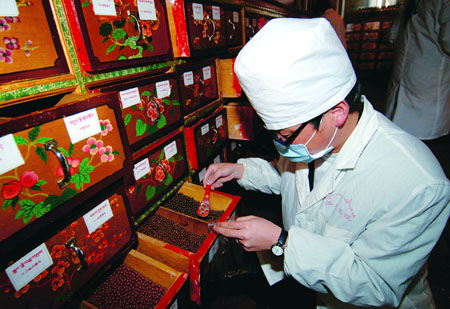
Doctors with the Tibet Tibetan Medical Hospital giving treatment to patients. The hospital is staffed with some 700 medical workers and is visited by 220,000 patients a year.
In order to strengthen the research work on Tibetan medicines, in 2006, the Tibet Autonomous Region Hospital set up the Tibetan Medicine Research Institution covering 17 research subjects. The Four-Volume Medical Code, with Champa Trinle, the State-level expert on Tibetan medicine, as editor in chief, is one of the projects for arranging the literature on national ethnic medicines, A New Compendium of Tibetan Medicine, and Dictionary of Tibetan Medicine, the research subject of the State Administration of Traditional Chinese Medicine have been published.
On April 6, 2007, the magazine China's Tibetan Medicine started its publication, with such topics as the historical literatures on Tibetan medicines, astronomy and calendar, basic theory, clinic diagnosis, medication and prescription. It mainly discusses the origin and development of Tibetan medicines, studies and inherits the cultural heritage of Tibetan medicines, scientifically sums up the diagnoses and therapeutic methods of various diseases, does research on the effective components and drug processing techniques, playing an positive role in improving the integrated level of the Tibetan medicine academy and accelerating the prosperity and progress of Tibetan medicine academy.
Cooperation Projects on Maternal and Child Health
In September 2006, Tibet began to implement the Cooperation projects on Maternal and Child Health during the Period 2006-2010 of the Ministry of Health of China and the United Nations Children's Fund in seven counties of four prefectures, of which Gyaca, Qusum and Chagyab were the three new counties implementing the scheme. The project aims to improve the quality of maternal and child healthcare services and pay more attention to the migrant pregnant and lying-in women and children living in poverty. After the completion of the projects in 2010, the healthcare network at county, town and village levels will be set up and improved through the integrated construction of medical service institutions, aiming to make the 80 percent of families in the project covering areas enjoy economical and highly-efficient basic health and nutrition intervention services, get to know enough about prevention, care and feeding means to ensure the survival and development of the pregnant and lying-in women as well as infants; at least 70 percent of health centers in the towns and villages can provide basic obstetrics services, emergency treatment services for newborn babies and basic healthcare services; It aims to ensure that the proportion of pregnant woman who go to hospital to give birth reaches 80 percent or increases by 50 percent on the existing base; the anemia rate of pregnant women and children can be reduced by 10 percent and the incidence of malnutrition decreases 25 percent, so as to improve child health and reduce disease.
From 1986, Tibet implemented such projects over five periods. In the implementation in the period 2001-2005, it covered 15 counties of Xigaze, Shannan, Nagqu and Nyingchi prefectures, with 600,000 directly benefiting from it. |