Foreword
The Chinese Government has always attached great importance to the quality and safety of agricultural products. Since agriculture came to a new stage of development in 1990s, emphasized have been not only quantity and safety but also quality and safety. The government has put forward clear-cut objectives of promoting high-yield, efficient, quality-oriented, eco-friendly and safety-driven agriculture to ensure agri-product quality and safety. With over ten years' effort, China has improved the quality and safety level remarkably, and on the whole agri-product is safe and reliable.
Abiding by the central government's planning, the Ministry of Agriculture (MOA) launched Plan of Action on Agri-safe Food nationwide in 2001. Agricultural authorities at all levels have been called upon to address issues of public interest such as illegal use of highly toxic pesticides and animal drugs as well as residues in excess of limits, with focus on control of highly toxic pesticide residues in vegetables and clenbuterol contamination in animal products; to promote the control of the whole production chain from farm to table where the critical points are input control, production and market access; to enforce regular surveillance and take it as the base to raise public awareness and delegate responsibilities; replicate standard-based production and take it as the leverage to raise production and managerial levels. At the present, 93 percent of the vegetables tested for pesticide residue and 98 percent of the animal products tested for clenbuterol contamination are in compliance with the residue limits. With increasingly improved assurance system for agri-product quality and safety, enhanced surveillance and control capacity, remarkably expanded standard-based farming, and gradually improved laws and regulations, a ?five in one? operation mechanism targeting at agri-product quality and safety is coming into shape which comprises of service, administration, supervision, punishment and emergency response.
Contents
Foreword??????????????????????????????1
I. Remarkable Improvement in Agri-product quality and safety????..? 3-6
II. Protection and Monitoring of Environment in Production Places?????.6
III. Control of Inputs use in crop and animal farming and aquaculture ????..6
IV. Improvement of Regular Surveillance System ????????????..7
V. Rising Capacity for Standard-based Farming ?????????????7
VI. Initial Shape of Inspection and Testing Framework??????? ? ?7-10
VII. Fast-Growing Safe and Quality Brand Products?????? ?... ???8-9
VIII. Development of Traceability System ????????? ?????.?.9
IX. Major Breakthroughs in Legislation ???????????? ?.?9-10
X. Strengthening of Enforcement in Accordance with Law????????.10
XI. Increasingly Dynamic International Cooperation ?????????..10-11
Conclusion??????????.??????????????????..11
I. Remarkable improvement in agri-product quality and safety
1. Compliance rate in vegetables keeps rising.
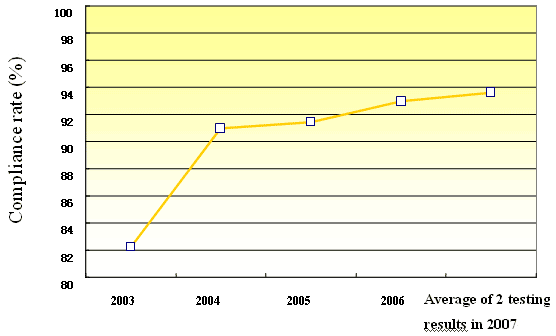
Based on 2003-2007 inspection findings of pesticide residues such as Methamidophos and dimethoate in vegetables in 37 cities, the compliance rate keeps a rising momentum (Figure 1). According to residue tests made in January and April 2007, the compliance rate was 93.6 percent on average, derived from 96.7 percent from production bases, 93.7 percent from wholesale markets, 91.7 percent from supermarkets and 92.5 percent from farm produce markets. And the compliance rate is rising year by year.
Figure 1 Compliance rate in vegetables in 37 Cities based on inspection, 2003-2007
2. Compliance rate in animal products remains high.
Based on inspections of veterinary drug residues such as clenbuterol and sulfonamides made in 22 cities from 2003-2007, the compliance rate has shown a rising momentum across the board (Figure 2 and Figure 3). According to inspection in January and April 2007, 98.8 percent of the animal products tested for clenbuterol contamination and 99.0 percent of tested for sulfonamides residue are within residue limits.
Figure 2 Compliance rate for clenbuterol residue limits in animal products based on inspection and tests, 2003-2007
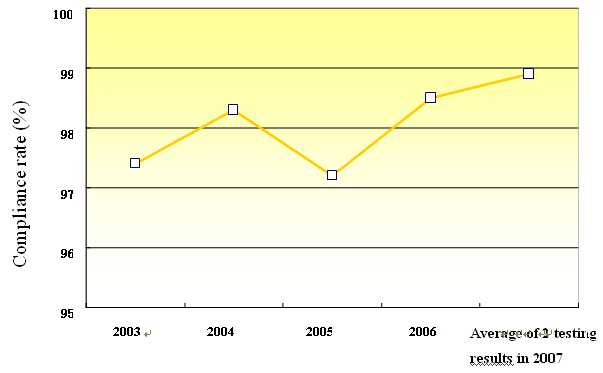
Figure 3 Compliance rate for sulfonamide residue limits in animal products based on inspections and tests, 2003-2007
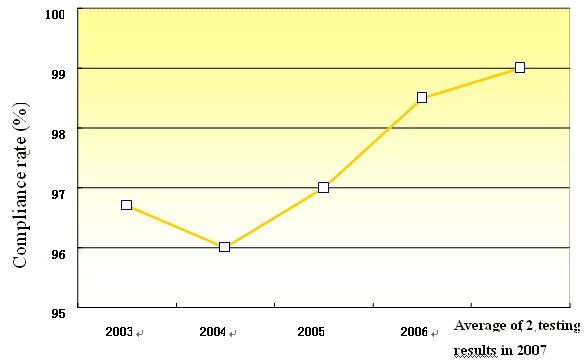
Inspection and test results show that the compliance rate for clenbuterol is 99.1 percent for slaughterhouses, 99.5 percent for supermarkets, 100 percent for wholesale markets and 96.5 percent for farm produce markets, while that for sulfonamides is 98.7 percent for supermarkets, 99.0 percent for wholesale markets and 99.2 percent for farm produce markets. Obviously, the quality and safety of animal products keeps a high level as the compliance rates indicated.
3. Compliance rate of aquatic products keeps a rising momentum.
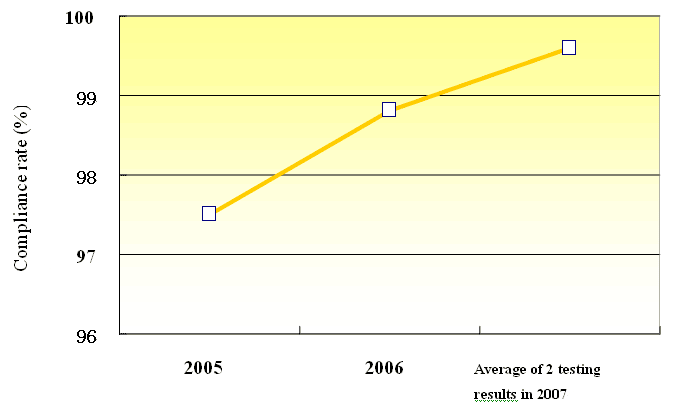
According to tests of aquatic products from regular inspection and tests in 22 cities from 2005 to 2007, the overall quality and safety level has been rising in recent years (Figure 4). Tests in January and April 2007 indicate that the average compliance rate for chloramphenicol limits was 99.6 percent derived from 100 percent supermarkets, 99.7 percent in wholesale markets and 99.3 percent in farm produce markets.
Figure 4 Compliance rate for chloramphenicol limits in aquatic products based on inspections and tests, 2005-2007
Tests for nitrofuran antibiotic metabolites detection in aquatic products from inspections of supermarkets, wholesale markets and farm produce markets in April 2007 show that the compliance rate was 91.4 percent.
Tests of random samples for drug residues in production places show that the compliance rate sustains at over 95 percent. The overall quality and safety level of aquatic products has been improving, which sharpens competitive edge of China 's aquatic products in the international markets. Therefore their export grows steadily. In 2006, the export volume and value reached 3.015 million tons US$9.36 billion, rising by 17.4 percent and 18.7 percent over last year, respectively.
II. Protection and monitoring of environment in production places
A sound environment in production places is the basic shield for agri-product quality and safety. In recent years, agricultural authorities have been actively taking measures to protect environment in fields.
First, relevant rules and regulations have been issued. MOA formulated the Measure for Management of Production Places and 23 provinces, autonomous regions or municipalities directly under the central government that have unveiled their respective Regulation on Agricultural Environment Protection, which require enhanced monitoring and control of agricultural environmental quality and combating pollution. Second, environmental monitoring and control have been strengthened. A monitoring and assessment mechanism has been developed to observe any changes in environment health in production places. Then, the status quo and changing tendency of environment quality in key areas have been acquired for government to take reference in making decisions. Third, clean production technologies have been promoted. Farmers are guided to adopt them to farm safe, green and organic products. Moreover, agricultural authorities at all levels are called on to carry out extensive investigation and address pollution cases in agriculture in a wide range so as to prevent its spread and reduce contamination in agricultural products.
III. Control of inputs use in crop and animal farming and aquaculture
In recent years, MOA has carried out special programs targeting at monitoring and control of pesticides and residues, veterinary drugs and residues, feed and additives, and drug residues in aquatic products, conducted inspections on enforcement of laws and regulations on pesticides, veterinary drugs, feed and additives, and cracked down on malpractices such as sale and use of banned drugs and chemicals.
China began its overall ban on domestic sale and use of five pesticides with high toxicity including Methamidophos on Jan. 1, 2007. Agricultural authorities at all levels have taken active steps to make investigations and confiscate such pesticides when found. In the first half of 2007, the agricultural authorities confiscated 488.7 tons nationwide, which ensures agri-product quality and safety at source.
The inspection of farming materials markets has been reinforced. Since the special program on combating adulterated farming materials started six years ago, there has been the involvement of inspectors for over 6.52 million person times in performing duties, and more than 1.056 million tons of fake and shoddy agro-supplies have been confiscated, contributing to the effective walling off their entrance to the fields.
IV. Improvement of regular surveillance system
Since MOA began the regular surveillance initiative in 2001, altogether 83 000 vegetable samples, 40 000 animal product samples and over 1500 aquatic product samples have been tested and 1.10 million effective data gained. At present, the regular surveillance covers inspections and tests of pesticide residues in vegetables in 37 cities, clenbuterol contamination in animal products in 36 cities, and chloramphenicol and nitrofuran contamination in aquatic products in 22 cities. And based on testing results, MOA releases regular information of agri-product quality and safety.
In parallel, there have been 30 provinces, autonomous regions and municipalities directly under the central government doing provincial-level regular surveillance in light of local reality. Up till now, a regular surveillance network combining the ministerial and provincial efforts has come into shape. The scope, varieties and species it covers are expanding. Based on surveillance results, local authorities are able to identify major problems, weakness and critical points for effective intervention and take countermeasures in a timely manner, which has promoted the widespread effective control of agri-food quality and safety.
V. Rising capacity for standard-based farming
During the Tenth Five-Year Plan period, MOA organized the formulation of over 800 national agricultural standards and 2 235 sectoral standards and guided the local authorities in formulating over 8 000 local standards, representing 1.6 times of the total number of farm-related standards ever appeared before. These standards, having extended to the whole production process including processing, packaging, storage, transportation and other links, have formed a system of agricultural standards pillared by national and sectoral standards, supported by local standards and supplemented by company standards.
MOA organized the establishment of 539 country-level demonstration bases plus 100 demonstration counties/farms for standard-based farming, and guided local authorities to build approximately 3500 provincial-level demonstration bases, which covers an area of over 500 million mu. Standardization, by facilitating large-scale production and vertical integration, has contributed to farmers' income increase and transformation of production practices.
VI. Initial shape of inspection and testing framework
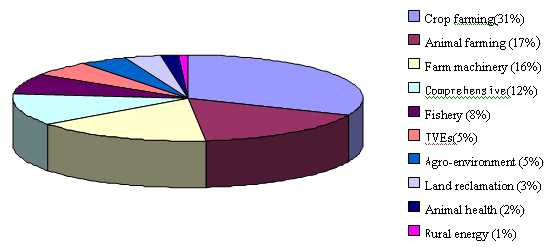
MOA is committed to the development and administration of agricultural quality control system. By the year 2006, there have been established 323 national (ministerial) quality control centers, and 1780 provincial, prefecture and county testing agencies. Figure 5 shows the distribution of the testing agencies by sub-sectors. A system, consisting of support and complementary centers at ministerial, provincial and country levels, for inspection and testing of agri-product quality and safety is gradually coming into being, which provides technical backup in strengthening supervision on agri-product quality and safety. By the year 2010, the government will have funded one ministerial-level research center on agri-product quality standards and testing techniques, 42 specialized quality control centers at ministerial level, 15 regional quality control centers for competitive agri-produce at ministerial level, 36 comprehensive quality control centers at provincial level and 1200 quality control stations at county level in order to improve institutional testing capacity and enable agencies at provincial level and above to have the same testing capability as their counterparts in developed countries.
Figure 5 Quality control centers by sub-sectors
VII. Fast-growing safe and quality brand products.
The present era witnesses the hand in hand growth of safe agri-food, green food and organic agro-food. So far, there are a total of 28 600 certified safe agri-food, and 24 600 certified production places covering a total area of 316 million mu. There are 5 315 green food label holders for 14 339 products, with a total of 72 million tons from 150 million mu of certified production places. There are all together 600 organic agri-product label holders certified by China Organic Food Certification Center (COFCC) for 2 647 products, with a total of 19.56 million tons from 46.64 million mu of certified production places. Market share of high quality brand products is expanding steadily. Safe, green and organic agri-products take the majority or 90 percent of agricultural export. In the past 5 years, export of green food has increased at a rate of over 40 percent a year, and the Chinese green food has been recognized by over 40 trading partners. It is also an important way of increasing income of farmers to be involved in developing brand products or industries with prominent features.
VIII. Development of traceability system
Since 2004, MOA has explored ways and means on traceability systems for agri-product quality and safety, and conducted trials in eight cities including Beijing , Tianjin and Shanghai for surveillance of agri-product quality and safety. Tracing of production places and marketing flow has been realized by adopting the Pilot Project of Traceability System on Vegetables Moving into Beijing , and the project has made important progress in developing, controlling, using and enquiry of product labeling information code. R & D on safe vegetable traceability system has conducted in Shouguang of Shandong province, which has taken bar code as a leading tracing tool. Nanjing city has launched trials on IC card-based agri-product quality management system. Shanghai municipality has also had trial work to build traceability system for livestock products, realizing the traceability for certain amount of chicken eggs.
Efforts have been made to press forward the Agri-product Labeling Initiative with focus on labeling management, and pay special attention to enhancing traceability control throughout the whole production process from safety in production places, on-farm production recording, packaging and labeling up to market access. Targeting at major crop, livestock and aquatic products, the traceability of quality and safety is taken as a critical appraisal component in evaluating the progress in promoting standardization in standard-based farming demonstration bases/farms, safe agri-food demonstration counties, notifiable-animal disease-free areas and leading large-scale crop or animal farms, so as to enhance the quality and safety traceability management across the board. In addition to the development of traceability system, efforts have also been made to strengthen supervision, standardize agri-product labeling, and intensify labeling inspection.
IX. Major breakthroughs in legislation
China has promulgated a number of laws and regulations targeting at agri-product quality and safety standards, environment control in production places, production management, marketing regulation, and supervision and control of the quality and safety among the others. For example, the Law on Quality and Safety of Agricultural products came into force on 1 November 2006, indicating a new development of legislation in this regard. Currently, there are the following laws and regulations in this regard: the Law on Agriculture, the Animal Husbandry Law, the Fishery Law, Law on Animal Epidemic Prevention, the Regulations on the Management of Pesticides, the Regulations on the Management of Animal Drugs, the Regulation on the Management of Feeds and Feed Additives, and the Regulation on the Administration of Agricultural Genetically Modified Organisms' Safety.
For enforcement of the Law on Quality and Safety of Agricultural products, MOA has organized the drafting of the Administrative Measures for on the Safety in Production Places and the Administrative Measures on Agri-food Package and Labeling, and these two legal documents have been promulgated. And the Administrative Measures on Standardization of Agriculture, the Administrative Measures on Monitoring Agri-product quality and safety and the Administrative Measures on Appraisal of Agri-product quality and safety Testing and Inspection Apparatus are in the process of preparation. Based on the Law on Quality and Safety of Agricultural products, a legal system for agri-product quality and safety is being established step by step.
X. Strengthening of Enforcement in Accordance with Law
Effort is made to carry out surveillance and regular inspections on agri-product quality and safety in accordance with the law, tighten random inspections on production places and markets, trace origin of substandard products timely, and inspect the enforcement of the Law on Quality and Safety of Agricultural products. Malpractices such as illegal production and sale of products are cracked down, and legal awareness of producers and salesmen improved to ensure agri-product quality and safety.
Effort is taken to implement special programs for enforcement of laws and regulations on agri-product quality and safety. In light of serious problems, intensive rectification campaigns have been launched to strengthen monitoring effort to remove hidden dangers promptly and effectively prevent bad incidences relating to agri-product quality and safety. Work is done to punish law-violating cases to safeguard market orders and consumers' safety.
Effort is done to build up law enforcement to improve enforcement capability at the grass root level and ensure performance of government duties in accordance with the law. Currently, 1 662 counties and 175 prefectures and cities in the country have established agencies to enforce agricultural laws and regulations with over 23 000 employed law enforcers who have become the leading force in executing laws and regulations on agri-product quality and safety.
XI. Increasingly dynamic international cooperation
China acceded to the Codex Alimentarius Commission (CAC) in 1984, and became the host country of the Codex Committee on Pesticide Residues (CCPR) of CAC in 2006 through successful campaign. In September 2006, the Chinese government and the Norwegian government jointly sponsored the 28th Session of Codex Committee on Fish and Fishery Products, CAC. The meeting adopted a number of suggestions put forward by the Chinese Delegation. In addition, China was authorized to work for the study and elaboration of three criteria.
In May 2007, the 39th Session of CCPR was organized by MOA in Beijing . A total of 199 delegates from 52 member countries, one member organization and seven international organizations attended the meeting. The success of this session has contributed to the influence of China in setting pesticide residue standards in the international arena, and provided a chance to introduce to the world the achievements made by China in ensuring agri-product quality and safety.
In 2004, MOA started the official evaluation of technical barriers to trade (TBT), inviting agencies and experts to evaluate the forthcoming laws and regulations, technical standards and conformity assessment procedures in other countries. In 2006, MOA received 307 circulars of TBY/SPS from 27 WTO member countries. In May 2007, MOA together with other competent departments of public health, food and drugs, environmental protection, inspection and quarantine established a National Expert Committee on Agri-product Quality and Safety Risk Assessment to evaluate risks related to quality and safety in farm produce.
Conclusion
Food safety is a common issue for the world. All countries are working hard for it. In the past few years, the Chinese government has strived hard to solve problems, which has facilitated dramatically improved quality and safety of agricultural products in the country. However, we are fully aware that it is a long way to go for agri-product quality and safety to satisfy ever-growing consumers' demand for safe consumption, and it is a very demanding task to establish and improve an agri-product quality and safety system.
To this end, the Chinese government will take the control of origin as the focus to strictly regulate the use of inputs and banned drugs in particular, and press forward the standard-based farming; take promoting agri-food labeling as the tool to realize traceability throughout the whole production process; take strengthening regular surveillance as the focus of efforts to develop a list of law-breaker enterprises for targeted control, and to improve agri-product quality and safety appraisal systems; take speeding up revision or elaboration of standards as the focus of departure to follow international ones and improve our own systems for residues of pesticides and animal drugs; and take reinforcing awareness raising as a way to give play to experts and associations or organizations, to enhance positive public outreach and spread scientific knowledge. By following the Scientific Outlook on Development, we will actively promote a modern agriculture through more effective measures, and strive for pushing the quality and safety of agricultural products to a new high.