 "Had I been born Chinese, I would have been a calligrapher, not a painter," Picasso once said.
The attraction to the art that so fascinated the cubist is clearly visible in an exhibition called "Brushes with Surprise: The Art of Calligraphy in Modern China," which opened at the British Museum in London yesterday. The exhibit will last until May 19.
"This is the British Museum's first exhibition that is devoted exclusively to Chinese calligraphy," said Gordon S. Barrass, curator of the exhibition who also authored the English book "The Art of Calligraphy in Modern China." The book was recently published by the British Museum Press.
Virtually all 50 works of art within the exhibition come from the world-class collection the British Museum has amassed over the past eight years. The collection covers the evolution of the art in the Chinese mainland since 1949, when the People's Republic of China was founded.
"It is part of the museum's continuing program of 'Illuminating World Cultures,' in which it strives to open windows not only on ancient cultures from around the world, but on modern ones, too," Barrass told China Daily.
"Because of that, the objective of the exhibition is inevitably different from which a Chinese curator might have organized for a Chinese audience knowledgeable about calligraphy," he stressed.
According to Barrass, the exhibition has focused on the evolution of the art in China over the past 50 years because the changes that have taken place have made the whole subject "far more accessible to foreigners."
Another important reason is that Chinese calligraphy during this period is an area that has not been exhibited to Western audiences before in a comprehensive way, he noted.
Examining trends
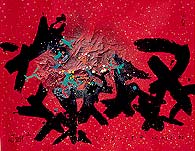
In the opinion of Beijing artist Gu Gan, whose works (The attached picture shows a piece of his works) are included in the show, what makes the exhibition most remarkable is that it is the first major exhibition aimed at Western audiences to show new trends in the art of Chinese calligraphy during the last 50 years.
"Barrass is the first Englishman who wrote a book and organized an exhibition to introduce the dramatic transformations of Chinese calligraphy from the traditional to the modern and the avant-garde, after many years of in-depth research," the artist said. Gu is an old friend of Barrass.
It was in the early 1970s, when Barrass was a diplomat at the British Embassy in Beijing, that he developed a keen interest in Chinese culture, and the art of calligraphy in particular.
For more than 20 years, Barrass, who speaks and reads Chinese well, has travelled to China on business often and to meet with Chinese artists and scholars such as Huang Miaozi and Gu, who led him to the new territory of modern Chinese calligraphy that stimulated his interest in researching this subject.
Meanwhile Barrass started to collect calligraphic works himself and helped the British Museum build its splendid collection of modern Chinese calligraphy, the highlights of which are included in the show.
The unique Oriental linear art of calligraphy has, for thousands of years, been a defining feature of Chinese culture.
But over the past 50 years, as a result of China's modernization and opening to the outside world, there have been dramatic innovations in this art. Brushwork has become more exciting and colorful. The ideas expressed through it also provide fascinating insights into life in modern China.
"These exhibits show the extent to which this ancient and revered art has been refreshed with great vitality and imagination," Barrass noted.
The exhibition introduces the art of calligraphy through the works of a number of China's leading calligraphers and explores the four trends, as Barrass categorized, that artists have explored over the past half century: classical, modernist, neo-classical and avant-garde.
The first trend is the continuation of what one might call the 'Grand Tradition' of classical calligraphy in the early years of New China. The exhibition features works by accomplished calligraphers in this trend, among them Shen Yinmo, Ye Gongchuo, Guo Moruo, Mao Zedong, Deng Sanmu, Sha Menghai, Lin Sanzhi, Qi Gong and Wang Shixiang.
Among the most extraordinary exhibits is an original piece by late Chairman Mao, which is on loan from Hong Kong collector Harold Wong. The other pieces by Mao in the collection are fascimilies made by the Rongbaozhai Gallery in Beijing.
The second trend represents the growth of modernism as China increased its links with the outside world after the "cultural revolution" (1966-76).
The modernists argued that calligraphy could not become a means of creative expression until it broke free of traditional constraints, drawing inspiration from other arts, both Chinese and Western. A few examples are late calligraphers Zhang Zhengyu and Li Luogong and artists Huang Miaozi, Gu Gan and Wang Dongling.
The third trend is a refreshing classical tradition by younger artists, who may for the sake of convenience be called neo-classicists, among them calligraphers Zhang Sen, Liu Zenfu, Han Yu and Sa Benjie.
The most spectacular among the exhibits are those made by so-called "avant-garde" calligraphers, who seek to produce works that command attention in order to make people reflect on a subject or to challenge conventional thinking. Such artists include Zhang Dawo, Pu Lieping, Wei Ligang, Wang Nanming and Zhang Qiang.
"I feel it's both an interesting and pitiful cultural phenomenon that such a significant exhibition is first organized by the British Museum and a curator from Britain, instead of the Palace Museum in China and by a Chinese curator," said Zhang Qiang, an art professor from the Jinan-based Shandong Institute of Arts, before leaving for London.
In response to concerns that the exhibition might have overly stressed the social context rather than the artistic value of calligraphy to cater to the interest of Western visitors, Zhang said: "That's only one of the angles for the studies of calligraphy."
"It is inevitable that mis-readings and misunderstandings can occur when Chinese calligraphy is presented to Western audiences, but as long as the studies are objective, their efforts deserve to be respected," Zhang added.
Decoding calligraphy
Barrass accepted that the biggest problem for him in writing the book and organizing the exhibition is trying to explain calligraphy to people who do not read Chinese.
"Calligraphy should, I believe, in the first instance, be appreciated as a visual art. For those people who cannot read Chinese, calligraphy is an abstract art," he said.
But, he pointed out that in China, as in the rest of the world, there is no such thing as "meaningless art." "Even the most abstract art has a historical and cultural context," he said.
"In Chinese calligraphy, much of this significance is derived from the characters (which can be read in translation) and by the ideas which those characters inspire. The main challenge of this exhibition has been how to bring this extra dimension to life for the visitor," Barrass said.
Fortunately, many foreigners find it easier to appreciate the meaning of modern Chinese calligraphy. They are more ready to relate the calligraphic works to the events in modern China than they do to those of earlier centuries.
Moreover, in many cases, the artists express themselves more directly than most classical calligraphers did and in so doing they provide fascinating insights into the life of modern China, Barrass said.
"Visually, calligraphy has become more interesting. In the works of many artists there have been important innovations - in composition, brushwork, ink techniques and, in some cases, the introduction of elements of Western art," said Barrass. "Also because of the influence of modern art, many Westerners are now more interested in what one might call 'the art of the line,' which lies at the heart of calligraphy."
The British Museum has made a special effort to make the exhibition accessible to non-specialists, for example, through displays that explain the techniques of calligraphy and the different types of scripts that are used, and by explaining the development in the art against the background of great changes that have taken place in China over the past half century.
On Friday and Saturday, calligraphers Wang Dongling and Zhang Qiang, whose works fall into the modernist and avant-garde categories respectively, will show how they work to the public in the Great Court of the British Museum. During the exhibition, there will be several displays of traditional calligraphy and special educational programs.
In April, the British Museum will also host a conference on modern Chinese painting and calligraphy.
"We believe it (the exhibition) will play an important part in widening Western understanding of modern Chinese culture," remarked J. Robert Knox, keeper of the Oriental Antiquities Department of the British Museum.
(China Daily January 31, 2002)