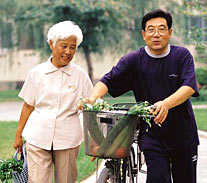
Xu Yunying's husband was paralyzed and bedridden for 16 years before he died, five years ago. After her initial grief, Xu was happy to resume her old routine of doing exercises in the morning sunshine with her neighbors, tending to her plants, and watching TV in the evening. Then, after a while, she began to feel lonely and miss her husband's company, despite all the distress and difficulty his condition had caused. She does not, however, have any intention of remarrying.
There are many elderly widows like Xu Yunying in China who, despite straitened economic circumstances and changes in traditional marriage concepts, would never consider a second marriage. Their reasons are various. They don't want to marry a man younger than them, but on the other hand, would worry about the state of health of an older man.
"I want no more emotional upheavals," says Xu. "I can't afford hired help at home, and neither do I want to spend the rest of my life looking after another man." Since her husband's death, therefore, Xu has not looked into the question of a second spouse, having decided to remain a widow.
The right to freedom of marriage has always been promoted and protected in China, and since the 1980s, with the increasing numbers of seniors, the issue of their second marriage has become a source of social concern. Clauses protecting elderly marriage partners have been added to the local laws of 22 provinces and municipalities.
In 2001, the revised Marriage Law stated clearly that marriage freedom must in no way be infringed upon. There are matrimonial agencies that specialize in senior citizens. The media also actively supports elder remarriage, and young people are aware that their parents have the freedom to marry again if they wish. This has resulted in a slight increase in the rate of remarriage within this age group.
According to research by Professor Hao Maishou from the Tianjin Academy of Social Sciences, in the mid 1990s it reached 7 percent and has continued to increase in recent years. Yet despite social concern and encouragement, it is still relatively low. According to a social survey, there are 1.3 million elder people in Tianjin, of whom 30.3 percent are widowed, yet only 10 percent have remarried.
Research carried out by Du Peng, deputy director of the Population Research Institute at the People's University shows that most elderly women choose not to remarry. Some, like Xu Yunying, do not want to be tied down again, but in most cases the traditional concept of remaining loyal to the spouse prevails. Du Peng's survey demonstrates that 50 percent of the senior population in Beijing believes traditional attitudes to be the major obstacle to their remarriage. Other deterrents are the opposition of children, and the knotty problem of property.
Cases of failed remarriage
Remarrying in later years is not an easy decision, and making a marriage work after taking this step is also a challenge. Says professor Hao, "In the 1980s the divorce rate in senior remarriage was as high as 80 to 90 percent. This has dropped in the last year or so, but in big cities like Beijing and Tianjin where there is a large senior population, the rate maintains a level of about 70 percent."
Residents of Wuhan, Hubei Province, seventy-two-year-old Wang Minxin and his new wife were very happy when they read the revised Marriage Law on April 28, 2001. On marrying they had been driven out of Wang's home by his son, and were obliged to find rented accommodation. Said Wang Minxin to his wife "We can take him to court now," and sure enough the court pronounced Wang's son guilty of intervening in his marriage freedom. Two years passed, Wang Minxin began to miss his son and grandson and longed to meet with them and bury the hatchet. But his son refused to share the house with his father unless he divorced. This put Wang Minxin in a difficult situation, as when he grows older he will need to rely on his son, albeit under less congenial circumstances. He and his wife are happy now, but in another ten or twenty years may well be a burden to each other.
Sixty-two-year-old Li's story is quite different. He took his second wife to court over a matter of property. Li and his second wife Zeng each had their own house, and on marrying decided to live in Zeng's. On one occasion when Li was away on business, Zeng's granddaughter asked her for help in finding the funds she needed to study in Japan. Zeng sold Li's house without asking his permission and gave the sale proceeds to her granddaughter. This infuriated Li's children, who berated Zeng and informed Li of her actions, insisting that he repossess the house. Li was unhappy at Zeng's making such a big decision without consulting him, and Zeng, who had all along planned to repay the money, was furious that Li had taken his children's, rather than her side. She asked for a divorce and drove Li out of her house. A happy marriage thus ended in acrimony.
Another elderly couple from Tianjin married a month after making one another's acquaintance, and quietly divorced three months later, acknowledging that they were incompatible. The woman's late husband had been content to let her make all the decisions, but her new partner's character was as strong as her own. He was also not very caring, and would happily go out to enjoy himself while his wife stayed alone at home. The marriage consequently ended in discord.
The distance between reality and expectation
Why do so many seniors divorce after remarrying? According to Pei Xiaomei of the Center for the Study of Gerontology at Tsinghua University, owing to the disparity between their expectations of a second marriage and its reality. "Many elderly people do not consider deeply the ramifications of marrying again. For example, a woman in her 60s may want a wealthy partner in good health and with a large house. But she may overlook the question of whether or not their personalities match.
In any event, remarriage in women over the age of 65 has declined in recent years. The reason would seem to be because neither eligible marriage partners nor proposed living conditions measure up to expectations, and because remarriage puts a strain on relations with offspring on either side.
Another factor is that rapid economic developments in China in recent years have left many Chinese senior citizens confused and worried. Analysts say that the incomplete pension system, medical care and social services inhibit seniors from remarrying, as they think that if they take a new marriage partner their offspring will refuse to look after them when they are sick and infirm. Many, on the other hand, see remarriage merely as a means to financial security, which leads them to make hasty, inadvisable matches.
The solution?
The Maishou Matrimonial Agency is the brainchild of Professor Hao Maishou. His agency stands apart from others as it provides its elderly clientele with pre-nuptial contracts. Professor Hao is an expert geriatrician with more than 20 years experience. On comparing Chinese family and marriage law with that of the West, he found the former to be lacking as regards the interests of senior citizens. He subsequently formulated his Three Unchanged Principles applying to elderly remarriage. They are: "unchanged property right, unchanged inheritance right and unchanged parent/offspring obligation." The principles clarify how previously married (generally widowed) elderly people who wish to marry again should proceed, with specific reference to their rights, possessions and property. This avoids any misunderstandings and conflicts that may occur at a later date.
The principles give the elderly specific legal guidance as they consider their second marriage. The purpose of the pre-nuptial contract is to set down agreed conditions of marriage on the premise of the Three Unchanged Principles. The contract has eight clauses, covering such issues as property, medical care, and offspring, each with detailed articles. Articles relating to property cover pre-nuptial estate property, enterprise assets, living expenses after marriage, shared property, and medical expenses, to name a few. The contract encompasses solutions to the kinds of economic problems that might be encountered within marriage. It takes legal effect once the two sides reach agreement and have the contract notarized.
The nuptial contract was not readily accepted at first. Some believed it to be prejudiced against women, like the five senior women in Gansu who disputed its legality to the extent that they took Hao Maishou to court. Professor Hao insists, however, that his methods are fair and have produced good results. To date, 300 couples have signed his notarized contract, only 5 percent of whom have since divorced.
Hao has, however, encountered problems of people being unwilling to sign or rewriting it to make it simpler. Professor Hao admits that most aged people are loath to spend half their monthly income on a piece of paper that resembles a self-sale indenture. Another marriage expert says that Chinese people still embrace the traditional marriage concept of two partners merging into one entity after marriage. The contract system is, therefore, too westernized a concept for them to accept. It might resolve economic conflicts, but is not the remedy to all matrimonial problems. Even after signing the contract, many do not abide by its conditions, and divorce proceedings ensue.
Cohabiting and cross-generation marriages -- the new trend
The concept of cohabitation has been of increasing relevance to older people in recent year it is currently going through a process of criticism and acceptance.
Professor Hao is entirely in favor of people 50 years old or older cohabiting, as they may then avoid loneliness and devote the remainder of their lives to taking care of each other. In the absence of any legal obligation to support one another, their children continue to take this responsibility, and there is no change as regards inheritance of property or possessions.
Some consider cohabitation as an emotional arrangement and marriage as more practical. The former resembles a long-term relationship with a friend of the opposite sex, between whom there is mutual respect and understanding that either party has the freedom to stay or leave as they please. Cohabiting partners can come to a written agreement about the rights and obligations of their arrangement according to Chinese law and lodge it with the Ministry of Civil Affairs. Either side has the right to terminate such an agreement on demand.
Two widowed seniors in Zibo City, Shandong Province who had married were obliged to divorce and cohabit in order to have a place to live. The woman's deceased husband left her the house allocated to him by his work unit. On her second marriage the work unit demanded that she return it to them and live at her second husband's house, but this belonged to his son. The pair had no choice but to divorce and live together. They are now waiting to buy her late husband's house, after which they will hold another wedding ceremony. Many such petty regulations stand in the way of elderly people's second marriages. Professor Hao has formerly proposed that the Marriage Law acknowledges cohabitation among the elderly, but has yet to receive a response.
Another difficulty inhibiting successful remarriage in the senior age group is that older people become set in their ways. It is no easy matter to find someone who complements their character and shares their interests. There are also the practical issues of housing, finance and offspring that prevent seniors from living together even when otherwise compatible. Housing is particularly relevant, as many live with children who cannot afford their own house. If they were to marry again they would need to move their children out. Also most elderly people have children who need their help in the home looking after grandchildren.
One solution is to embark on a new rhythm of life where one partner goes to the other's house a few nights of the week, and stays at his/her own household to take care of family matters during the day. If one should fall sick, the other looks after him/her, obviating the need for their offspring to take time off work. At weekends, when the offspring can manage without them, both partners can go out together and enjoy themselves. According to Professor Hao, about 50 percent of the urban elderly cohabit.
Cross-generation marriage is a trend that has emerged in recent years. Elderly Chinese men were previously happy to find a partner that would simply look after them, but nowadays seek younger partners with tender hearts and good figures. Sexologist Shi Chengli says that the motives for cross-generation marriage are mainly sexual. According to the traditional Chinese medical concept, emotions and desires have great influence on the health, and maintaining a tranquil mind builds up the immune system and brings longevity. This encourages elder people to be restrained in their sexual behavior and so conserve energy. Modern medical theory points out, however, that an active and fulfilling sex life is also a source of good health and a strong immune system at any age. Statistic indicate that 90.4 percent of men aged over 60 still have sexual desire, and that 54.7 percent strongly so. It has also been suggested that men aged 70 retain sexual desire that women of the same age have generally lost. Cross-generation marriages are, therefore, a viable proposition.
Aged people generally expect a lot from their second marriage, both physically and spiritually. According to Professor Hao, apart from the social and financial problems that need to be resolved, the seniors should concentrate on maintaining a cheerful disposition and emotional stability in order to stay happy and healthy.
(China Today August 3, 2003)