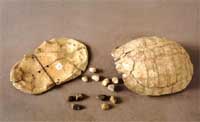
Neolithic graves in central China may hide the world's earliest writing, if the "signs" carved into 8,600-year-old tortoise shells can be deciphered by academics.
The claim, made by a team of Chinese and American researchers in the March issue of Antiquity, a journal based at Cambridge University, Britain, has triggered heated debate among the world's archaeologists.
The debate centers on the origin of writing.
The earliest writing on earth is commonly believed to have evolved in what is today's southern Iraq about 5,200 years ago. There, settlers invented the cuneiform, a way of arranging impressions stamped on clay by a wedge.
It is commonly recognized that writing didn't emerge in China until 2nd millennia BC, about 2,000 years after it appeared in Iraq.
In China, early writing known as jiaguwen consisted of pictographic inscriptions on bone and tortoise shells.
However, the Chinese and American researchers claim their findings may overturn long-held convictions about where the evolution of Chinese writing began. After studying the artifacts from a site called Jiahu, in central China's Henan Province, they have proposed that the pictograms inscribed onto animal bones and shells unearthed there predate the jiaguwen used in the Shang Dynasty (c. 16 century-11 century BC).
The Jiahu site dates back more than 7,000 years. The researchers' findings have been covered by the British Broadcasting Corporation and US television networks because, if proven correct, it would mean the Jiahu "signs" would predated the writing of Mesopotamia by more than 2,000 years.
The researchers have won support from some archaeologists but been challenged by others, who call their hypothesis "nonsense."
"There is nothing new here," Robert Murowchick, a Boston University archaeologist told Science magazine. He reportedly dismissed the notion "simple geometric signs" can be linked to early writing.
Andrew Lawler from Science magazine commented: "The research is sure to fire up a long-standing debate about how Chinese writing evolved and whether religious practices spurred its origin."
Discovery in Jiahu
The project is based in University of Science and Technology of China (USTC), winning state sponsorship. The research team was led by Li Xueqin, a renowned historian and archaeologist. It also includes archaeologists Zhang Juzhong and Wang Changsui from USTC in Hefei, capital of east China's Anhui Province, as well as Garman Harbottle, a researcher with Brookhaven National Laboratory in New York.
Their work is based on the 1983-87 excavation of the Jiahu site, which was discovered in 1962. The site has been carbon dated to between 7,000 and 5,800 BC.
"Since the excavation began, we had noticed tortoise shells, which contain pebbles of various colors and shapes, in the graves. We paid special attention as similar shells appeared in Yinxu, where the oracle bones or jiaguwen were found," said Zhang Juzhong, then leader of the excavation team from Henan Institute of Archaeology.
Everyday Zhang looked through the shells newly unearthed to see if there were markings. And finally, on an afternoon in May, 1987, an intern student from Zhengzhou University, Henan, found a stone tool inscribed with a series of signs.
The next day, archaeologists opened Grave M344, and saw an adult male whose head was missing. Where his head would have been were eight sets of tortoise shells and one fork-shaped bone artifact.
Zhang picked up one nearly complete plastron -- part of a tortoise shell -- pierced with a hole.
"It felt so smooth," he recalled. "Its owners must have often held it in their hands."
He carefully brushed off the dust, and on the lower middle part of the plastron was an eye-shaped sign, which greatly resembled the later jiaguwen pictograph for "eye" in the Yinxu oracle bones.
"We were exhilarated, and bought meat and liquor for celebration," recalled Zhang.
Team member Wang Changsui said the tortoise shell was also faintly marked with a resemblance of a man holding an object with the same fork-like shape as the artifact. He believes the sign is related to ancient divination.
Another plastron was incised with two vertical strokes, fairly similar to the character for "20" in the jiaguwen inscriptions found at Yinxu, said the research paper.
Up to 16 signs were found on 14 fragments of tortoise shells, pottery, bone and stone artifacts in the excavation. The Jiahu site had already revealed a society of unexpected complexity, with 45 house foundations, 370 cellars, nine pottery kilns, and 349 graves containing objects including tools, ornaments, and ritual or musical artifacts.
The Jiahu site has revealed several important discoveries, including the earliest known musical instruments -- playable seven-hole bone flutes spanning an octave.
As soon as the excavation ended, a team of researchers with the Henan Institute of Archaeology went to Beijing "with complex feelings," said Zhang. They consulted more than 10 leading archaeologists and historians, including Hu Houxuan, Su Bingqi, Li Xueqin and Zhang Zhenglang, about the signs.
"Some of the scholars said the signs are early writings, made before the Yinxu oracles, and they interpreted several signs on the spot," said Zhang Juzhong.
"Others said they are intentionally inscribed signs but not necessarily writings, and still others said the etchings are just marks, not signs."
Clues to writings' evolution
With no consensus from the authorities, the team returned to Henan, and Zhang started to research the curious markings.
As he and fellow researchers later wrote, "while we do not challenge the primacy of Mesopotamia in human literacy, we do suggest that China, with a potential record of nine millennia, offers a unique opportunity to observe the evolutionary stages which led to the development of a script.
Co-author Li Xueqin told China Daily: "We don't say they are words or languages. We do say they are signs and the earliest evidence in the world of a long line of experimentation in sign use, which led to writing."
Yao Zongyi, professor with the Chinese University of Hong Kong, who did textual research on each of the signs, supported Li. He wrote, "the carved signs of Jiahu provided new materials to solve the key problems about the origin of Chinese writing."
The researchers, who cannot decide at this stage what these signs represent, compare them with the jiaguwen inscriptions of 2nd millennia BC, from the Shang Dynasty. For instance, a sign inscribed on a broken plastron, which resembles the modern character for "sun," represents "window" in the Yinxu oracles.
But many researchers objected to the attempt to tie " the Jiahu etchings to the Shang breakthrough," said Science magazine writer Lawler.
William Boltz, professor of Classical Chinese at the University of Washington, Seattle, said: "There is a span of 5,000 years (between Jiahu and Shang period)... How can the development of Chinese writing have taken so long?"
The professor noted speculation about the links between the two based on graphic similarity alone over such a great period of time is next to meaningless.
"How does anyone know that the one graph is in fact the graph for 'eye'?'' he said.
"It may look like an eye to someone, and it may have some general approximate graphic similarity to the graph that stood for the word for 'eye' in the Shang language, but it might just as well be a graph that stands for something else, perhaps a heap of grain under a protective cover."
The span of five millennia is conspicuous because there haven't been any inscribed tortoise shells found between 6,000 BC and the Shang Dynasty in Henan or anywhere else in China.
But Zhang said while no inscribed shells were found, many potteries and pot fragments from the five millennia that followed have been unearthed carrying signs, especially in the Dawenkou, Yangshao, Longshan, Liangzhu Cultures.
In several cultures after Yangshao (6950-4950 BC), pottery signs grew more complex and began to be applied with writing brushes, wrote the researchers.
For example, a flat pot from the late Longshan Culture (2310-1810 BC) at Taosi, north China's Shanxi Province, is brush-painted with a red sign, which is identical to the modern character wen (literature).
And a jade tortoise of 5,300 years ago at Lingjiatan, east China's Anhui Province, hid a jade tablet in it, which was inscribed signs "of the same nature" as those from Jiahu.
"Neolithic men may have abandoned the use of tortoise shells as a material to write on for a certain period and turned to other materials," said Zhang. "After all, the oracle bones found in Yinxu and recently in Zhengzhou were so mature that they couldn't have appeared all of a sudden,"
Lawler wrote the genesis of Chinese writing is even harder to pin down because "many researchers assume that there were earlier writings -- about unknown subjects -- on perishable material such as bamboo."
Besides the gap of five millennia, researchers were also puzzled by the fact the Jiahu signs and others found elsewhere in China before the Longshan Culture were mostly single markings, while the jiaguwen oracles were written in sentences at Yinxu.
"That fact pushes us back to the slippery question of what writing is, and if a single character accounts for writing," said Zhang.
If the single signs from Jiahu are writing, Chinese writing could be traced back to about nine millennia ago.
More "ifs" may lie in Jiahu, where only 5 per cent of the site has been excavated, and meanwhile many other Neolithic sites remain untouched.
"The present state of archaeological record in China, which has never had the intensive examination of, for example, Egypt or Greece, does not permit us to say 'in which period of the Neolithic did the Chinese invent their writing?'" wrote the researchers.
"What did persist through these long periods was the idea of sign use."
(China Daily June 12, 2003)