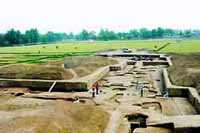
Chinese archaeologists recently found a large-scale building foundation in Erlitou Ruins of Yanshi, central China's Henan Province, which belongs to the later period of Xia Dynasty. The discovery, the first of its kind in China, again excited the archaeological field after the heated discussion on the division of Xia and Shang dynasties .
"The site causes great concern because it was founded at the key moment when the Xia Dynasty (c. 2100 BC - c. 1600 BC) was replaced by the Shang Dynasty (c. 1600 BC - c. 1100 BC)," said Dr. Xu Hong, head of the Erlitou Archaeological Team under the Chinese Academy of Social Sciences. "Was it built by people of the Xia or the Shang? Further excavation will help find the final resolution and provide new materials for periodization of the two dynasties."
Erlitou Ruins, a new mystery
The Erlitou Ruins were discovered by Chinese scholars in their field research of Xia culture. In the following 40 years’ outdoor excavation, they obtained rich relics and references. As a result, the Erlitou Ruins were confirmed as the ruins of an important capital existing between the Xia and Shang dynasties. The first-hand information and scientific materials laid a solid foundation for the research of Xia culture. Meanwhile, since its discovery, disputes about it have never ended.
Situated in the central area of the Xia Dynasty as shown in historical records chronologized as in the Xia Dynasty, the Erlitou Ruins naturally became a key site in the exploration of the Xia culture as well as the division between Xia and Shang dynasties. The question remaining is whether it is a Xia-dynasty capital or the Shang capital Xibo.
Disputes also center on the nature of the Erlitou culture. Some think it featured Xia culture in early period and Shang culture in later period, while others believe it was of pure Xia culture.
After the periodization of the Xia, Shang and Zhou (c. 1100 BC - 221 BC) was completed, more and more experts tended to believe Erlitou was a site of Xia ruins and it once served as the capital during the dynasty’s middle and later periods.
"This means people can almost touch the pulse of China's first dynasty. I say 'almost' because many mysteries about the Erlitou Ruins remain unsolved," Dr. Xu Hong said. "We've got only an outline of the information it has provided, such as the internal layout, evolution process, culture, social life, organizational structure and ethnics, of this capital."
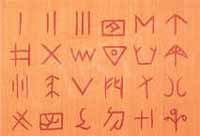
"The final solution to the mysteries of Erlitou culture and Xia culture still depends on more historical witnesses, such as the creation of characters," Xu said. "With further investigation, excavation and research on the Erlitou Ruins, people will better understand the significance of the ruins in exploring the source of Chinese culture, Chinese early civilization and formation of state."
Palace complex: the earliest ever found
Under the No.2 site of Erlitou Ruins, which is the foundation of a large-scale palace complex, archaeologists recently discovered a new site of rammed earth, which indicates an earlier, larger and more complicated structure once existed there. It pushes the age of China earliest palace complex back 100 years.
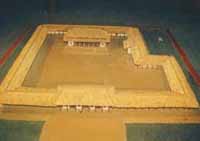
According to Dr. Xu Hong, the site, encoded No.3, should belong to early-period Erlitou culture. To date, it has been confirmed that the structure was about 150 meters long, and its major body comprises at least three courtyards.
Before the discovery, archaeologists believed the No.1 and No.2 sites of Erlitou were the earliest large-scale palaces in China, leading to the conclusion that the early period palace was simple in structure and usually had one gate and one courtyard. The excavation of No.3 site, however, made them change minds.
The Erlitou Ruins, dating back 3,850-3,550 years, were found in 1959. As early as in 1978, archaeologists had noticed large-scale rammed earth under the No.2 palace site and decided to explore its scale, structure and date. In recent years, the Erlitou Archaeological Team has focused their field work on early buildings of Erlitou and its relationship with later buildings. Since autumn 2001, more than 3,000 square meters have been excavated.
The result is the discovery of the more complicated No.3 and No.5 palace sites, which sit side by side, one in the east, the other in the west. Under the passageway between them, there is a 100-meter-long wooden-structured drainage culvert.
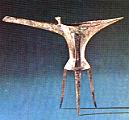
In the middle and south courtyards of No.3 site, archaeologists also found rows of medium-sized tombs, of which five have been cleaned up. All of the tombs are paved with cinnabar and traces of coffins can still be seen. Burial articles unearthed include bronze, jade, lacquer and white pottery ware as well as glazed pottery inlayed with turquoise and artifacts made from seashells. Many items, such as white pottery in shape of wide-rimmed bamboo hat, jade ornament looking like a bird's head, large vessel inlayed with turquoise and ornament composed of nearly 100 gear-like holed clams, had never been seen before.
The discovery of the tombs with so many aristocrats is of great significance to the study of the nature of No.3 site and the burial ceremonies of the Erlitou culture.
Basic structure of Erlitou made clear
In the past half a century, Chinese archaeologists have dedicated themselves to seeking relics of the Xia Dynasty and their work centers on western Henan Province. Historical records show the western part of Henan Province was the central area for activities in the Xia Dynasty. In 1959, historian Xu Xusheng found the large ruins of Erlitou in Yanshi of western Henan Province. Since then, three generations of archaeologists have conducted more than 40 excavations.
Research proves this was the largest living community in China and even in East Asia in the first half of c. 2000 BC. It boasted the earliest palace building group of China, earliest bronze sacrificial vessel group and earliest bronze smelting workshop. It is the earliest capital city which can be confirmed to date.
Dr. Xu Hong, head of the Erlitou Archaeological Team under the Chinese Academy of Social Sciences, stresses the academic significance of the work: it helps better understand the nature of Erlitou Ruins as a capital, the emergence of city, and the early form of state.
The palaces in the Erlitou Ruins had three avenues: the one in the east was nearly 700 meters long, the other two in the north and south were over 300 meters each, with a distance of 400 meters between them. Also, several paths were discovered in the palace area. Between No.1 and No.2 sites, large areas of earth, hundreds square meters of pebble and some rammed-earth foundations were found.
The latest exploration and excavation show the palace ruins were distributed in a northwest-southeast trend along the ancient Yiluo River. The longest distance from east to west was 2,400 meters, and that from north to south, 1,900 meters. The northern part of it had been damaged by the Luohe River, with only a three-square-kilometer area left. The most important part was the highland in the southeast, with palace foundation ruins, bronze smelting workshop ruins and medium-sized tombs. The western part of it was relatively low and used to be common residential areas. On the edge of the eastern part a ditch extending 500 meters intermittently was found. It was believed to be a ditch providing earth for construction or pottery making in the past. Also, it formed the eastern border of the palace.
Background: Journey into the Xia Dynasty
Erlitou is a common village on the northern bank of the Luohe River, Henan Province. Few has known it was the location of the capital of China's first dynasty, Xia between c.1900 BC to c. 1600 BC. It witnessed the prosperity of the Xia and the transmission from the Xia to the Shang. However, the memory about the Chinese nation seemed to dim from people's mind and some even doubted if there had been such a brilliance.
In the 20th century, the discovery of inscriptions on tortoise shells or animal bones and excavation of the Yin Ruins of Anyang proved the existence of the Shang Dynasty. This greatly encouraged Chinese scholars, who hoped to restore the real appearance of the Xia Dynasty by seeking relevant relics.
Since Erlitou was discovered by Xu Xusheng and his archaeological team in 1959, Chinese archaeologists have entered a new stage in the exploration of the Xia culture.
The continuous excavation brought to light ruins of large-scale palace foundations, large-scale bronze smelting workshop, pottery making and bone article workshops as well as buildings related to religious sacrifice, 400 tombs, sets of bronze and jade sacrificial vessels. All these have proven Erlitou was the earliest capital ever founded in China.
Along with new discoveries, the disputes over Xia culture and the division of the Xia and Shang dynasties have heated up again, attracting both domestic and overseas scholars. The periodization of the Xia, Shang and Zhou dynasties greatly promoted the study of Xia culture. The initial building of the Shang city in Yanshi has been confirmed as a boundary mark between the Xia and Shang dynasties, and Erlitou Ruins, a capital of the Xia Dynasty. More and more scholars begin to accept the view that the mainstay of Erlitou culture was Xia culture.
Now the exploration on the source of Chinese civilization and Xia culture is still going on. Dr. Xu Hong, as well as other scholars devoted to this study, is fully confident of the future: "The discovery of the Yin Ruins astounded the world in the 20th century. We believe the Erlitou Ruins will lead the study of Chinese ancient civilization to a new stage in the 21st century."
(China.org.cn translated by Li Jinhui, November 10, 2003)