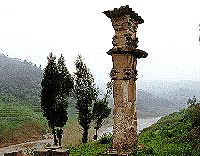
When talking about treasure, people usually think of jewels, diamonds or precious stones. But what has been considered the most important in Three Gorges Museum, which collects and displays cultural relics in the Three Gorges area and will be completed this year, is nothing like this. It is a pair of rare ques of the Han Dynasty (206 BC - AD 220).
According to A Narrative History of The Three Gorges, que refers to symbolic sentinels on both sides of a city gate. In ancient Chinese, que or space has a similar pronunciation and meaning with que or symbolic standing sentinels. They were made of wood or stone.
The que as a symbol emerged in the Zhou Dynasty (c.1100 BC - 221 BC). By the Han Dynasty it referred not just to the sentinel of a city gate or palace, but also stone carvings that were erected in front of temples, courtyards or tombs. The que symbolized one's revered status or origins, and became a typical structure of the Han Dynasty.
Wuyang Que
The Han Dynasty que that guards the Three Gorges Museum is called Wuyang Que. It was discovered in Wuyang Town, Zhongxian County of Chongqing Municipality. Found at a river beach two years ago, in the southern bank of the Yangtze River, it has been verified to have a history of more than 1,800 years. Archaeologists hailed it as a "living fossil" of ancient Chinese architecture.
Wang Chunping, deputy director of Chongqing Municipal Cultural Relics Bureau, introduced that the que of the Han Dynasty is the earliest known ground building ever found in China. It is a predecessor of huabiao, an ornamental column erected in front of a palace or tomb. The most famous huabiao we can see today is the pair carved out of marble in front of the Tiananmen Gate Tower.
China now has only 23 Han Dynasty ques under preservation and all of them are under state protection. Most ques are now in Sichuan Province as it was a place of inconvenient transportation and it experienced less war disturbance according to experts. The best-known Han Dynasty que is now kept in Taishi, Shaoshi and Qimu mountains, all in the Songshan Mountains of central China's Henan Province. The que of the mausoleum at Gaoyi, found in Ya'an, Sichuan Province, is of very high cultural value.
The Han Dynasty ques in the Three Gorges area were found in three different places of Zhongxian County. The other two were Dingfang Que and Wuming Que. The Dingfang Que is the highest among all the Han ques found to date and reaches 6.26 meters.
Most gate ques during the Han Dynasty were wooden-structures, so they either fell victim to the flames of war or rotted and fell over. Some stone ques were wind-eroded. The Wuyang Que, however, was well preserved and buried in sand for a longtime. Experts called the que: "History of Han Dynasty carved in stone."
After the pair of Wuyang Ques was unearthed, they had been kept in the courtyard of Chongqing Museum, waiting to be moved into China's Three Gorges Museum which will be finished soon.
According to Wang Chuanping, the stone que of the Han Dynasty were only built in front of the tombs of those with high status, so he judged the tomb occupant to have been Yan Yan, a renowned general during the Three Kingdoms period (220-280).
The Romance of the Three Kingdoms depicted Yan Yan thus: Liu Bei (founder of the Shu Han Kingdom) entered the Shu State, Yan Yan was captured alive by Zhang Fei, general of the Shu. Rather than kneeling down, Yan denounced the invading enemy: "Your people deserted morality and justice. You'll see a headless general rather than a surrendered general!" Zhang, known for his rash bravery, got angry and wanted to kill Yan. Yan again said loudly: "You're ignorant! Why still not cut off my head but get angry?" Yan's loyalty and sternness not only subdued Zhang Fei but also audiences of later generations.
Yan Yan was a native of Zhongxian County. Near the Wuyang Town there is a village called Jiangjun (General) Village, which was said to be named in commemoration of Yan Yan. These were all recorded in history books of the Ming and Qing dynasties. Wang Chuanping said the marvelous pair of ques reminds people of all sorts of literary figures and stories in Chinese history.
"In the tomb we found a vessel inscribed with ‘Hua Family Clan Stone,'" said Wang, "And to our surprise, we found out that some families had the surname Hua in the General Village. They might be descendants of tenants of Yan Yan and been buried with their master. If things were really like this, it might be an interesting topic for research, i.e., peasants' lasting love for their own land."
However, the ownership of the tomb and identity of Hua clan descendants needs further verifying. Archaeological teams have cleaned up over 20 tombs on the site of the Wuyang Que, but still found no solid evidence to assure Yan Yan's tomb was there.
To be specific, the pair of ques lying in tranquility in Chongqing Museum are just a huge heap of stone parts. Experts working with the museum pointed to the red granite blocks and introduced different parts of them, including the base, body, top of the que as well as the flat stone and coffin level.
The pair of ques are not as beautiful as people imagine. On the contrary, they look simple and unsophisticated. On their bodies are a sculptured gray dragon, a white tiger, a red phoenix and a black turtle, four animals usually used in stone carvings to represent east, west, south and north.
People in the Han Dynasty thought life would go on after death, so they should take with them the que which signified one's revered status. For this reason, the stone que were built in imitation of the wood que in front of the mansion of the deceased. Stones were exquisitely carved into symbolic sentinels. The flying eaves, distinct tiles and corrugated ridges became more and more attractive. Experts said if they piled the blocks up, the ‘mother' que would reach five meters and the ‘child' que up to four meters.
Experts pointed out the ques might have collapsed before the Song Dynasty (960-1279), as the Song people loved traveling and would write down the scenery they had encountered on their way. However, no record has been found about this pair of que from the notes of the Song people about Three Gorges area.
There was a 1,000-year gap between the Song and Han dynasties, so the ques must have stood for hundreds of years before they broke down. But why did they seem so new when they were unearthed? Some stone statues in front of the Ming Tombs look blurred now even though they have also gone through several hundred of years. "You must bear in mind the natural environment in ancient times was much better than it is today. There was neither acid rain nor countless wind or sandstorms. In fact, cultural relics have undergone the most severe erosion since men stepped into industrialized society more than 100 years ago," the experts explained.
Dingfang Que
Dingfang Que is located in the Zhongxian County proper, the highest one among all Han Dynasty ques found in China. It is also a pair of mother-and-child ques, with the mother que standing even higher.
Getting closer to it, people will find obvious traces of wind erosion. The designs are hard to distinguish. With Dingfang Que as a contrast, people will truly understand the preciousness of the Wuyang Que which is preserved so well. They were both set up during the Han Dynasty, but had totally different destinies.
In front of the Dingfang Que is a stele with faded writings to the effect of how the que was born. It said that the que was built outside the Zhongzhen (Loyalty and Staunchness) Temple, or General Ba Temple as called by local people, to commemorate Ba Manzi. Ba Manzi was general of the Ba State during the late Warring States Period. He was once sent to the Chu State on a diplomatic mission, asking for the Chu King to send troops to help the Ba put out rebels. In exchange, the Ba offered three of its cities to the Chu. Later Manzi cut his own head off to express thanks to the Chu King. The que was used for posting orders. In the 1980s, it was listed as a key cultural relic unit subject to state protection.
According to the book A Narrative History of Three Gorges, hundreds of characters carved on the que flaked off during the Ming Dynasty (1368-1644). Only five characters were left, read as "Han Duwei Ding Fang." (Duwei was an official position at that time.)That's the reason the Ding Fang Que got its name.
The book also mentioned that on the right side of the que, there was a relief, which depicted one man riding a deer, while another followed with something in his arms. The relief is said to be the story of Dong Yong attending to his father. Dong Yong is a legendary figure who sold himself to bury his father, which moved Heaven. Then the Seventh Fairy Maiden descended to the world and married him. However, the great age of the picture prevented people from really understanding it. The person riding the deer looked like a boy while the other seemed to be an official wearing his due hat.
Local children used to play in front of the que, but were unaware what it was. They got to know the significance of the que only recently.
Xi'an Ancient Architecture Engineering Company entered Zhongxian last October and undertook the disassembly, transport and reassembly of the que. On February 12, 2003, it was moved successfully to its new home -- Baigong Temple, which was built to commemorate Bai Juyi, a great poet of the Tang Dynasty (618-907), who once took the post of prefectural governor of the area.
However, the General Ba Temple has been toppled, because of its age (a building of the Qing Dynasty) and value doesn't meet the standards of resettling it. The disassembled parts were carried downstream to Yunyang County, where the rebuilding of the Zhang Fei Temple was waiting for them. Some say the old logs keep away white ants.
Because of the loyal Ba Manzi and Yan Yan, the place's name was later changed to Zhongzhou (Loyalty), which was renamed to Zhongxian.
Wuming Que
Another que standing alone in the suburb of Zhongxian is called Wuming Que, meaning nameless. It dates back to the Eastern Han Dynasty (25-220).
The que was found on a mesa about eight km to the east of Zhongxian County. To date, only the right que was found, featuring double eaves and side building characteristics. It was said two naked male bodies were carved on it, rarely seen in ancient Chinese artifacts.
The que is 5.65 meters high and built with nine stones. It is composed of basement, body, waist eave, tower and coping. It is also a cultural relic under state protection. On February 20, 2003, the renovation work on Wuming Que was finished in Baigong Temple amongst people's applause.
Going downstream from Zhongxian County, the Yangtze River still rolls to the east, but people's minds linger on the Three Kingdoms Period.
(Beijing Youth Daily translated by Li Jinhui for China.org.cn, September 12, 2003)