As economic development goes forward from strength to strength, the challenges faced by China in environmental and ecological protection have been attracting increasing attention. 2003 turned out to be a year that witnessed a whole series of controversial developments with much lively debate taking place across the nation.
Sichuan dam proposal under fire
A proposal to build a dam affecting the upper reaches of the ancient Dujiangyan irrigation scheme in southwest China's Sichuan Province sparked much controversy.
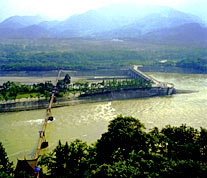
Dujiangyan is located 57 kilometers from Chengdu, the capital of Sichuan. This huge irrigation and drainage system was completed over 2,200 years ago. Since then it has irrigated the vast Chengdu Plain protecting it down the centuries from both drought and flood. In 2000 it was listed on the United Nations Educational, Scientific and Cultural Organization (UNESCO) cultural heritage list.
But now the Dujiangyan Administrative Bureau has brought forward a plan to build a 23-meter-high and 1,200-meter-wide dam on the Minjiang River. The proposed Yangliuhu dam would be only some 1,300 meters from the Yuzui section of Dujiangyan. The waters of the Yangliuhu reservoir would lap to within 350 meters of the world heritage site.
On April 28 the Dujiangyan Administrative Bureau invited experts on water conservancy, environmental protection and the preservation of cultural relics to carry out an on-the-spot survey. On June 5 the bureau once again called the experts together to reappraise the dam project. It had been under fire because of its knock-on effects on the age-old irrigation system.
According to Xiao Ming, deputy director of the Dujiangyan Administrative Bureau, the construction of the Yangliuhu reservoir is a necessary part of the Zipingpu hydropower project. This is one of western China's 10 key development projects.
Senior engineer Wang Bingqing with the Sichuan Provincial Water Conservancy Department echoed this view, "The Yangliuhu dam is important both to allow the Zipingpu hydropower project to become fully operational and to supply water for drinking and irrigation on the Chengdu Plain."
However, Wang pointed out that "the project ran into fierce opposition because Dujiangyan is not only a world heritage site but is also a well-known scenic spot and a historic site under state protection."
On August 29 the Sichuan provincial government finally voted not to go ahead with the Yangliuhu dam project.
Thirteen dams for the Nujiang River
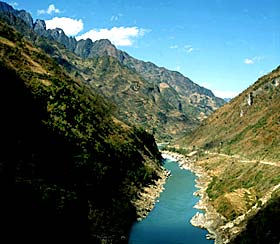
On August 14 the National Development and Reform Commission received the Report on the Hydropower Program in the Mid and Lower Reaches of the Nujiang River. This report by the Nujiang Prefecture of Yunnan Province proposes a terraced water conservancy project.
The plan calls for two reservoirs and 13 dams to be built on the river. With a combined capacity of some 21 million kilowatts they would generate 103 billion kilowatt-hours of electricity annually.
And so the Nujiang, China's only "virgin river" still free from dam construction, finds itself on a development list.
Living conditions are harsh along the Nujiang River basin so hydropower development is attractive to the Nujiang Prefecture as a means of stimulating the local economy. However it would not be the only option nor the best choice available in tackling poverty.
Prof. He Daming, director of the Asian International Rivers Center at Yunnan University has pointed out that dam construction around the world has led to the relocation of 40-80 million people. Meanwhile more than half of all hydropower stations completed have generated less electricity than had been predicted. The reality is that the benefits accruing from dam construction often fail to live up to expectations.
So the question emerges as "do we really need to dam up the Nujiang River with its ecological integrity still intact and put at risk this unique landscape with its ecological environment and biodiversity?"
Fundraising on the backs of sanitation workers
To address a shortfall in funds, a neighborhood public sanitation department in Nanchang, capital city of Jiangxi Province, recently took a novel step. It sold advertising space on the waistcoats worn by its sanitation workers.
However its "walking ads" have attracted criticism and the given reason of shortage of funds has been called into question. People are asking, "If the practice were to become widespread, how would the revenues raised be administered and expended?"
It has been argued that doing a good job in environmental sanitation is a fundamental responsibility of government. Naturally the government has a duty to allocate adequate funds for this very necessary public service.
On the one hand, city sanitation needs to be properly carried out. On the other hand, any shortage of funds has to be prudently addressed. Where will it all end?
No more free bags for Shanghai shoppers
In 2004 Shanghai supermarkets are to start charging customers for their plastic carrier bags. An online survey by the Shanghai Environmental Protection Bureau indicated that 90 percent of Shanghai residents supported the move. Sources at the bureau say the new measure aims to reduce trash dumping and improve the environment of the city.
The Irish government brought in a tax of 15 euro cents on each plastic bag. As a result, the use of plastic bags in that country was cut by 90 percent. And in Germany where plastic bags had been blamed for environmental pollution, supermarkets now charge for them.
Though it is not unreasonable to expect both consumers and supermarkets to accept a share of the costs of tackling the problem, neither can be blamed for all of the pollution problems associated with plastic bags. Despite the success of the European precedents the introduction of charges for Shanghai's plastic bags is still open to question. What's more, compared with the publicity surrounding the charges the other measures being taken deserve rather more attention.
Two days off just to make a point
In a move to raise public awareness on environmental issues, the Zhuzhou municipal government in Hunan Province announced December 4 that all sanitation workers in that city were to get two days leave and all at the same time.
The action caused quite a stir. Some said it was a good way to educate the city's residents on the valuable role of the sanitation workers. Some others though accepting the ruse as well intended, felt that the authorities should have consulted first rather than just going ahead with the move.
In any case, to have all the sanitation workers on vacation at the same time was certainly a matter of some immediate interest to everyone living in the city.
Should we eat wild animals?
At a news conference on May 23, the Shenzhen municipal government announced a joint report by Shenzhen and Hong Kong scientists that pointed to the SARS virus as having originated in wild animals. This indicative finding caused quite a stir. People started to get jittery at the mere mention of wild animals and there was a great outcry that they should be completely banned as a food source.
The question of whether or not to eat wild animals does not just hinge on a single issue and requires consideration.
The law enforcement inspection group of the National People's Congress said that any intervention to forbid the consumption of wild animals should be guided by sound scientific principles. Liu Mingzu, head of the group, stressed that the protection of wildlife resources and developments in domestication and animal husbandry are mutually supportive of each other.
Jiang Hai, a researcher with the Huanan (South China) Endangered Animals Research Institute, said that any wide sweeping generalization about eating creatures from the wild would not be appropriate. "What is wildlife after all?" he said, "Taken literally, if all animals which have not been domesticated are considered wild, then is sea food to be considered wild?"
An environmentalist said, "Isn't the eating of wild animals just something of a novelty to satisfy a whim for the unusual or fashionable delicacy? If everyone could just do without, I should like to say 'Thank You' on behalf of the wild animals and all those who love nature."
Yuan Xi, also a researcher with the Huanan Endangered Animals Research Institute and his colleagues pointed out that the means of transmission of viruses from wild animals and domesticated fowl to human hosts isn't necessarily through the food chain.
Dr. Xie Yan, a researcher with the Institute of Zoology of the Chinese Academy of Sciences said that the SARS virus was transmitted from wild animals to humans. This is not the fault of the wild animals but results from invasive actions by humans. To satisfy their avarice humans have with a lack of constraint invaded the habitats of the wild animals to kill, process and eat them. Such behavior has rebounded like never before. Humankind should not now seek to blame and send punitive expeditions against the creatures of the wild. Instead we should sincerely examine our own mistakes and correct them.
The troubled Sanmenxia Dam
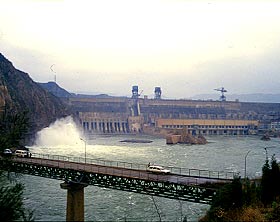
In the history of Chinese water conservancy there has never been a project like the Sanmenxia Water Control Project. It has experienced twists of fate at every turn with lessons to be learned from planning and policy-making through to construction, operation and management. Its repeated difficulties and hardships have frequently drawn nationwide attention.
2003 witnessed a particularly severe flood on the Weihe River. It was to last over a month and leave 200,000 people homeless. It seemed to confirm a prediction made more than 40 years ago by Prof. Huang Wanli. An expert in the field of water conservancy, he warned then that "building the Sanmenxia Dam will lead to severe flooding." The Sanmenxia Water Conservancy Project has now becomes a focus of debate. The difference is that today many people are speaking out against the project. Back 40 years ago, only Prof. Huang Wanli and technician Wen Shanzhang voiced their opposition.
Suo Lisheng, vice minister of water resources, said that the fact that the Weihe River has now become a hanging river, raised above the level of the surrounding countryside, was due to the Sanmenxia Water Conservancy Project.
Qian Zhengying, retired minister of water resources, called for a halt to the generation of electricity and water storage in the Sanmenxia Reservoir.
As for the losses caused by the Sanmenxia Dam, there is little to be gained by seeking to point the finger of blame. Even if the dam does come to be abandoned, reflection must not be allowed to stop. Who to blame is not so important now, but the lessons that can be learned are.
In fear of the flesh-eating piranha
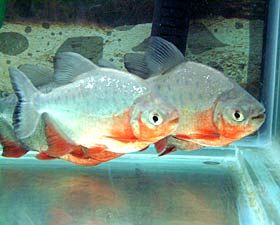
There are more than 20 varieties of piranha that most famous flesh-eating fish from the mighty Amazon River in South America. The red piranha (Serrasalmus nattereri) is most representative of the species and is the big seller to Chinese fish enthusiasts. It may be a beautiful color but nature has made it cruel predator. Its aggressive nature powerfully backed up by its terrible teeth will soon reduce its unfortunate quarry to a pile of bare bones.
Rather that being concerned that people may be injured, ecologists are more worried about the prospect of these bloodthirsty fish escaping into the wild where they would pose a severe threat to the local ecological balance like some terrible new "wolves in the water."
As for the bloodthirsty nature of the fish, relevant departments have called for all these fish to be located and killed. However this draconian, one-size-fits-all approach has been called into question.
While the experts at the Beijing Aquarium would support measures to prevent the spread of the fish, in their analysis there is no need to wipe the piranha out entirely. It is their view that, "The flesh-eating fish are brought into the country with the aim of popularizing science and helping young people understand the nature of this cruel species. In any event most of the imported fish have gone through a sterilization process and are unable to reproduce."
To clone or not to clone the giant panda
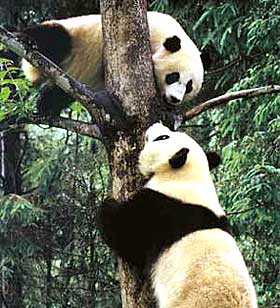
Today there are only about 1,000 giant pandas left in the world. They are mainly distributed in the mountains in south China's Sichuan Province. For decades now, Chinese scientists have spared no effort in their mission to preserve this much-loved and endangered creature. But the future of the giant panda still hangs in the balance.
A research study on the "Cloning of Giant Pandas" has been carried out conjointly by the Fuzhou Giant Panda Research Center and the Institute of Zoology of the Chinese Academy of Sciences. The work now concluded on the animal's reproductive hormone gene has the potential to help the giant pandas famously fragile ability to reproduce. However, the possible use of cloning to help protect the giant panda is a matter of some controversy.
Chen Dayuan, an expert in zoology, said that cloning technology can help increase giant panda numbers. What is the point in discussing the merits of biodiversity and debating what is and what is not natural without first ensuring the very survival of the species?
However some authoritative experts do not agree with the cloning of giant pandas. They point to cloning as merely the copying of individuals with nothing to contribute to the genetic biodiversity of the species. They can well understand the wish to conduct cloning as a scientific experiment but say it represents just one particular point of view. However the government's wildlife management department won't approve of the cloning of giant pandas. And what's more it won't make a living giant panda available to be used in cloning research.
Welfare rights for animals
Many people today still think that animals have no consciousness and are incapable of thoughts and emotions. They are fair game to be exploited by humankind. They consider that humans have a right of dominion over the animal kingdom and are free to maltreat, kill and eat other creatures.
In recent years, there have been frequent incidents of animals being maltreated. Pet dogs have had their vocal chords cut, tigers have died exhausted in cruel tiger-dog fighting spectacles while bears are kept in captivity to have their bile drawn off. Such cases have drawn nationwide attention.
Animal welfare means letting animals live a healthy and happy life. The basic principles include freedom from hunger and thirst, freedom to live comfortably, freedom not to be maltreated and hurt, freedom from being filled with horror, anxiety or sadness and freedom to express their natural instincts.
On the other side of the world, legal rights for animals were established as early as 200 years ago. However, few people on this side are sensitive to animals' emotions or give a thought to animals' needs, dignity or legal rights. In China particularly, animal welfare law is still quite new.
People might say, "If animals gain welfare rights, does this mean they will be on an equal footing with humans?" Actually welfare in this context means respecting their rights and allowing them some dignity. Humans have basic rights to life, health, education and respect for their dignity and so enjoy welfare rights guaranteed under legislation.
The promotion of animal welfare aims to encourage people to care for, protect and treat animals well. It hopes for improvements in animal's living conditions coupled with concern for their emotions and dignity.
It is a matter of humanity and good intentions towards the other creatures with which we share this world of ours.
(China.org.cn by Li Jingrong and Shao Da, January 2, 2004)