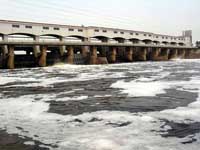
The Huaihe is China's third largest river, affecting the lives of one-sixth of the nation’s population. It flows from west to east, south of the Yellow River and north of the Yangtze. It is also the river that received the earliest, and now the largest, investment in pollution control.
Despite all the money that has been poured into the Huaihe over the past decade, pollution has returned with a vengeance. The key water pollution indices have reached or surpassed previous records and 60 percent of the water in the river valley is below Grade 5 – useless for industry or agriculture, and certainly not potable. This poses a direct threat to some 130 million people.
Did the central and local governments and enterprises simply pour 60 billion yuan (US$7.2 billion) down the drain?
Things could be worse
In the early 1990s, water quality in the Huaihe River was deteriorating by the day, adversely affecting industry and individuals along the river. The State Council held a special meeting in June 1994 concerning pollution control on the river, which led to the issuance of the Provisional Regulation on Water Pollution Prevention and Control of the Huaihe River Valley. It is the only regulation in China drawn up for an individual river.
With the issuance of the regulation, the central government, local governments at all levels in Jiangsu, Shandong, Anhui and Henan provinces, and enterprises began to invest in pollution control on the Huaihe. The Ninth Five-Year Plan (1996–2000) included 200 pollution control projects on the river, involving a total investment of 12 billion yuan (US$1.4 billion). Some 1,000 enterprises, such as the Lotus MSG Group and the Fengyuan Group, put billions more into building sewage disposal facilities, and a hundred cities built sewage and garbage disposal plants. Many paper mills and leather tanneries had no hope of adequately reducing pollution and were shut down, causing a loss of industrial output valued at 20 billion yuan (US$2.4 billion). All told, public and private sectors in the four provinces and the central government spent more than 60 billion yuan (US$7.2 billion).
Says one unidentified expert, "Simply stating that the 10-year effort was of no avail is not realistic. Without those efforts, the Huaihe would definitely be totally different than it is today."
The massive investment did result in the establishment of a relatively complete system of environmental protection departments and an effective monitoring network. Administrative and law enforcement contingents were formed, coordinated with a personnel supervision mechanism.
And despite the rapid economic development and the heavy population pressure, Huaihe River pollution was reduced initially. GDP in the region along the river doubled in the past decade while the total chemical oxygen demand (COD), the key pollution index, discharged into the river decreased from 1.5 million tons in 1993 to 1.2 million tons in 2003.
Chen Baisheng, head of the Water Resources Bureau of Fuyang City, Anhui Province, says that the biggest achievement in the past 10 years is the increase in environmental awareness. "From the thoughtless launching of small-production but big-pollution paper mills and tanneries in the past to the close of those enterprises at present, both the government and the people have become aware of the importance of protecting the Huaihe River."
Back to square one – and worse
The administrative offices and monitoring system are in place, and public awareness enhanced, yet recent data indicate that pollutants in the Huaihe have returned to the levels of 10 years ago, and in some cases are even worse. From January to May, 13 cross-sections of the main trunk of the river all showed pollutant levels above the acceptable standard. COD was approaching the record level, while ammonium and nitrogen content exceeded by 30 percent the previous record for the January-May period. In Xuchi County, Jiangsu Province – located on the lower reaches of the river – water quality remained below Grade 5 for 100 consecutive days, a phenomenon that had not occurred in several years.
From the origin of the Huaihe River in Tongbai County, Henan Province, to Hongze Lake and its estuary in Jiangsu Province, people on both sides of the river worry constantly about drinking water. Hostels in Tongbai County and boatmen on Hongze Lake all drink only mineral or purified water. A senior Bengbu City citizen says that even boiled tap water there cannot be drunk without adding salt or sugar to kill its foul taste.
According to the data collected from all the local environmental protection bureaus along the river and the Huaihe River Water Resources Committee, 60 percent of the water is at Grade 5 or below. Water of this grade cannot be used in industry or agriculture, much less be drunk. It has forfeited its function as water.
The water quality in tributaries of the river such as the Shaying, Wohe and Honghe rivers is even worse. There is a water crisis on the Huaihe River, and it involves roughly 130 million people.
Who is the culprit?
Strict legal and administrative provisions protect the Huaihe River. Governments and environmental protection bureaus guard it. So who is still polluting the Huaihe?
Pollution patterns on the Huaihe have changed greatly, a fact that seems to have drawn little attention. Domestic sewage has become the biggest source of pollution, replacing the industrial waste of the past, and it is growing worse.
In 1999, domestic sewage discharge in the Huaihe River valley exceeded the industrial waste discharge for the first time, and the gap has widened every year since. At present, 60 percent of the pollution in the river comes from domestic sewage, and the figure in some regions is as high as 87 percent.
Throughout history, most of the land along the Huaihe has been agricultural. At the end of the 1990s, the riverside urbanization rate in Jiangsu, Shandong, Henan and Anhui provinces was just under 30 percent. However, towns and small and middle-sized cities have grown quickly in recent years. The permanent population in most prefectural-level cities in the region is over 300,000; in county and county-level cities it averages 100,000; and numerous smaller towns with 10,000 permanent residents have emerged. Plans call for the urbanization rate in the region to reach 40 percent with a net population increase of 20 million by 2010.
That means a significant increase in domestic sewage.
In sharp contrast to the growth in urbanization, domestic sewage disposal facilities are near an all-time low. The State Environmental Protection Administration reports that construction has not begun on 93.3 percent of the domestic sewage disposal plants included in the Tenth Five-Year Plan for the four provinces. Because of budget deficits, most of the existing plants are not operating.
Zhengzhou City, the capital of Henan Province, discharges into the lower reaches of the river 2.4 million tons of sewage each day, of which only 370,000 tons have been treated. The average amount of treated domestic sewage in Fuyang, Bengbu, Xinyang and Huainan, all situated along the main trunk of the Huaihe, is less than 10 percent of the sewage output.
Another important reason for the rebound of Huaihe pollution is the obvious economic development, which has caused industrial pollution and sewage discharge to increase considerably. Industrial output along the river has been increasing an average of 20 percent annually in the past few years, and a relatively strong market has led to even more rapid growth in the papermaking and food processing industries. Both are heavy contributors to pollution.
For example, the output value of the Fengyuan Biochemistry Group in Bengbu is expected to increase to 7 billion yuan (US$845 million) this year from 4 billion yuan (US$483 million) last year. Price hikes for chemical fertilizer and paper have widened the group's profit margins considerably, spurring it to expand production.
It appears that the lure of high GDP growth figures has led to local protectionism in some areas – or at least an inclination on the part of authorities to look the other way when pollutants are illegally discharged or condemned factories reopen.
There is an old folk rhyme that says, "No matter wherever you have been, no place is as good as the banks of the Huaihe." But even after ten years and 60 billion yuan, that rhyme is no more realistic than an ancient fairy tale. Wang Yushi, head of the Zhoukou Monitoring Station, says, "Ten years later, the Huaihe River is still crying. And unless we take action, the people today and the coming generations on both sides of river will keep crying, too."
(China.org.cn translated by Zhang Tingting, June 11, 2004)