Vice Minister of Culture Zhou Heping recently received notification from a professor in northeast China that South Korea planned to apply to the United Nations Educational, Scientific and Cultural Organization (UNESCO) to list its version of the Dragon Boat Festival as an intangible cultural property. Chinese folklorists and ordinary citizens alike were concerned.
“How embarrassed we will feel if a foreign country lists the festival as its own cultural property. The Dragon Boat Festival has been celebrated in China for more than 2,500 years,” said Zhou.
Wu Bing’an, the professor who sent the notification to Zhou, is deputy director of the China Ethnic Cultural Heritage Salvage Project Expert Committee and vice secretary-general of the China Folklore Society. He said he wrote the letter after he confirmed the news with South Korean folklorists.
The city of Yueyang, in central China's Hunan Province reacted vehemently to the news. On May 9, the city convened a special symposium to discuss the issue. Those in attendance included officials from the publicity, culture and cultural relics departments. Vice Mayor Sui Guoqing said, “It is our duty to safeguard the traditional Chinese festival. Now we have added the review and application to our agenda.”
Shen Ji’an, director of the Yueyang Culture Bureau, said, “The Dragon Boat Festival is closely connected with the ancient city of Yueyang, where the patriotic poet Qu Yuan leapt into the Miluo River.”
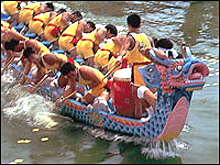
Qu Yuan (340 - 278BC) was a minister of the State of Chu during the Warring States Period, and is sometimes known as the father of Chinese poetry. He committed suicide when Chu fell to invading forces. To commemorate him, residents in the Yueyang area have for many centuries followed such customs as posting poems on the door, making figurines of Chinese mugwort, displaying a thin sword made from wormwood, drinking realgar liquor, eating zongzi (pyramid-shaped glutinous rice dumplings wrapped in reed or bamboo leaves), making stuffed steamed bread and wearing incense bags. The most important part of the tradition, however, is the dragon boat race.
For all the pride the Chinese take in such traditions, however, they do not necessarily hold any proprietary rights over them.
“Unlike natural heritage sites, which are fixed and unique, the 'masterpieces of the oral and intangible heritage of humanity' can be shared,” said Wu. “If UNESCO approves something as an intangible cultural property of one country, other countries may still apply. For example, mukamu is a typical music of the Xinjiang Uygur Autonomous Region in northwest China, but still UNESCO has approved Iraq mukamu and Azerbaijan mukamu as those nations' intangible cultural properties.”
Professor Gao Bingzhong, of Peking University's Sociology Department and secretary-general of the China Folklore Society, agreed. “Some Chinese think South Korea is snatching our cultural heritage. This is not true. 'Masterpieces of the oral and intangible heritage of humanity' refer to the culture of humankind and examine it from a global perspective. In this sense, culture is shared by the world.”
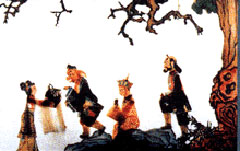
In fact, Kirghizstan is applying to list the Manasi, one of the three epics of the traditional nomadic culture of Xinjiang, as its intangible property. The country also applied last year to list Aken balladry, a type of singing to the accompaniment of a plucked instrument that is also well known in Xinjiang. The matouqin, a bowed stringed musical instrument with a scroll carved like a horse's head, has already been listed as an intangible cultural property of Mongolia, but it is part of the Inner Mongolian culture, too. Shadow puppet plays, known throughout China, have been approved as a cultural property of Indonesia.
A staff member of the Korean Embassy in China points out that his country is not applying to list the Dragon Boat Festival in a broad sense, but a specific sacrificial ceremony connected with the festival that is held in the city of Gangneung.
According to the Korean Kangwon Daily, soon after the royal sacrificial rites to ancestors and religious chamber music were named intangible cultural properties by UNESCO in 2001, South Korea's Ministry of Culture and Tourism published the list of items planned to apply to list in the next decade. The Gangneung dragon boat festival sacrifice was one of them.
This year, the Gangneung International Tourism and Folklore Festival will be held from June 11 through 27. During this period, some preparations will be made for the application. The sacrifice is conducted on the 5th day of the 5th lunar month, the same as in China.
Some Koreans working in China believe that the Chinese who are upset may be overreacting. A teacher surnamed Kim pointed out that the festival has been celebrated in Korea for more than 1,000 years, since it was introduced from China. It has been integrated with Korean culture over the centuries, so that celebrations now bear little resemblance to China’s.
“My original intention was to call for sufficient attention to be paid to Chinese folk culture and protection of intangible culture.” Wu said. “China has abundant intangible cultural properties, but for a variety of reasons they are often ignored.” Wu was in Beijing in early April to lobby for improved protection of folk culture. However, of the 29 intangible cultural assets recommended by experts for enhanced protection, none were traditional festivals or folk customs.
China’s long history has made the country heir to countless intangible cultural assets, but modern times have sent folk arts into a decline. As the master craftsmen grow old and die, many of their precious traditional arts die with them. Pop songs are replacing local operas and cartoons are killing off shadow puppet plays. Most people see a centuries old residential compound as shabby housing, while a section of an ancient city wall is merely an obstacle to traffic.
The importance of traditional holidays such as the Dragon Boat Festival and Mid-Autumn Festival are waning, too. In contrast, imports such as Christmas and Valentine's Day are gaining widespread attention. To those who are blindly enchanted by all that is new, ancient sacrificial ceremonies, paper-cutting art, shadow puppets and traditional festivals are hopelessly old-fashioned.
In a sense, these intangible properties are more important to a nation than tangible ones. The Great Wall and the Forbidden City are physical symbols of China's culture. But what makes that culture unique and what keeps it alive are its people.
The issue of the Dragon Boat Festival will have a positive impact on the salvation and preservation of China's intangible cultural heritage, according to Zhao Shu, chairman of the Beijing Folklorist Society. “The urgent task now is to systematically and scientifically sort out the traditional festivals of China as soon as possible and then apply.”
In recent years, China has been active in applying to UNESCO for listing of its tangible cultural heritage sites. But there is still some confusion about application procedures and requirements for intangible cultural properties. “We should take this chance to clarify the procedures and give a detailed introduction to the public,” Zhao said. “We do not expect to see Spring Festival applied for by another country.”
“China's traditional festivals have a long history and most of them have spread in some form throughout East Asia. This demonstrates that East Asian culture is important to the world. At the same time, the application by South Korea reminds the Chinese people that we must cherish our past,” Zhao continued.
Gao Bingzhong, secretary-general of China Folklore Society, concurs. “The aim of being included as a 'masterpiece of the oral and intangible heritage of humanity' is to promote the protection of culture heritage,” he said. “Individuals like us should endeavor to set up a perfect protection mechanism so that our cultural heritage can adapt to modern development rather than being sapped by it.”
Vice Minister of Culture Zhou Heping said that China is now speeding up efforts to “package” its traditional festivals. It intends to apply to UNESCO to have the entire group named a “masterpiece of the oral and intangible heritage of humanity.” However, experts point out that the package deal will not give prominence to any special festival or art form and will complicate the job substantially.
The Dragon Boat Festival is expected to be part of the package.
(For more information on South Korea’s traditional festivals, visit http://www.korea.net/publication/pdf/general/hello_en.pdf )
(China.org.cn by Li Jinhui May 20, 2004)