| Tools: Save | Print | E-mail | Most Read |
| Full Measure of Evil Yet To Be Revealed |
| Adjust font size: |
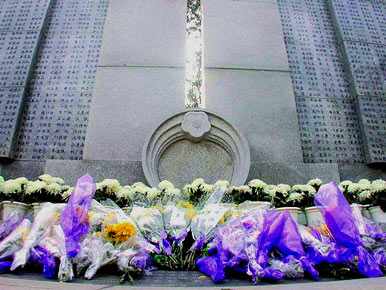
From July 1 to August 19, 12 graduate students from Nanjing Normal University (NNU) carried out a door-to-door survey in over 270 villages in the suburban Jiangning District of Nanjing, Jiangsu Province, according to a southcn.com report on September 23. After interviewing 1,038 survivors and eyewitnesses of the Nanjing Massacre, they confirmed that the death toll in Jiangning alone stood at 7,361, with 1,343 identifiable by name and 6,018 remaining anonymous. Their actions can be described as "salvage job" as those surviving the massacre are now dying off themselves, commented historian Sun Zhaiwei of Jiangsu Provincial Academy of Social Sciences. During World War II, invading Japanese troops occupied Nanjing, then capital of China, on December 13, 1937. International figures show that the non-combatant death toll of the massacre in the ensuing six weeks stood at 300,000. In memory of the victims, the Nanjing municipal government built a Nanjing Massacre Memorial in 1985. Inside the memorial hall there is a stone wall nicknamed "Cry Wall" on which only 3,000 names of the slaughtered were engraved.
The number of 300,000 was first promulgated in January 1938 by Harold Timperly, a Manchester Guardian correspondent in China during the Japanese invasion, who wrote in a telegram "(not) less than three hundred thousand Chinese civilians slaughtered, many cases (in) cold blood." The post-war International Military Tribunal for the Far East estimated that "over 200,000" civilians and prisoners of war were murdered during the first six weeks of the occupation of Nanjing. In 1947, at the Nanjing War Crimes Tribunal, the verdict of Lieutenant General Tani Hisao -- the commander of the 6th Division -- quoted a figure of more than 300,000 dead, an estimate made from burial records and eyewitness accounts. However, in an effort to deny the atrocities committed by the Japanese army, Japan's right-wingers have never stopped arguing that the estimated death toll was a vast exaggeration. Sun Zhaiwei attributed obtaining the 3,000 names engraved on the "Cry Wall" to a 1946 investigation by the KMT's National Government, China's then central government. "Japanese troops occupied Nanjing for eight years, which made immediate post-war investigation already very difficult," said Zhang Lianhong, head of NNU's Nanjing Massacre Research Center. After WWII ended, Japanese and Europeans could verify the number of war dead, obtaining names and even addresses. In Japan's Hiroshima Peace Memorial Park completed in 1954, a stone chest contains 237,062 names, all A-bomb victims. In January 2005, over 102,000 names of Jewish victims were read in relays by nearly 700 people gathering in Amsterdam to mark the 60th anniversary of the liberation of Oswiecim, home to the infamous Auschwitz concentration camp. "The situation in China was very different," Sun Zhaiwei said. "The eight-year Anti-Japanese War (1937-45) was followed in succession by the civil war (1946-49), the Korean War (1950-53), and a spate of mass movements in the 50s, 60s and 70s, during which the history of the Republic of China (1912-49) became a 'forbidden zone' where no historians were allowed to study. Accordingly, the Nanjing Massacre fell into oblivion." "During my childhood my grandfather often mentioned to me the atrocities committed by Japanese army after they captured Nanjing," recalled 43-year-old Wu Xianbin, curator of a Nanjing-based exhibition hall of historical materials on the Anti-Japanese War. "However, I never read a single word of it from books available then, so I was not quite convinced of the cold-blooded killing. Purely by chance, in 1984 I watched a video tape imported from the US and thus learned the truth of the massacre." That same year, the study of the long forgotten Nanjing Massacre formally began in the mainland. From 1984 to 1987 the Nanjing municipal government "published A Narrative History of Nanjing Massacre, built a memorial hall and erected 15 monuments," Sun Zhaiwei said. "And adding new names to the total register is part of the ongoing memorial expansion project." "If we did this job 20 years ago, things would have been much better. But on the other hand, if we took it 10 years later, probably no eyewitnesses were still living," Sun said. "We've already missed many chances. Now what we can do is that, number one, to rearrange the extant archives; number two, like those NNU students, to interview survivors alive and learn what happened to their relatives, neighbors and friends during the massacre."
Door-to-door survey "Grandpa/grandma, tell us what happened in those years." In such opening remarks the students engaged in the field survey tried to evoke the old people's past memories. Starting from December 4, 1937, Japan's 9th, 11th, 13th and 16th divisions advanced by both land and water and Jiangning, the biggest of Nanjing's 13 suburban counties, lay on the route that was taken by the invaders coming from the east, south and west. Seventy-six-year-old Wang Guohua, a widower, witnessed the death of his family. "Hiding in a cave, we were found by the Japs," he recalled. "They shot dead my mother instantly. With serious bullet wounds, both my father and my four-year-old brother died later." According to Wang, "along with my mother, three other people -- Geng Jinxi, Liu Desheng, Sun Fuhe -- were also killed in the cave, all in their twenties. My cousin, forced to take off his dress first, was stabbed dead. In a pond in front of Dayangen Village, six Japs killed a total of 23 people, including Jin Zhaokun, 30; father of Sun Mingfu, around 30; Ding Liangfa, over 50; Heng Jingshan, 60, and his son petnamed Sandaizi, about 20; a person nicknamed Shilingyan, over 30; a person petnamed Xiaokun, some 20; and an anonymous beggar. As for other victims, I cannot remember their names." The forgetting of names was of primary concern to the students. When making investigations in Moling Town, Zhang Zengxiang was told that some dozen people were killed in Duqiao during the massacre. Zhang spent three days locating Duqiao, present-day Dongnan actually. However, in the interview with Ren Jiafa, the eyewitness could only describe the tragedy while forgetting all the victims' names. "A baby's crying exposed those people hiding in a tunnel to the searching Japs," Ren recalled. "They were ordered to come out one by one to be bayoneted. In that way, a total of 17 or 18 were killed, including a little girl under 10 years old." Fortunately, another eyewitness Zhang Qinyi clearly remembered that the slaughter "occurred on the morning of December 9. The dead included a woman named Ren Baomei who was in her twenties then." During the interviews, the students were deeply impressed and moved by the victims' varying reactions when facing the slaughters. Showing the full scale of human emotion, accounts range from Pang Shengtao of Baihe Village who killed an enemy with a broadsword after being stabbed in the stomach to Wanghou Village where two Japanese soldiers slaughtered dozens of villagers in a temple with a knife, meeting no resistance. More strikingly, some fleeing parents suffocated their little kids in order to prevent them from crying. In another case, adult villagers threw some dozen children into a river to be drowned. A monument was erected last August in Hushan Village of Tangshan Town, where a bitter battle between KMT troops and the invading Japanese army broke out. Pointing to the 64 names engraved on the tablet, 83-year-old Su Guobao told reporters on September 10: "Su Guojiu, my three-year-old brother, bit a Jap in the hand. He was then thrown into a river. The furious Japanese also beheaded Wang Lirong who tried to save my brother, and stabbed dead Dai Changyi, Chen Kairong, Dai Xingchuan, Dai Dayin, Dai Xingzheng and Dai Dajun. I was lying under the corpse of Dai Changyi, and thus narrowly escaped the mass slaughter." This April, neighboring Xigangtou Village built a monument too, with 37 names engraved on it. On August 16 Tamaki Matsuoka, a primary school teacher in Osaka, led 19 Japanese students to lay wreaths before the two monuments. "We're going to bring the true history back to Japan," Matsuoka said. "By the end of this year I'll fly to Japan to tell them what happened here 69 years ago," Su Guobao said. In the past three years, one-third of eyewitnesses of the massacre in Hushan Village have passed away. Almost in every village the students engaged in the survey were told that "if you came five, three or even one year earlier the situation would have been much different." For instance, in Lulang Village all the old people mentioned a man named Tao Laoxiao, claiming that he knew a lot about the past. Regrettably, Tao died two years ago.
(China.org.cn by Shao Da, October 4, 2006) |


| Tools: Save | Print | E-mail | Most Read |
 |
| Related Stories |
| Product Directory China Search |
Country Search Hot Buys |
