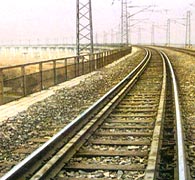
 When railway construction workers first came to the Qinghai-Tibet Plateau, they were amazed at the majesty of its snowfield scenery. Cut off from the outside world, everything on the plateau -- its snow-capped mountains, grassland, lamas, prayer banners, the Potala Palace, and the Tibetan people living 4,000 meters or more above sea level, has an aura of mystery.
Beautiful it may be, but Tibet lags behind other areas of China. Inadequate transportation facilities restrict its economic development, as it is only accessible by highway or air transportation. This is, to a certain extent, attributable to the harsh climate and geographical environment on the plateau, but it is obvious that if Tibet is to develop and catch up with other areas of China, it must have a railway.
With this in mind, the Ministry of Railways invited experts from the Chinese Academy of Sciences, the State Seismological Bureau, the Ministry of Communications, and the Chinese Academy of Geology, to discuss the feasibility of constructing the Qinghai-Tibet Railway.
In 2000, a report on constructing the Qinghai-Tibet Railway was passed to President Jiang Zemin by the Minister of Railways, Fu Zhenhuan.
President Jiang Zemin responded with three full pages of written instructions. He pointed out that construction of the Qinghai-Tibet Railway would benefit the development of Tibet's communications and tourism, and promote economic and cultural exchanges between Tibet and the interior. He said that this decision must be taken and expedited as China enters the new century.
On June 29, 2001, construction of the Qinghai-Tibet Railway started at Golmud, Qinghai Province. The railway will traverse the Hoh Xil "no-man's land," cross the Kunlun Mountain Pass (4,767 meters above sea level), to enter the Northern Tibet Plateau, and then go on to Lhasa, capital of Tibet Autonomous Region. Out of the 1,142 kilometers of railway, 960 kilometers are more than 4,000 meters above sea level and 550 kilometers are in areas of frozen earth. Thirty railway stations are to be built, among them Tangula Mountain station, which will be the highest-altitude railway station in the world. When the railway is complete, it will be possible to travel from Lhasa to Beijing in just 48 hours.
Construction of the Qinghai-Tibet Railway will take six years, at a total investment of 26.2 billion yuan (US$3.17 billion). There are unparalleled difficulties to address regarding terrain and environmental protection in this project. Its construction has consequently attracted worldwide attention, and been compared in magnitude to that of the Great Wall.
Building the highest-altitude ever railway to traverse the frozen earth zone is a first in the history of railway construction. It is testimony to the development of science and technology in China, and constitutes a scientific record of Chinese exploration on the Qinghai-Tibet Plateau.
Overcoming the Hidden Perils of Frozen Earth
Scientists originally planned four possible railways to Tibet: the Qinghai-Tibet Railway, the Sichuan-Tibet Railway, the Yunnan-Tibet Railway, and the Xinjiang-Tibet Railway. They settled on the Qinghai-Tibet Railway because, apart from the frozen earth aspect, it is much the best choice of the four as regards avoiding avalanches, desert, and marshland. It is nevertheless a project hitherto unequaled in engineering cost, project duration, and transportation capacity.
Building a railway over areas of frozen earth is a feat seldom attempted. A century ago, Russia built a railway on the frozen earth zone in Siberia, near the North Pole. Later, Canada, the United States and China's Northeast built railways of a total length of 20,000 kilometers over similarly frozen territory. These railways are, however, in high-latitude zones, where the frozen earth is stable. The Qinghai-Tibet Railway traverses a low-latitude zone, where the frozen earth is unstable owing to strong sunshine and a relatively high earth temperature. The railway presents, therefore, an engineering and ecological challenge of proportions no other country has ever had to face.
Zhang Luxin, aged 55, is leader of a group of experts from the Qinghai-Tibet Railway Construction General Headquarters, and doctorate supervisor at the Cold and Arid Area Environment and Engineering Research Institute of the Chinese Academy of Sciences (CAS). He began working at the CAS Institute of Glaciology and Cryopedology, famous for its research on the frozen earth along the Qinghai-Tibet Railway, in his early 20s. As from 1974, Zhang Luxin spent four years trekking the 560-kilometer-long frozen earth zone on the Qinghai-Tibet Plateau, gathering first-hand data.
According to Zhang Luxin, frozen earth penetrates three to five meters below the earth's surface, where it is even harder than the surface earth. Beneath the frozen earth is permafrost, and on top of it is a seasonally thawing layer. These three layers form a kind of sandwich, with frozen earth as the filling. The frozen earth closest to the seasonally thawing layer is largely ice. In certain areas it is exclusively ice, and therefore sensitive to temperature changes in the seasonally thawing layer. It is thus clear that the seasonally thawing layer is of vital importance to preservation of the frozen earth on which the Qinghai-Tibet Railway is to be built.
"The seasonally thawing layer is like a quilt over the frozen earth," said Zhang Luxin. "It stops hot air from the earth's surface filtering down to the frozen earth layer, preventing it from thawing and subsiding. The core of the problem is maintaining frozen earth heat stability. Protecting the seasonally thawing layer is, in a sense, a means of conserving the frozen earth."
Reducing the amount of heat descending from the earth's surface, thereby increasing reserves of frozen earth, is the ultimate aim of Zhang Luxin and his fellow scientists. In order to adapt to various frozen earth characteristics, different forms of roadbed have been adopted, such as the slab-stone ventilation roadbed, pipe ventilation roadbed, a sun-shaded roadbed, and a bridge-style road. The method most widely applied on the Qinghai-Tibet Railway is the slab-stone ventilation roadbed, Zhang Luxin's own invention.
One summer during the 1990s, Zhang Luxin and five doctorate students went out on the Qinghai-Tibet Plateau to collect slab-stones. They transported the stones to a 15-meter-long experimental roadbed, and piled them up to form a one-meter-deep slab-stone layer. On top of this they laid earth, sleepers, and rails, and thermometers were inserted in the crevices between the slab-stones, to test their effect and influence on the frozen earth.
Why use slab-stones rather than gravel? According to Zhang Luxin, slab-stones are better than gravel at diffusing heat, and a one-meter-thick slab-stone layer keeps the rail a safe distance from the frozen earth. In warm seasons, the heat that descends and passes through crevices between the slab-stones dissipates more readily. In cold seasons, the crevices accelerate the flow of cold air down, thus preserving the frozen earth. This invention constitutes a major contribution by a Chinese scientist to cryopedological research.
Building a roadbed is most difficult across unstable frozen earth zone -- a problem that has long perplexed scientists. Conditions in this zone inspired Zhang Luxin to invent his bridge-style railroad. This is a concept arising from the perspective of global warming in the coming decades that will make the frozen earth zone even more unstable. Zhang Luxin said, "Trains can travel over this 'bridge' as the pile foundation rests directly on permafrost, making it much easier to build a reliable roadbed." Beams used for the bridge, made by the No. 12 China Railway Engineering Bureau's Beam Factory, cost 200 million yuan (US$24.19 billion). "It is incredible," said Zhang Luxin, "that just a few decades ago, it would have been impossible for a country lacking economic strength to undertake such a mammoth project."
In order to accomplish the experimental task of constructing the Qinghai-Tibet Railway more effectively, in 1997 the No. 1 Prospecting and Designing Institute under the Ministry of Railways, the Northwest China Academy of Sciences, the Beifang Communications University, the Shijiazhuang Railway Institute, and the Lanzhou Railway Institute chose Qingshuihe, which has frozen earth with a high ice content, as the experimental site for the roadbed, bridge and culvert. Experts experimented with different forms of roadbed along this 400-meter-long experimental site, and tested temperature changes on the various layers beneath the roadbeds.
The materials used in construction also aroused public interest. The PVC pipe used for pipe ventilation is a new application, and as PVC is a familiar, widely used material, its use avoids the cost of formulating new materials.
Protecting Plateau Wildlife
Unique flora and endangered fauna, such as the Tibetan antelope, have their habitat within the harsh Qinghai-Tibet Plateau environment. Construction of the railway will inevitably affect their living environment, but scientists have tried their best to keep this impact to a minimum.
Ran Li, chief engineer of the No. 1 Prospecting and Designing Institute of the Ministry of Railways, also in charge of prospecting and designing the project, participated in compiling and editing the environmental impact evaluation report, a prerequisite for construction of the Qinghai-Tibet Railway. According to Ran Li, hundreds of millions of yuan are to be invested in environmental protection when laying the railway -- a precedent in the history of Chinese railway construction.
The Qinghai-Tibet Railway traverses Hoh Xil, known as "no-man's land" and a wildlife paradise. Each year, animals migrate here to mate, and with this in mind, engineers designed a bridge-like safety channel at the Wudaoliang Basin, spreading animal dung over it to encourage wild animals to pass through. Trains crossing this zone are prohibited from blowing their whistles.
Railway construction at the source of the three rivers (the Yangtze, Yellow and Lancang rivers) will use drilling machines without slurry to avoid polluting the river source.
There are 20,000 builders on the construction site along the railway who generate 5 tons of garbage daily. After six years, this garbage will amount to 7,000 tons. Each type must be dealt with separately. Degradable garbage that does not pollute water is buried on the spot, while daily sewage is sprinkled about to let it evaporate.
There will, however, be pollution problems of this kind to be faced after the railway opens. One train can carry over 1,000 passengers, and the handling of daily-life garbage along the line is a problem that must be resolved.
According to experts, the new train carriages will be enclosed, and opening their doors and windows will be prohibited, as will throwing out garbage along the railway line. Water-polluting garbage will be transported to Golmud or Lhasa for treatment.
Environmental protection requirements during construction of the Qinghai-Tibet Railway are of the highest level ever in the Chinese history of railway construction. In Premier Zhu Rongji's words, the time limit may be extended, but expansion of the construction site is not permitted. Every inch of green area must be protected.
Regarding Tibet's ecology, another salient point of view has been aired. According to certain experts, construction of the Qinghai-Tibet Railway will not, in the long-term, damage the environment, but rather promote its protection. This is because, as Tibet is short of coal resources, averaging 6 kilograms per capita, the cost of transporting coal on the Qinghai-Tibet Highway is enormous. The high price of coal causes an irrational structure of energy consumption. The main fuels used for daily life in agricultural and pastoral areas are wood and animal dung, but in Northern Tibet, local inhabitants cut down pine trees that grow on the plateau slopes, and that need decades to mature, for fuel. Cutting down trees further damages the already fragile ecological environment. On completion of the Qinghai-Tibet Railway, coal and petroleum can be transported into Tibet by train. This will favorably alter Tibet's structure of energy consumption, stop tree-felling, and thus protect the ecology.
Benefits Brought by the Railway
The Tibetan people have shown great enthusiasm for the Qinghai-Tibet Railway, and will benefit greatly from it. Losang Gyaincain, mayor of Lhasa City, said, "The Qinghai-Tibet Highway put an end to Tibet's complete isolation, and construction of the Qinghai-Tibet Railway will bring Tibet into modern civilization, enabling its development to be realized in leaps and bounds. The old adage, 'It is easier to go abroad than enter Tibet' will soon be a myth."
Zhang Wansheng, director of the Tourism Administration of Tibet Autonomous Region, was visibly excited when talking about construction of the Qinghai-Tibet Railway. He said that the railway opens another new route for tours of Tibet, which is now one of the most popular tourist destinations in the world. At present, the main means of transportation to and from Tibet is by air, which is of limited capacity and high cost. The Qinghai-Tibet Railway will provide a much cheaper means of transportation, and passengers can enjoy the scenery along the way, as they gradually adapt to the plateau climate and altitude. It is certain that construction of the railway will bring considerable benefits to Tibet's tourism industry.
Experts point out that the railway has epoch-making significance in promoting economic development in Tibet. It will accelerate the blending of Tibet's plateau economy with that of the interior, and promote Tibet's products on the national and world markets. Tibet's mining, green drinks, medicine, agricultural and livestock products and ethnic handicrafts will all benefit from the Qinghai-Tibet Railway.
The railway will also enhance development of the Qaidam Basin in Qinghai Province. It has already prompted the construction and development of large and medium-sized projects, such as the Qinghai Potash Fertilizer Plant, the Xitieshan Lead-Zinc Mine, the Qinghai Aluminum Plant, the Qinghai Oilfield, the Golmud Refinery, the Mangya Asbestos Mine, the Longyangxia Hydropower Station, and the Lijiaxia Hydropower Station. More than 85 percent of materials going to Tibet needs to be transported via Golmud, so the Qinghai-Tibet Railway will greatly improve both Qinghai's and Tibet's comprehensive transport capability, upgrading their overall transportation facilities and investment environment.
(China Today November Issue)
|