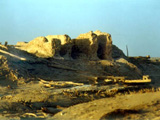
 Chinese archaeologists announced last Friday that a ransacked ancient tomb along the Silk Road in Xinjiang Uygur Autonomous Region was not the legendary royal mausoleum of Loulan (Kroraina), as some media reports suggested early last month. In the following report, Ma Zhefei, a journalist working with the Chinese newspaper, China Archaeology News, shares his experiences during a fact-finding investigation he participated in following media reports that the famed tomb had been raided.
A century ago, Swedish explorer Sven Hedin discovered the ruins of the Loulan (Kroraina) Kingdom in the great Lop Nur. That set in motion a series of explorations along the ancient Silk Road, involving Ellsworth Huntington from the United States, Marc Aurel Stein from Britain and Hedin's compatriot Folke Bergman. Unfortunately, it also triggered a series of lootings by tomb raiders.
During last month's Spring Festival period, the ruins of Loulan, under the jurisdiction of Ruoqiang (Qarkilik) in Northwest China's Xinjiang Uygur Autonomous Region, again became the focus of media and archaeological circles, when a local paper reported that some people had stumbled upon the legendary royal mausoleum of Loulan which had been looted.
In late February, I had the opportunity to join a team of archaeologists from Xinjiang Cultural Heritage and Relics Institute on a fact-finding investigation to the historic site. The field trip had the approval of the State Administration of Cultural Heritage.
Our mission was to examine the site of Loulan, about 1,000 kilometers from the region's capital, Urumqi, and to determine whether the looted tomb was the royal mausoleum.
On the night of February 20, our team reached the site, located 22 kilometers north of the ancient ruined city of Loulan.
Following the footsteps of local archaeologists, we entered the tomb. After passing through a 10-meter long passage, we found ourselves looking at two burial chambers. There we saw, to our amazement, mural paintings on the walls, layers of wooden blocks for making coffins, textile pieces, human bones, wooden cups, leather bags and saddles, ivory and wooden combs.
After careful examination of these items, Zhang Yuzhong, vice-president of the Xinjiang Cultural Heritage and Relics Institute and the head of our team, told us that the tomb must have been built around the 3rd century, between the late Han Dynasty and the Western and Eastern Jin dynasties (265-420 AD).
Earlier last month, Lin Meicun, a professor with Peking University and a prestigious scholar on Loulan, had said that it was unlikely to be the mausoleum of the Loulan Kings.
He said that Lop Nur was, in the third century, the border between the kingdom and regions under the direct jurisdiction of the Han Dynasty (206 BC-AD 220). Royal mausoleums would have been built in Ruoqiang, the then Loulan capital, which is far from the Lop Nur.
Lin's opinion is shared by Zhang who does not believe the looted tomb is the royal one of Loulan.
Historic annals record that the Loulan Kingdom, which established itself around 2nd century BC, was renamed the Shanshan Kingdom in 77 BC, and lasted until about the 5th to the 6th centuries AD, explained Zhang.
Despite this fact, Zhang and his colleagues consider the tomb to be highly significant and suggest it may have belonged to a noble family.
The murals on the walls offer fresh clues and insights into the lives of the people of the area after the demise and disappearance of the Loulan Kingdom.
Zhang paid particular interest to the tomb's long passage, explaining it was a characteristic of tombs which first appeared in the late Western Han Dynasty (206 BC-AD 24). The design later became popular in the East Han Dynasty.
He said tombs of a similar layout have been found in the Turpan area of Xinjiang and in the Dunhuang areas of Northwest China's Gansu Province.
The wooden coffins, with colored decorations, were not new to Zhang and his colleagues, either. They had seen similar ones in the area five years ago, during an archaeological survey and trial excavation.
When we finished examining the looted tomb, we extended our inspections of the area, eventually covering a 50-kilometer radius around the ruined ancient city of Loulan. What we saw and found dismayed us.
We found graves which had been unearthed, and some badly desecrated, with wooden coffins torn open exposing skeletons, and silk fragments scattered around.
Some of the boards were charred, and we suspected that they had been gratuitously used to make campfires, possibly by the tomb raiders themselves.
We entered two large tombs to find nothing but skeletons and broken coffins.
Yin Baolin, from the local police authority in Bayingolin Mongolia Autonomous Prefecture, and his colleagues traveled with us. They had successfully investigated a series of lootings in Loulan in 1998 and 2000 from which they accumulated a great deal of relevant experience.
This time, however, Yin and his officers gleaned few clues from the site, making the solving of the case quite difficult.
Around the pillaged tomb, we saw car tracks, some old, others new, which indicated that the tombs had been looted only a few days before we arrived.
On the third day after we reached Lop Nur, we found charred wood, some of which was still smoldering - we had only just missed the tomb raiders.
By following the car tracks, we captured a suspect three hours later. He confessed that he and three accomplices had robbed the tombs. Until a decade ago, the very name of Lop Nur was associated with death. A no-man's land, it was known as a lifeless area spanning nearly 1,000 square kilometers, with the only signs of habitation the occasional red willow and shrivelled reeds which might died years earlier.
Anyone who had tried to enter the area alone was likely to lose their way and perish in the seemingly endless wilderness, whose landscape looks identical as far as the eye can see.
Things changed after petroleum exploration began in the mid-1990s. New roads have been built, and Lop Nur has somehow come alive.
"One only needs a vehicle to travel in Lop Nur," said Yin.
But the advent of technology and man has led to a rising spate of looting of Lop Nur's ancient ruins. The cash profits to be made are enormous with an intact colored coffin fetching up to a 1 million yuan (US$120,000) in Urumqi, the regional capital, said Yin. The loss to the nation in terms of its cultural heritage is, however, incalculable.
The local cultural relics protection authorities have been working hard to combat the raiders and those who deal in looted artifacts.
Sheng Chunshou, the director of the Cultural Relics Protection Authority in Xinjiang, said he and his colleagues have pressed the regional People's Congress, the local legislature, to introduce new regulations concerning the protection of cultural relics.
One of the important clauses is "Approval from the State and Xinjiang bureaux of cultural heritage is required before entering cultural relics sites which are not open to the public."
Last year, the State Development Planning Commission and the State Administration of Cultural Heritage set up a 1 million yuan (US$120,000) special fund for the protection of Loulan. With the money the regional cultural heritage bureau has helped install satellite telephone systems in the nearby counties and check-points on the major roads. It also plans to build a permanent working station at Loulan.
But as the authorities step up efforts to protect the nation's treasures, those intent on enriching themselves have resorted to subterfuge to enter the area by claiming to be involved in "environmental protection" and "wild life protection," revealed Sheng.
Others have simply entered Loulan from Dunhuang, in neighboring Gansu Province, roughly the same distance between Lop Nur and Urumqi.
Archaeologists and local police have also found themselves battling evermore sophistically equipped and better financed tomb raiders.
"We have only got to a few sites, where ancient tombs are concentrated," Zhang said. "We have not even been able to go to some sites which Sven Hedin and Marc Aurel Stein visited 100 years ago."
Racing against the tomb robbers, leading archaeologists in the region have worked out a salvage plan to conduct an extensive study of the cultural relics of Xinjiang.
"Where we find we are unable to protect the relics, we may carry out archaeological excavations and salvage the relics before the robbers come," said Sheng.
The plan is now being scrutinized by the State Administration of Cultural Heritage.
Zhang Bai, the administration's deputy director, said that the administration has given due priority to the western regions in its policy making, in line with the country's "go west" strategies.
"Xinjiang comes first," Zhang Bai said.
(China Daily March 24, 2003)
|