Cab driver Che Dianguang would have never imagined that he would become a newsmaker some day.
Rows of taxis queue in front of the Beijing Railway Station to wait for customers. The industry's monopoly situation and harsh competition have worsened the working conditions of taxi drivers.
The 42-year-old Beijing man, along with other two colleagues, has brought the Beijing Transportation Management Bureau to trial.
They accuse the bureau of illegally refusing their application for individual taxi licences.
The move is the first administrative lawsuit in Beijing's taxi industry and also part of efforts to challenge the decade-old taxi management system.
The system is characterized by stringent market entry requirements and monopoly from taxi companies.
Following a fast growth in the late 1980s and early 1990s, the number of taxi companies in Beijing rose to 1,400 and the number of taxis to 60,000 in 1994.
In response, the government decided to suspend the approval of new taxi companies and ban individual operations from that year.
In 1996, the city went further to impose a gross limit on the sector to limit the overall number of cabs.
As a result, taxi companies began to monopolize the industry because of the limited number of taxi licenses available.
There are currently more than 200 large taxi companies that own 66,000 cabs in the city. There are only about 1,000 individual taxi licenses, and all were granted before 1994.
Most of the city's cab drivers have to rent cars and buy licenses from these firms.
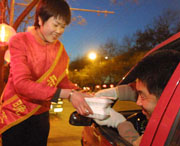
A taxi driver receives a packaged dinner from a hostess at a Beijing restaurant. Many drivers have to sacrifice their dinner time in order to fulfill their daily quota and make ends meet.
Taxi drivers have to pay for fuel and repairs as well as a monthly rent of between 4,000 and 5,000 yuan (US$483 to US$603) to their companies.
Monopoly in the taxi sector has led to a rampant abuse of drivers' rights, with taxi companies charging exorbitant prices for licenses.
Local media reports said a car worth 60,000 yuan (US$7,260) could fetch as much as 150,000 yuan (US$18,120) from a taxi driver.
These rental fees have slashed the incomes of taxi drivers, forcing them to work seven days a week, up to 16 hours a day, to the severe detriment of their health.
A recent survey suggested that a Beijing cab driver works for 427 hours on average each month, compared with the statutory requirement of 252 hours.
But their monthly average income is just 1,817.5 yuan (US$220), a rate that equals just over 4 yuan - half a US dollar - per hour.
These hours mean most company-hired drivers suffer from occupational diseases, and chronic fatigue is just one cause of traffic accidents.
Nationwide, the country's nearly 2 million taxi drivers are leading lives as tough as their Beijing counterparts because all major Chinese cities model their regulations on Beijing.
The shortage of jobs and financial hardship have forced taxi drivers, most of whom are workers laid off from State-owned enterprises or surplus rural laborers, into an industry fraught with harsh working conditions and low incomes.
"We all know our job is like working in hell where we have to suffer overwork, low income and poor working conditions," said cab driver Liu Guangtian.
"But most of us can do nothing but endure it, given the current unemployment in the country."
The taxi companies, however, defend the high rental fees as necessary for supporting their huge operation cost.
Moreover, taxi companies have been playing an important role in regulating the taxi sector, some managers were quoted as saying by Xinhua News Agency.
Despite increasing complaints about the taxi monopoly, few people have taken action to challenge it, partly due to a lack of legal recourse.
Start of a long road
An opportunity finally emerged on July 1, when the Administrative Licensing Law went into effect.
The Law aims to restrict the government's power, streamline administrative approval procedures and remove restrictions considered unnecessary.
Article 13 of the Law stipulates that administrative licensing may not be needed for those industries that can be effectively regulated through the market competition mechanism.
Shao Changliang, another plaintiff in the lawsuit, said there was no need to impose a gross limit in the taxi industry because the sector should be free to market competition.
The gross limit has actually created discriminatory market entry for individual taxi drivers and led to a monopoly by taxi companies, he added.
"In this case, the government has been using its administrative power to illegally deprive individual taxi drivers of their right to operate a taxi business," said Shao.
The cab driver described the present taxi management system as one under which "taxi drivers, taxi customers and the State all make contributions to taxi companies."
"To change it, we must break the improper monopoly of the taxi sector and strive for a fair competitive market," Shao said.
He compared the monopoly in the taxi sector to a dam, and himself to an explosive.
"I will blast the dam," he said.
On July 1 Shao and Che, along with another colleague, Wang Xueyong, started their fight for their right to operate individual taxis.
They filed an application with the Beijing Transport Management Bureau.
It was the first time the bureau had received such an application since 1994. So far, more than 2,000 taxi drivers have followed suit.
The bureau rejected the applications on July 12, citing a gross limit on the number of taxis as stipulated in the Outline for Beijing's Transportation Development in the 10th Five-Year (2001-05) Plan Period.
Drafted in 2002, the Outline says "the overall number of taxis in Beijing has met the limit target and no more transport capacity should be added."
Four days later, the three drivers went to the bureau again, asking for a hearing to discuss the rationality of the policy. They were refused again.
Believing they would not get an appropriate reply from the bureau soon, the three brought a lawsuit against it in the Xuanwu District People's Court on September 1.
On November 8, the court opened the first hearing of the case.
The three plaintiffs said the bureau's Outline for Beijing's Transportation Development goes against the Administrative Licensing Law and thus should be made invalid.
Lawyers for the bureau, however, argued that the Outline has been approved through legal procedures and should be strictly enforced.
Although the court has yet to issue a verdict, the case has drawn not only wide media coverage but also huge attention from researchers and pundits.
Unfair approval system
Guo Yushan, a researcher on public utilities, has hailed the three drivers' legal step as a major sign of social progress in China.
First, it suggests that the country has strengthened the rule of law to ensure better social justice.
"What's more important is that the disadvantaged are learning to use legal weapons to safeguard their legitimate rights," he says.
Yu Hui, a researcher with the Institute of Industrial Studies under the Chinese Academy of Social Sciences, says the taxi monopoly is rooted in the unreasonable government approval system.
He stresses that the industry should allow full competition and be completely open to all qualified individual practitioners.
"But, unfortunately, the government made a wrong move in the first place by introducing the most stringent approval systems into a market that should be free to individual entry and exit," Yu says.
On top of that, he adds, the licenses to run taxi companies were granted to some private firms free of charge.
These firms then made an unfair profit by taking advantage of the privilege to exploit their employees with long hours and low pay and watched their money pile up.
The researcher says the government has failed to take efficient measures to support taxi drivers even after recognizing their disadvantaged position as being the result of unequal contracts with their companies.
In recent years, the media have reported an increasing number of cases of breach of contract by taxi companies who imposed arbitrary penalties on their employees.
Some companies have even refused to pay medical and unemployment insurance premiums for taxi drivers in violation of their contracts.
Other researchers go as far as to call the taxi industry one of the sectors under the protection of the government's "legal monopoly."
"The current monopoly in the taxi industry has lined the pockets of the business owners as well as some officials but has badly hurt the interests of the State, taxi drivers and their customers," says Shen Mengpei, a researcher with the State Seismology Bureau, who is an ardent defender of taxi drivers' interests.
Shen, a deputy to the Beijing Municipal People's Congress, has put forward motions on three different occasions, in 1999, 2000 and 2003, calling on the local legislative body to help overhaul the taxi industry.
Shen says that each cab was capable of generating about 3,303 yuan (US$399) of monthly gross profit for any given taxi company in Beijing, indicating that the city's taxi firms boast profits of 2.6 billion yuan (US$316 million) each year.
But a taxi company currently pays about 250 yuan (US$30) per month in business tax on each cab to the State, or 170 yuan (US$21) less than what a self-employed taxi driver pays.
Under the present government approval system and the business monopoly, however, only taxi companies can benefit by making exorbitant profits at the expense of the interests of taxi drivers, according to Shen.
Economist Zhang Shuguang urges Beijing to follow the example of almost all other major cities around the world and sell the right to conduct taxi business directly to taxi drivers themselves via auction.
Then the government can more efficiently regulate the taxi industry through market forces, he says.
Professor Shi Jichun, with the School of Law at the Renmin University of China, points out that the monopolized taxi industry should serve as a classic case of administration failure by the government.
"The government has been trying very hard to regulate the taxi industry through executive control in line with the out-dated thought inherited from a planned economy," the professor said.
"But the monopoly system has unfortunately ended in failure by sacrificing the maximum interests of the whole society."
(China Daily November 24, 2004)