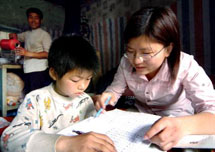
Zhaozhao became the "little terror" of his neighbourhood when he was two and a half. He bit, pushed, hit and kicked children and adults alike at the slightest provocation and sometimes even for the lack of it. Three nannies left, smarting from the injuries inflicted by this enfant terrible. Finally, his parents handed his new caretaker a stick and told her to use it as she saw fit.
With his punishment meted out swiftly and painfully, Zhaozhao soon learned it was not to his advantage to attack. He is still not the friendliest of boys in the neighbourhood, but at least he can be on the playground without others fleeing at the sight of him.
China has at least two versions of the "spare the rod and spoil the child" adage, which can be traced to the Book of Proverbs in the Bible. Though schools universally have banned corporal punishment, parents who prefer not to use "the rod" are often considered indulgent.
Last year a survey by the Guangdong Provincial Women's Federation showed that 54 percent of university and middle-school students experienced some sort of physical punishment. What's surprising is that 80 percent of parents and teachers believe corporal punishment does have its benefits.
That authoritarian parenthood is deep-rooted in Chinese culture has been observed by two professors of the China University of Political Science and Laws in Beijing, Tian Lan and He Junli, after a similar study. Their survey also found that exactly 54 percent students had faced corporal punishment.
"It's my children that I'm thrashing, and it's none of your business" is the typical attitude of child-beating parents.
Physical punishment is prevalent in Hong Kong Special Administrative Region, too. A 2003-04 household survey conducted by the University of Hong Kong found more than 44 percent parents had beaten their children to "straighten" them up.
Priscilla Lui, who lobbies for "zero corporal punishment" legislation in Hong Kong, says her efforts have met with resistance from many quarters.
"People, and they include professionals and high ranking officials, don't see non-abusive corporal punishment as a problem," says Liu, director of a non-governmental organization named Against Child Abuse (ACA).
More harm than good
Although academics are still debating whether moderate, non-abusive corporal punishment could be harmful, its benefits seem to be minimal.
After analyzing 88 studies spanning 62 years, Columbia University psychologist Elizabeth Thompson Gershoff found 11 "strong associations" between corporal punishment and child behaviour or experience. Ten such experiences are negative, including poor relationship with parents, higher risk of depression, childhood aggression, anti-social behaviour and abuse of spouse or children in adulthood.
The only positive aspect could be "immediate compliance."
But is the short cut to obedience effective in changing a child's behaviour for good? No research has been able to give a yes answer to that.
In Zhaozhao's case, a thrashing could be the worst possible way of trying to change his aggressive behaviour, several experts say.
"Adults set a bad example by resorting to violence to solve a problem," says Gao Shouyan, director of Eastbaby, a Beijing-based research and development centre that specializes in early childhood education.
"My biggest worry is that corporal punishment could escalate easily," Gao warns.
From her experience as a consultant, Gao has found that corporal punishment has more to do with the parents' mood than the children's behaviour. Most parents to whom she has provided consultation concede having punished their children physically in a fit of rage and not out of conscious choice.
It's difficult to draw a line between corporal punishment and child abuse, child psychologist Lin Siu-fung says. "We are not always able to control our emotions," said Lin, a lecturer at the Chinese University of Hong Kong.
"What if the child does not respond the way you want him or her to after the beating? A parent is likely to get angrier and the child still more defiant," Lin said "... Such a cycle is a disaster in the making."
Hong Kong-based Family Heartware's education and publication director, Henie Chui Wai-yi, agrees physical punishment is a tricky disciplinary technique. Instead, she suggests, it's better not to use it at all.
"It's difficult to explain to children why they should be hit when you tell them not to hit others," she says. Family Heartware is a Christian organization that conducts parenting skill workshops and publishes books on related topics.
Even the "spare the rod and spoil the child" brigade disagrees on whether parents should use hands, sticks or canes to beat a child. The group disagrees, too, whether the punishment should be immediate - regardless of the circumstances - or in private only. And there is also a lack of consensus on how old is too old for a child to face corporal punishment.
Alternatives don't work?
But harried parents should not lose heart because studies show non-violent disciplinary techniques do succeed in setting boundaries for a child.
Time-out (sending a child to an isolated place such as a chair or another room), privilege removal ("No TV if you don't clean up the mess!") and logical consequence (letting a child go hungry if he or she doesn't eat lunch) are some of the effective recommendations.
Some may argue that serious misbehaviour calls for serious action. ACA's Lui, however, says the need to leave a strong impression on a child is no excuse for hitting. Recalling her own childhood experience, Lui said that she had learned that theft was a serious offence without being thrashed.
"My grandmother used to do handicraft, and she had some beautiful beads" Lui said. "So one day I took some to school without telling her. That made her very angry because I had taken her things without permission. But she didn't beat me. Instead she threw the whole lot of beads into the toilet bowl right in front of me... That created such a profound impression that I can still remember it vividly."
Gao of Eastbaby and Chui of Family Heartware both recommend praise as a technique in children's behaviour. "The best thing about praise is that it suits children of almost all temperaments," Gao said.
Lin emphasizes "attachment," the bonding between parents and children. Any form of punishment, even psychological, should be avoided if possible. "Just as we do in case of health, we should focus not on curing a disease but on not falling sick," she said.
A consistent system of getting messages across should be built between parents and their children and should include giving verbal instructions, providing non-verbal support and setting examples.
"More important, everything has to be 'consistent,' including the way you act and react," Lin said. "That forms a pattern so that children can act and react accordingly over time."
Many behavioural problems can thus be prevented because children do wish to please their parents, Lin says.
But there are parents like Zhaozhao's, who insist that they have tried every trick in the book without any result.
Gao says a common reason for disciplinary failure is not following through on the rules. If the parents have set "no soda during meals" as a rule, they have to stick to it even when their child says he has no appetite. The moment they agree to give the child a cola to get him to eat a few morsels of rice, he learns not to take their rules seriously, Gao says.
On the other hand, parents should be careful not to set too many rules because that could lead to double disaster: killing a child's creative instincts and making enforcement of all the rules difficult, she warns.
Many children are punished for playing with breakable objects. That's because "children are curious by nature. As long as it's safe, I suggest parents to sit down with them and play with things they are curious about," Gao said.
Toddlers have a short memory and need to be reminded often about the dos and don'ts, Family Heartware's Chui says, warning mothers of another parenting pitfall: nagging.
She advises parents to rethink their strategy if they don't want to start sounding like a broken record.
"Be creative. Surprise them. Tell them a joke for a change. If your children think of you as nagging, they mentally cover their ears, blocking all your messages."
It takes a lot...
But experts agree that there is no magic solution applicable to all children. Lin says effective discipline depends on a number of factors and that includes children's age, development, personality, relationship with the parents and the interactive style among the family members.
Don't expect to learn the "best" disciplinary trick by reading just one book and attending just one workshop, Family Heartware's Chui says.
"Most parents have to go through the trial-and-error process," she said.
Probably the most important thing is that parents understand thoroughly that the reason a child has to be disciplined is to help make him or her become part of the real world.
Chui has counselled many parents, whom she describes as "paying too close an attention to their children," which creates tension and induces rebellion.
"You have to take the word 'control' out of your mind," she said. "Your child is another human being. You should not try to control it and make it a person subject to your choice. The goal of discipline is to help and guide a child in its growth and development."
A balance of firmness, flexibility, creativity, constant learning, maturity and wisdom is required from parents. This may not be an easy thing for parents balancing careers and family.
The complexity of disciplining a child is the very reason corporal punishment should be banned, Lui said.
"There must be a clear, strong message that parents may not hit their children, no matter how stressed and ineffective they feel," she said. "The purpose of a spanking ban is not to throw parents into jail but to draw a bottom line."
Sweden, which in 1979 became the first of 17 countries to outlaw all forms of corporal punishment, has had only one prosecution.
"We cannot stop at the legislation," Lui said. "Parent training, affordable day-care centres, counselling service ... need to be provided to help parents give their children the best of care."
(China Daily May 27, 2006)