Zhang Xiaoying is an 11-year-old fourth-grade at the Beijing East Road Primary School in Nanjing, Jiangsu Province. In 2003, under the instruction of his teacher, Zhang and his schoolmates undertook a survey of the catering industry-especially fast food restaurants-in Nanjing. In separate teams, the students interviewed young students dining at Liu Changxing Restaurant, a Chinese fast-food chain, and diners at Western giants KFC and McDonald's. The students found that 78 percent of the children interviewed ate Western fast food very often. Why was Western fast food so attractive to children? Sixty-two percent cited taste; 22 percent cited nutrition; and 16 percent cited free gifts.
In his survey report, Zhang proposed a question to his teacher: If China boasts various dishes from eight cuisine styles (Sichuan, Cantonese, Jiangsu, Zhejiang, Shandong, Jiangxi, Fujian, and Anhui Dishes), why doesn't the country have a successful brand that could match KFC and McDonald's in opening chain restaurants around the world, to help all foreigners enjoy Chinese food?
Western Fast Food: Accounting for Taste
Nine-year-old Liu Ziyuan says McDonald's is one of his favorite haunts. He doesn't like hamburgers, he says, because his father told him that too many hamburgers would make him fat. His targets are the toys there, he said, especially Snoopy. Fu Lei, 19, often eats at the KFC or McDonald's near her school; the neat and pleasant environments help her study. An employee of a computer company, Yun Tian said she loves Western fast food because it's clean and convenient.
KFC hit the Chinese mainland in Beijing in 1987. McDonald's came in 1992. Other Western fast food places, such as Pizza Hut, Kenny Roger's Roasters, and A&W, as well as Yoshinoya from Japan, followed suit. With industrialized production, precision management, and modern marketing concepts, the foreign fast food restaurants brought an intense challenge to traditional Chinese restaurants, which had simply concentrated on the taste of their food.
As those advantages rapidly increased their market shares in China, though, some of the Western fast food giants were pegged as purveyors of junk food in their home countries. Some were charged extra taxes for the high fat their food contained. In order to maintain and expand their business in China, the Western fast food restaurants began to seek inspiration from traditional Chinese food, and to make adjustments to their cooking styles.
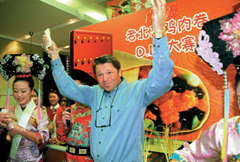
In 2001, McDonald's, an active practitioner of global standardization, presented Happy Rice to Chinese customers-the first change to its core products list in 27 years. Compared to McDonald's, KFC has gone further in implementing localization strategies. To account for Chinese tastes, KFC added to its menu vegetable dishes, porridge, and soup. In 2003, its new product, the Chicken Roll of Old Beijing, gained wide popularity.
At the beginning of 2004, KFC released its health food policies for China, saying it would draw a lesson from its outlets in the United States to increase its range of selection and promising to try hard to develop a variety of balanced, nutritious new products appealing to Chinese taste. The policies won acclaim from Prof. Xu Jide of the Shanghai Second Medical University and many other experts, who said later that they hoped KFC would keep its promise.
"It's won't be surprising if one day McDonald's makes dumplings or noodles," says Li Shijing, president of the Beijing Food Association, "because since China became a member of the World Trade Organization, the Western fast food giants have sped up their process of localization."
Chinese Fast Food: a Die-Hard Favorite
To most Chinese people, Western food is only an occasional alternative. Their love for traditional food like rice and soy milk dies hard, and Chinese fast food restaurants remain popular.
A normal meal for a Beijing resident includes five types of food: cereals, vegetables, meat and eggs, beans, and oil. He typically eats two to four kinds of meat, and vegetables like beans, fungus or seaweed make up about half the meal. His staple dish will be rice, corn, or other side crops.
Chinese dishes are world-renowned for their richness in both nutrition and content. The same goes for Chinese fast food.
Some experts point out that while the advantages of Western fast food lie in their modern operational mode, strict production and management, and standardized services, Chinese fast food is advantaged in variety, taste, nutrition, and price. Most of the Chinese fast food restaurants still remain at the level of workshops, however, with limited transportation and small-scale production.
The biggest hang-up for Chinese fast food chain outlets is food hygiene. In recent years, Malan Noodles, Xinya Dabao (New Asia Snacks), and some other Chinese fast food stores have spared no expense to improve food hygiene levels. From 2001 to 2003, the Malan Noodles Chain Restaurant Co., Ltd., carried out a nationwide campaign to upgrade its outlets, equipping them nationwide with up-to-date kitchen facilities and high-grade washrooms. The No.1 motto in the company's training manual was, "We give you clean noodles."
Chinese fast food restaurants have also tried to improve their management practices. Twin Seeds, a food enterprise that boasts 28 outlets in Guangdong Province, took the lead in standardizing chain restaurants. By independently researching and developing cooking facilities, it realized production standardization. According to its general manager, Pan Yuhai, they designed standardized steamers that cook their core products within strict parameters. The steamers have basically taken the place of cooks at every Twin Seeds.
The study of the modern operational concepts of Western fast food enterprises has prompted the development of Chinese fast food enterprises. Malan Noodles is China's largest fast food chain group; it learned how to franchise from KFC. Any applicant for a Malan franchise is inspected by the group's head office. To date, the group has established nearly 400 franchised outlets around China. These feature corporate qualifications and independent businesses, but follow guidelines from the head office.
Competition drives innovation. As Chinese fast food places maintain their own advantages and learn from Western enterprises, they become stronger. As for the question posed by fourth-grader Zhang Xiaoying: the Beijing Food Association's president Li Shijing projected an optimistic attitude. In his belief, thanks to the adoption of modern production and management, Chinese fast food will find a place in the world's food arena in the near future.
Fast-Changing
As Chinese and Western fast food compete with each other, both sides have seen losers. Chinese fast food Red Sorghum went under in 1999, and America's A&W packed up in 2003. Nevertheless, as all kinds of fast food restaurants make constant changes to cater to customers' tastes, the market share of fast food in China has greatly increased. According to official statistics, in 2003, China's food industry earned a total of 580 billion yuan. Of that, 180 billion yuan, about a third, came from fast food restaurants.
China's fast food industry has proven resilient, even in the face of SARS and bird flu. In early 2004, when bird flu hit China, the chicken-based KFC presented pork-burgers, and Quanjude, a classic Chinese restaurant famous for roast duck developed six non-duck dishes.
So fast food is here to stay. Its evolution, meanwhile, has influenced the dietary habits of the Chinese people. An estimated 75 percent of Beijing residents have breakfast at fast food restaurants or snack stands, and on average, each resident of Beijing, Shanghai, Guangzhou, Wuhan, and Shenyang Cities have fast food about nine times per month. Some eat it as much as 90 times in one month.
South Kexueyuan Road in Beijing's Haidian District, just 300 meters long, is lined with nearly 20 fast food restaurants, including McDonald's and KFC, MIM of Japan, and Yonghe King and Liuhe Renjia of China.
Yun Tian feels lucky for living on this road, which is crowded with delicacies. But he is obsessed by the same question every day: Chinese or foreign food for my next meal?
Five Fast Food Tips From Chinese Nutrition Experts:
1. Keep a balanced proportion of meats, carbohydrates, dairy products, vegetables, and fruits.
2. Keep greasy and sweet food to a minimum to reduce the intake of calories.
3. Light taste is recommended. Soup seasonings, which contain a large amount of salt, are no good for you if taken in large portions.
4. Fast food can be a choice for one of three meals each day, while the remaining meals should be normal food to supplement nutrition insufficiencies.
5. Eat fruit or drink juice after a fast food meal.
(China Pictorial April 16, 2004)