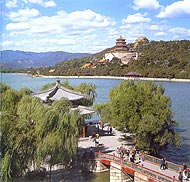
The Summer Palace, one of the finest examples garden architecture in China, is located in the northwest suburbs of Beijing. The 100-odd examples of traditional architecture in the park include pavilions, terraces, temples, pagodas, waterside gazebos, covered corridors, stone bridges and the famous marble boat. The palace occupies a total area of 290 hectares, three quarters of which is made up of shallow lakes.
The history of the Summer Palace dates back some 800 years when the first emperor of the Jin Dynasty, Wan Yanliang, moved his capital to the vicinity of Beijing and built his "God Mountain Palace" at the present site of Longevity Hill. A subsequent emperor of the same dynasty diverted the water from the nearby Jade Spring to the Gold Mountain, naming the lake it flowed into the Gold Sea. After the founding of the Yuan Dynasty, Gold Mountain was renamed Jug Mountain (Wengshan), as explained in the following legend: There was once an itinerant old man who discovered a large rock on the slope of Gold Mountain. Breaking it open, he found an earthenware jar hidden inside. The jar's surface was exquisitely carved with flowers, animals and dragons. Inside the jar were many objects of great value which the old man took away with him. Before his departure, however, he brought the jar to the sunny side of the mountain and inscribed it with the following couplet: "When this earthen jar is moved, the emperor's decline shall begin." During the Jiajing period (1522-1566) of the Ming Dynasty, the jar disappeared and, just as the old man predicted, the dynasty fell into decay.
In 1292, Guo Shoujing, a Yuan official in charge of irrigation work, suggested digging a riverbed leading all the springs in the vicinity of Jug Mountain to facilitate grain transport. Spring water from Changping, 50 kilometers north of Beijing, was thus led to the foot of Jug Mountain, and the lake was enlarged and renamed Jug Mountain Lake.
The names of the lake and the park and how they have changed over the course of their long history would make a study in itself. In the Yuan Dynasty, Kunming Lake was known as the Big Lake, the West Sea or the West Lake. Visiting West Lake in April was already a popular custom among the people in this period. In the Ming Dynasty a temple was built on the south side of Longevity Hill.
Emperor Zhengde of the Ming (reigned 1506-1521) built a palace on the bank of the lake and called it the Fine Garden for Enjoying Mountains (Haoshanyuan). He also changed Jug Mountain's name back to Gold Mountain and Jug Mountain Lake to Gold Sea. In the early 17th century, the infamous eunuch Zhongxian took over the entire garden for his private use.
When Qing troops occupied Beijing in the middle of the 17th century, the Fine Garden for Enjoying Mountains was renamed Jug Mountain Palace. It was during the reign of Qianlong (1736-1796) that the names of the last time. In commemoration of the 60th birthday of Qianlong's mother, the emperor erected the Temple of Gratitude and Longevity Hill and, following the example of the Han Dynasty Emperor Wu Di who had conducted Kunming Lake naval exercises in the Han capital of Chang' an many centuries before, the Gold Sea was renamed Kunming Lake. At the same, the entire area was called the Park pf Pure Ripples (Qingyiyuan).
The Summer Palace has fallen prey to two acts of destruction. The first took place in 1860 when the Anglo-French forces invaded Beijing and ravaged both the Yuanmingyuan Garden and the Park of Pure Ripples. Every single building in the park was destroyed by fire except nonflammable structures such as bronze pavilions and stone pagodas.
In 1888, Empress Dowager Cixi diverted 30 million taels of silver originally designated for the Chinese navy into the reconstruction and enlargement of the Summer Palace. She had the southern side of Longevity Hill laid out in imitation of West Lake in Hangzhou and the northern face in the architectural style of Suzhou. She gave the park its present name: Yiheyuan (Garden of Good Health and Harmony), known generally in English as the Summer Palace.
The second great act of destruction took place in 1900 when the Eight-Power Allied Forces invaded Beijing. The great temples rebuilt in the 1880s were completely demolished and almost every valuable object in sight stolen by the invading troops. In 1902, when Empress Dawager Cixi returned to Beijing from Xi' an, she ordered the reconstruction of the park. According to historical records, she "rebuilt the Summer Palace with unbounded extravagance and opulence, spending some 40,000 taels of silver per day. Singing and dancing went on without end."
After the Revolution of 1911, the Summer Palace became the private property of the deposed Emperor Puyi, who in 1914 opened the garden to the public. The entrance fee was so high that the palace had very few visitors. In 1924, Puyi was forced to leave the Forbidden City by the "Christian" General Feng Yuxiang, and the Beijing government turned the Summer palace once again fell prey to full-scale devastation; pavilions and covered corridors were destroyed, lakes became silted up, vegetation withered and died, and antiques and other objects of value were lost.
Today, older Beijing residents can still recall some of the palace's former treasures: the statue of the Goddess of Mercy and the watermelon made of kingfisher jade (feicui), the huge jade disc (bi) which "could be traded for several cities," the pearl that glowed at night, and the pearl-embroidered shoes. When the Kuomintang troops fled the mainland, they absconded with these and other treasures, some of which ended up in Taiwan, while he remainder was bought up by museums and private collectors in state of total dilapidation. After the founding of the People' s Republic in 1949, local authorities began the painstaking task of restoration. Today, after more than 40 years of repainting and reconstruction, the Summer Palace plays host to approximately 2 million visitors per year.
Below. We discuss the Summer Palace by area-the Eastern Palaces, the southern side of Longevity Hill, the northern side of Longevity Hill and the South Lake district.
The Eastern Palace
The Eastern Palace Gate, or main gate is guarded on each side by two brass lions from the Qianlong period. Set in the center of the staircase is a large slab of stone carved with two dragons amusing themselves with giant pearls. This symbol of imperial power was moved here from the Yuanmingyuan Gardens. Above the gate, the three Chinese characters of the name of the Summer Palace "Yiheyuan" have been inscribed in Emperor Guangxu' s hand. Immediately inside the gate is a "spirit wall," beyond which lies a bow-shaped "moon pond" crossed by a pair of stone bridges. In the days of the Empress Dowager, only she, the emperor and empress were permitted to come here, all other mortals being denied entry by a cordon of mounted guards. Walking west and passing through the Gate of Benevolent Longevity, you come to Palace of Benevolent Longevity (Renshoudian). This edifice was originally named the Palace of Encouraging Good Government . Restored in 1890, its name was changed to the Palace of Benevolent Longevity, an ironic notion derived from an old saying, "Benevolent People live long lives." Here Cixi held audience with high officials and handled the daily affairs of government. This palace once contained the famous screen behind which, out of propriety, Cixi ruled China. Though the screen has long since rotted away, the building still contains a number of interesting treasures: bronze vessels from the Shang Dynasty (c 16th-11th century BC); a screen bearing a scene on Dongting Lake made entirely of kingfisher feathers; lions carved from gnarled roots of trees; and Chinese decorative mirrors dating from the 18th century. Among these treasures is a sandalwood mirror frame carved with dragons, which took 3,600 days of labor to complete, the equivalent of one person working non-stop for 10 years.
North of the Palace of Benevolent Longevity is the Garden of Harmonious Virtue (Deheyuan). When Cixi rebuilt this section of the palace after it had been burned down by the Anglo-French forces, she spent a total of more than 700,000 taels of silver. A good portion of this investment went into the outdoor stage, which stands 21 meters high and has a stage area 17 meters wide, more than five times large than the average in the old days. Actually, the stage is composed of three levels, one on top of the other, and is impressive in several other respects: the ceiling of the lowest level is provided with seven traps through which a actors playing the roles of immortals, spirits or other celestial beings could descend. The stage floor also has seven traps which were used by ghosts and other underworld beings. Beneath the stage is a deep well and five square water tanks. Water was pumped from the tanks in some programs to produce underwater scenes on stage. On Cixi' s birthday every year, the same opera would be performed simultaneously on all three levels.
South from the Palace of Benevolent Longevity, you come to the Hal of Jade Ripples (Yulantang). It is said that the name of this structure comes from a poem by Lu Ji (261-303) which contains the line, "Tiny ripples flow up from the Jade Spring." Built in 1750, it was destroyed by the Anglo-French forces in 1860. Upon its restoration, it served as the private living quarters of Emperor Guangxu, though this luxuriously appointed home soon became his prison. Following the failure of the Reform Movement of 1898, to which Guangxu had lent his support, the Empress Dowager had the emperor imprisoned here and a brick wall built to prevent escape. Originally, Dropping Flowers Gate connected Guangxu' s home with the Hall of Pleasing Rue (Yiyunguan), the residence of his concubines. As a further punishment, Cixi ordered this gate to be sealed up, thus confining Guangxu to his elegant prison. Guangxu got into the habit of tapping his walking stick on the brick floor of his courtyard, carving out the uneven surface of his patio floor.
Between the Hall of Jade Ripples and the Hall of Pleasing Rue stands the Tower of Fine Sunset (Xijialou). Offering an excellent view of the Western Hills, it is an ideal spot for watching the sunset over Kunming Lake. Its eastern wing contains rockery hills and a Forest of (Stone) Lions modeled after the Forest of Lions Garden (Shizilin) in Suzhou, Jiangsu Province.
Walking north along the shore of the lake and heading west for a short distance, one comes to the Hall of Joyful Longevity (Leshoutang), the residence of the Empress Dowager. The eastern and western auxiliary halls were the center of daily activities. Each year, Cixi would move here in May, and not until the 10th day of the 10th lunar month (approximately the end of November), long past her birthday, would she move back to he Forbidden City. The current displays include a throne, imperial tables, screens, palace fans, and other imperial paraphernalia. Whenever "Old Buddha" (one of her favorite names) took a meal here, 128 different dishes would be served at a cost of 100 taels of silver, an amount which could buy enough millet to feed 5,000 peasants for one day. On display in the dining room are a basket of pearls, agate and kingfisher jade (feicui), as well as a panoramic mural on which the flowers of the four seasons are depicted in inlaid designs of gold, silver and precious stones. Magnolia, flowering crabapple and peony fill the courtyard. When the magnolias bloom in early April, the number of visitors increases dramatically. Directly south of the Hall of Joyful Longevity on the lake is a small dock with carved stone balustrades where Cixi would alight when arriving at the Summer Palace by boat.
From the west auxiliary hall of the Hall of Joyful Longevity through the Gate for Greeting the Moon, one comes to the eastern end of the Long Corridor (Changlang). First built in 1750 and destroyed by the Anglo-French forces in 1860, the current structure dates form the Guangxu reign. The total length of the corridor is 728 meters, making it the longest corridor in Chinese garden architecture.
Skirting the northern shoreline of Kunming Lake, the corridor links up the principle structures in this section of the Summer Palace. Four pavilions have been built at regular intervals along its length, each decorated with intricate paintings of flowers and historical figures. Every crossbeam in the Long Corridor is decorated with s colorful painting-17,000 in all. Among stories from Chinese history. Of additional interest are the two large stone kiosks jutting out over the water, making fine resting places on hot summer days.
The Southern Side of Longevity Hill
The main structure in the central architectural complex on the southern side of Longevity Hill is the Palace of parting Clouds (Paiyundian). This is fronted by a memorial archway built on the edge of the lake inscribed with the words "The myriad stars surround the Polar Star" and "The radiance of the clouds shines through the jade firmament." Between the archway and the Palace of Parting Clouds there are a number of evergreens and 12 Taihu Lake stones which represent the Chinese astrological animals. A n elegant pair of bronze lions guards the Gate of Parting Clouds. Inside the gate is a courtyard with buildings on each side; to the east is the Hall of Brilliant Jade and to the west the Hall of Brocade Clouds. A lotus pond in the courtyard is spanned by a stone bridge which leads to the gates of standing on the northern side of the courtyard, was the site of Empress Dowager Cixi' s birthday celebrations. There was a temple here in the Ming Dynasty, which was rebuilt during the Qianlong period and called the Temple of Gratitude and Longevity. After its destruction by the Anglo-French forces. Its name is taken from a poem by Guo Pu (276-324): "The immortals emerge from between parting clouds; a terrace of silver and gold appears."
The Palace of Parting Clouds, built on a stone terrace with staircases on three sides, is surrounded by white stone balustrades. The terrace in front of the palace is called the"Cinnabar Staircase."Bronze dragons, phoenixes, sacrificial vessels and large water vats are on display. The interior is similar to that of the Hall of Benevolent Longevity, including an oil portrait of Empress Dowager Cixi painted in 1903 by Katherine A. Carl, an American who also wrote a book about Cixi. Though the portrait was executed in Cixi' s 69th year, it flattered her to the likeness of a 30-year-old woman.
Covered staircases on either side of the Palace of Parting Clouds lead to the Hall of Virtuous Light. At the top is the highest point in the entire Summer Palace, the Pagoda of Buddhist Fragrance. This 38-meter-high pagoda, designed after the Yellow Crane Pagoda in Wuchang, Hubei Province, is supported by four hardwood columns. The immense task of restoration was begun in 1953. Repainting alone, applying some 600 kilograms of dark blue paint and 2.5 kilograms of pure gold leaf, took 16,000 worker-days.
The Revolving Scripture Repository (Zhuanlunzang) is the name given to the buildings east of the Pagoda of Buddhist Fragrance, which contain a large carved stone tablet. The 10-meter-tall tablet is inscribed with the words "Longevity Hill and Kunming Lake" in the hand of Qianlong. On its back is a short essay, "A Record of Kunming Lake," also in Qianlong' s hand. On either side are pavilions housing miniature octagonal pagodas, which revolve on vertical axles. These curious religious structures, designed to store Buddhist scriptures, are modeled after those in the Fayuan Temple in Hangzhou. The third pavilion is the so-called Bronze Pavilion. Standing 7.55 meters tall and weighing more than 200,000 kilograms, every detail resembles were executed with the lost wax method. Inside is a list of the craftsmen who took part in its construction.
The southern side of the Longevity Hill is full of smaller buildings with picturesque names, which will only be mentioned briefly. First, to the east: The House of Leisure (Zizaizhuang), dating from 1903, was built in the style of an old-fashioned country teahouse; the Hall for Nourishing Clouds (Yangyunxuan), divided into two side halls, served during the time of Cixi as a resting place of higher-ranking concubines, members of the imperial clan, and women who had been granted official titles; the Hall of Limitless Pleasure (Wujinyixuan), facing a small lotus pond, is an ideal place of retreat from the heat of summer; and finally, the Hall of Longevity (Jieshoutang) is surrounded by wonderful cypresses and magnolias.
To the west, there is Shao' s Nest, named after a Song Dynasty philosopher, Shao Yong, who called his retirement home the Nest of Peace and Joy. Another "nest," the Nest of Pines and Clouds, is derived from a line in a poem by the famous Tang poet Li Bai: "Here I will make my nest in the pines and clouds." The Pavilion of the Stone Gentleman (Shizhangting) recalls the Song painter and calligrapher Mi Fei, who would bow in reverence whenever he came upon a strange stone. To the west of the Pavilion of the Stone gentleman is a group of buildings called the Four Western Pavilions (Xisiting). Originally built by Qianlong, they were refurbished in 1892 to serve as a residence of the imperial concubines. After the failure of the Reform Movement of 1898, the Empress Dowager temporarily imprisoned Emperor Guangxu' s favorite, Concubine Zhen, in these precincts.
The listening to the Orioles Hall, the site of a popular restaurant, was first built in the 18th century and refurbished during the Guangxu reign. Fine old pine trees grow in its courtyards, while its exterior is planted with apricot trees and bamboo. To the rear of the hall stands the Strolling-Through-a-Painting Pavilion (Huazhongyou), a two-story building, which is flanked by the Adoration for the Hill Pavilion on the east and the Borrowing from Autumn Pavilion on the west. Covered galleries connect these two side pavilions with the main one. The name Strolling-Through-a-Painting Pavilion comes from the fact that standing on the exquisite veranda, it is easy to imagine oneself being part of a landscape painting.
To the west of the Stone Gentleman Pavilion. A rather unseaworthy boat sits permanently docked with its bow jutting out into the lake. This is the famous Marble boat, an ironic reminder that the funds appropriated by the Empress Dowager to reconstruct the Summer Palace had originally been earmarked for the Chinese navy. The boat's hull is of stone and Cixi herself in the style of an old steamship designed its two-story wooden cabin. To the east of the Marble Boat is the Hall of Accumulated Ripples from where pleasure boats set out for rides around the lake.
The Northern Side of Longevity Hill
There is a great contrast between the southern and northern sides of Longevity Hill. While the southern side is lavish to the point of extravagance, the northern slope is more peaceful and less crowed. With its winding hill paths, limpid flowing streams, luxuriant pines and cypresses, and numerous shrubs, the northern side of Longevity Hill reminds one of the countryside of southern China. There was originally a large number of fine buildings here, but with few exceptions they were all destroyed by the Anglo-French forces.
Apart from the long Lilac Corridor, there are only two palaces worthy of mention: the Tower of Great Fortune (Jingfuge) and the Garden pf Harmonious Delights (Xiequyuan).
The Tower of Great Fortune was known as the Palace of Epiphyllum (Tanhuage) during the Qianlong period and was rebuilt in its present form in 1892. This rather large square building is surrounded on all sides by corridors, and was frequented by the Empress Dowager for two main purposes: watching the moon, and admiring the scenery on rainy days. The elevation here permits a fine view of the Seventeen-Arch Bridge and the Knowing Spring Pavilion on Kunming Lake. Cixi often dined here on rainy days, for this was an ideal spot from which to gaze out upon the distant hills half-lost in clouds.
East of Longevity Hill in the very northeast corner of the palace stands the"garden within a garden,"the Garden of Harmonious Delights, perhaps the most peaceful and secluded place in the entire Summer Palace. The Garden was built during the Qianlong period. Water from Kunming Lake was led here to form a pond and a complex of ingeniously interconnected buildings was built around it. Since Qianlong copied the buildings themselves after a garden in the Huishan district of Wuxi, Jiangsu Province, the garden was first known as Huishan Garden. Its name was changed to the Garden of Harmonious Delights in 1893. The Hall of Embracing the Distance (Hanyuantang) is the central structure in the garden. Here the Empress Dowager would drink tea or perhaps take an afternoon nap. Everything in the hall remains as Cixi left it; there are sculptures of characters from the famous Qing novel A Dream of Red Mansions and an exquisite bamboo carved sailboat with 68 miniature figures of old men, each with their own distinct gestures and facial features.
Had the Anglo-French forces not destroyed the series of buildings on the banks of the Suzhou Creek in the rear section of the palace, they would not only be a favorite spot for visitors, but also a valuable resource for studying the social economy of the Qing Dynasty. In the old days, both sides of the creek in the vicinity of the Long Bridge were laid out with streets containing a variety of commercial establishments, such as teahouses, wine shops, bookstores and antique shops. Known as Suzhou Street, this area enabled the imperial family, entirely cut off from the normal society of the country they ruled, to taste Beijing urban life. The roles of the shopkeepers were played by court eunuchs, and when the imperial party approached, they would begin shouting to attract their customers' attention, just as in real life.
By crossing Long Bridge and walking north, one will come to the North Palace Gate, which was originally the main gate of the summer Palace.
At the eastern end of Suzhou Street stands a large gate-like structure which is inscribed on his eastern side with the words "Early morning light" and on its western side with "Gathering brilliance." This is yet another example of southern Chinese architecture.
The Palace Lakes
To the south of Longevity Hill is a vast expanse of water embellished with a number of small islands and a long embankment. The islands take their names from the structures built upon them: the Knowing Spring Pavilion; the Phoenix Pier; the Mirror Tower; and the Hall of Ornate Mirrors. The most accessible is the Southern Lake Island.
The Temple of the Dragon King is the main point of interest on the Southern Lake Island. Seen from afar, it resembles a mythical fairy mountain in the middle of the sea. The Southern Lake Island is connected to the shore by the magnificent Seventeen-Arch Bridge, which is decorated with numerous sculptures of lions. A large bronze bull sits on the shore at he east end of the bridge, ostensibly for the purpose of suppressing floods. An "Inscription to the Golden Bull" is cast in ancient seal characters on the bull's is cast in ancient seal characters on the bull's back. The Tapestry of Ripples Bridge (Xiuyiqiao) at the southern end of the lake narks the former site of a lock, which connected kunming Lake with the old canal, which leads to the center of the capital. Nearby are the tomb of Yelu Chucai, the famous advisor to Genghis Khan, and a naturally formed swimming pool.
The Western Embankment, totaling 2.5 kilometers, leads from the Willow Bridge in the south to the Lake Edge Bridge (Jiehuqiao) in the northwest corner of the palace. Peach and willow trees grow along its entire length and six bridges dotted on it were designed in imitation of those on the Su Dyke (Sudi) on Hangzhou's West Lake. The highest of the bridges is the superb Jade Belt Bridge (Yudaiqiao), known also as the Camel's Back Bridge, because of its tall and elegant arch.
Summer is naturally the finest time of year to visit the Summer Palace. By the end of April, winter jasmine and mountain peach make their early debut on the northern side of the Longevity Hill. Not long after this, flaming-red plums and sweet almonds come into bloom, followed by Chinese crabapples and lilacs. Next, magnolias and peonies, the "king of flowers," are in full bloom, while Chinese wisteria and herbaceous peonies are in bud along the Long Corridor. The mock oranges in front of the Palace of Parting Clouds bloom in mid-May, while the season for lotuses extends from July to October. At the height of summer, jasmine and osmanthus send forth their fragrance. The frost-defying autumn chrysanthemums bring this symphony of flowers to a splendid close, making their debut on October 1, China's National Day.
Note: Tingliguan, or the Hall for Listening to the Orioles located in the middle section of the Longevity Hill, where the Dowager Empress watched opera, is now a restaurant serving dishes cooked with the recipes from the royal kitchen.
Address: West of Peking University, Haidian District;
Entry ticket: 30 yuan/person, park admission only; 50 yuan/person, including park admission and charged exhibitions inside some of the halls;
Traffic: About 20 buses go to Yiheyuan from all parts of Beijing, stopping at the park's east, north or south gate. These include: Bus No.s 301, 303, 332, 374, 375, 726, 826, 801 and 808;
Tel: 86-10-62881144.
(China.org.cn)