|
The Palace Museum, former home to the Ming and Qing emperors, is also known as the Forbidden City (Zijincheng).
There are four entrance gates: the Meridian Gate (Wumen) to the south, the Gate of Divine Prowess (Shenwumen) to the north, the Eastern Flowery Gate (Donghuamen) to the east and the Western Flowery Gate (Xihuamen) to the west. The largest and best preserved group of ancient buildings in China today, its more than 9,000 rooms cover some 150,000 square meters. A 10-meter-high wall and moat more than 52 meters wide run six kilometers around the perimeter.
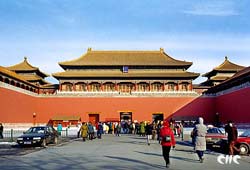
A visit to the Palace Museum begins at the Meridian Gate (Wumen) in the south. Passage through the central opening was formerly restricted to the emperor whereas the two side openings served civil and military officials as well as imperial clansmen. An excursion to offer sacrifices at the Temple of Heaven or Altar of Earth was heralded at the gate by bells, which to the Imperial Ancestral Temple was announced by drums.
The Front Palace is reached through the Gate of Supreme Harmony (Taihemen). There a sea of flagstones covering more than 30,000 square meters is bounded on three sides by grand halls. Directly in front stands the Hall of Supreme Harmony (Taihedian). North of that, the Hall of Complete Harmony (Zhonghedian) and the Hall of Preserving Harmony (Baohedian). These "Three Great Halls"(Sandadian) dominate the Front Palace.
Only the most important ceremonies were held in the Hall of Supreme Harmony -- the enthronement of an emperor; celebration of the first day of the New Year, winter solstice; Spring Festival (from the first to the fifteenth of the first lunar month); the emperor's birthday, announcement of successful candidates in the imperial examinations and proclamation of imperial directives.
The imposing "Three Great Halls" are built up on broad terraces and decorated with carved pillars. The ornamental Dragon's head at the base of each pillar serves the practical purpose of water drainage. If you visit the palace on a rainy day you will witness the magnificent sight of 1,142 dragons on the three terraces simultaneously spurting rain water from their mouths.
Three flights of steps, the middle of which is decorated with slabs of exquisitely carved marble, connect the three terraces along the central Imperial Way. That to the north of the Hall of Preserving Harmony is the most spectacular of all. Large marble panels are framed with an order of flowers and ocean waves. In the center, a sea of curled clouds set off groups of nine (the imperial number) coiling dragons (the emperor' s personal symbol) rising from their midst. These stone carvings are considered to be some of the finest in China.
Construction of the Hall of Supreme Harmony was initiated in 1420 under Emperor Yongle of the Ming Dynasty. Emperor Kangxi of the Qing Dynasty rebuilt the extant structure in 1695. Thirty-five meters high, it is the tallest building in the entire palace complex. The golden lacquer ware throne, set between two golden pillars both decorated with dragons, sits directly at its heart. Above a mirrored sphere hangs from an umbrella-shaped niche filled with yet more golden dragons.
On veranda is a display of musical instruments: bronze bells and a set of jade musical stones. There are month organs, bamboo flutes, and a qin, a zither-like instrument without bridges. Whenever the emperor approached his throne, the bronze bells and the musical stones were sounded, creating in a wonderfully harmonious clatter that was known as shao music. Outside on the terrace, incense was burned in bronze tripods (ding) and cranes. Civil and military officials would kneel on the platform inside by rank. Though fragrant smoke no longer rises from the Hall of Supreme Harmony, everything remains as if the "Son of Heaven" had just departed.
The next building north is the Hall of the Complete Harmony constructed under Emperor Yongle in 1420. Here the emperor would rest before attending to business in the Hall of Supreme Harmony. Each year, the day before going to offer sacrifices, he would come here to review the text of the sacrificial prayers. Ceremonies for receiving tribute, memorials to the throne and congratulatory documents were also rehearsed here. On veranda is a display of musical instruments: bronze bells and a set of jade musical stones.
The Hall of Preserving Harmony was also built in 1420. In the Qing Dynasty, the emperors held annual feasts here on New Year's Eve and on the 15th day of the first lunar month. Nobility of various national minorities and important civil and military court officials came in attendance. The final imperial examination was moved here from the Hall of Supreme Harmony during the reign of Emperor Yongzheng (1723-1735).
The Gate of Heavenly Purity (Qianqingmen) stands as the main entrance to the"Inner Palace," Qing emperors sometimes held court and seated on a throne in front of this gate . The northern half of the Imperial Palace, the "Inner Palace," begins here with a dizzying succession of exquisite courtyards, halls, towers and pavilions. The Palace of Heavenly Purity (Qianqinggong ), the Hall of Prosperity (Jiaotaidian) and the Hall of Earthly Peace (Kunninggong) are known collectively as the "Three Rear Palaces" (Housangong). From the Ming up through the time of Emperors Kangxi in the Qing Dynasty, the emperors lived in the Palace of Heavenly Purity and the empresses in the Hall of Earthly Peace. Later, the Palace of Heavenly Purity was used for holding audience with courtiers and foreign diplomats and the Hall of Earthly Peace for offering sacrifices to the gods. The padouk wood cabinets, lacquer ware stove stands, crane-shaped candle holders and the cloisonni braziers and incense burners are all arranged as they were in the old days.
The Hall of Prosperity is a small ceremonial hall. During the reign of Emperor Qianlong (1736- 1796), the 25 major imperial seals were kept here. They remain on display along with a chiming clock and a classical style water clock (clepsydra) made in 1745.
To the east and west of the "Three Real Palaces" are the Hall of Solemnity (Duanningdian), where the emperor' s clothing was stored; the Hall of Great Diligence (Maoqindian), where books, writing brushes and ink were kept; the Upper Study (Shangshufang), where the imperial princes met with their tutors; and the South Study (Nanshufang), where members of the Imperial Academy attending the emperor worked.
The Imperial Garden (Yuhuayuan) lies to the north of the flat-roofed Hall of Earthly Peace (Kunninggong), a classical piece of Ming architecture housing a statue of the Daoist Xuanwu. The garden's ancient pines and cypresses as well as the smaller temples and pavilions are all fine relics of the Ming and Qing dynasties. Each year the imperial family would climb up to the Imperial Viewing Pavilion (Yujingting) at the northern end of the garden on the ninth day of the ninth lunar month. To the east stands the Hall of Literary Elegance (Chizaotang), where a library of rare books was kept. A set of rare classical books entitled Selections from the Four Branches of Literature (Siku Huiyao), a revision of the Complete Library of the Four Branches of Literature (Siku Quanshu), compiled during the Qianlong reign, still survives in good condition as the only copy to be found in China.
The principal buildings to the east are the Hall of Ancestral Worship (Fengxiandian), the Hall of Abstinence (Zhaigong) and the six eastern palaces. Collectively known as the "Inner Eastern Road"(Neidonglu), they house an exhibition of Chinese art. The hall of Ancestral Worship was once the Imperial Family Temple, the Hall of Abstinence was where the emperor came each year to fast (no wine or meat) before offering sacrifices to Heaven and Earth. The Hall of Great Benevolence (Jingrengong) was originally the living quarters of the empress of Emperor Shunzhi (reigned 1644-1662) and was Emperor Kangxi's birthplace. During the Ming Dynasty, the Hall of Heavenly Favor (Chengqiangong) served as the living quarters of the empresses and imperial concubines. The Hall of Eternal Harmony (Yonghegong) was, in Ming times, the living quarters of the highest ranking concubines and during the Qing of empresses and concubines. The Hall of Sunlight (Jingyanggong) was from Ming times a repository for books. The Imperial Study was the emperor's reading room. During the Qianlong reign, a copy of the Book of Songs (Shi Jing) in the hand of Gaozong (emperor of the Southern Song, reigned (1127-1162) and illustrated by Ma Hezhi was preserved here. Qianlong wrote "Hall for the Study of Poetry" (Xueshitang) on a wooden plaque and had it placed inside. The Palace of Concentrated Purity (Zhongcuigong), built in the Ming Dynasty, was the living quarters of the crown prince.
To the east is the "Outer Eastern Road" (Waidonglu), which includes the Nine-Dragon Wall (Jiulongbi) and the Qianlong Garden. Here in the Hall of Ultimate Greatness (Huangjidian) and the Palace of Peaceful Longevity (Ningshougong) is housed a collection of fine paintings. The several halls behind, Known as the "Treasure Houses"(Zhenbaoguan), display countless ancient treasures.
This section of the Forbidden City has an interesting history. Emperor Kangxi ordered construction of the Hall of Ultimate Greatness in 1689. Kangxi's grandson, Qianlong, rebuilt the palace in 1772, having formulated a plan to rule for 60 years after which he would turn the reign of power over to his son. Twenty years previous to abdication, he began to prepare suitable living quarters for retirement, Worried he might not make it to 85, Qianlong began burning incense and praying to Heaven for long life. He chose propitious names for the buildings that would give sustenance to his hopes, like the Hall of Delight and Longevity, the Hall of Peace and Rest and the Hall of Character Cultivation. In 1795, a healthy 85-year-old Qianlong realized his life-long ambition. He abdicated in favor of his son. Emperor Jiaqing, but in the name of counselor to the throne, retained all of his former authority. He died three years later.
Here also is a reminder of the darker side of palace life -- the well where Emperor Guangxu's Concubine Zhen was drowned. Having supported him as he strove for reform and political power, she became his favorite, thus evoking the jealousy and hatred of Empress Dowager Cixi. Once placed under house arrest, she was denied access to the emperor and in 1900, when the Empress Dowager fled with Guangxu to Xi'an, she ordered the head eunuch Cui Yugui to dispose of Concubine Zhen by throwing her down the well.
There are six palaces in the section known as the"Western Road"(Xilu). The Palace of Concentrated Beauty (Chuxiugong) was twice home to Empress Dowager Cixi. Behind, the Hall of Beautiful Vistas (Lijingxuan) now houses an exhibition of Qing Dynasty art. The Hall of Double Glory (Chonghuadian), where Qianlong lived as a prince, was the place where the annual tea party was held in the first lunar month. Grand secretaries, palace ministers and members of the Imperial Academy would come to accompany Qianlong and drink tea, write poetry and make merry with him.
In the Palace of Establishing Happiness (Jianfugong), Qianlong spent leisure time admiring flowers. The Hall of Temporal Benevolence (Fuchendian), which dates from the Qianlong period, was where princes, dukes and ministers held ceremonial feasts at the New Year. The Longevity Hall (Changshougong), built in the Ming period, served as a temporary resting place for the body of Qianlong's empress before her burial. In 1884,when Empress Dowager Cixi lived here, it was frequently the scene of operatic performances.
The Queen Consort's Palace (Yikungong) was first built in the Ming Dynasty and rebuilt in 1655 by Emperor Shunzhi of the Qing Dynasty. In 1802, Emperor Jiaqing decided to connect this building to the Palace of Concentrated Beauty, replacing it with a new building, the Hall of Manifest Harmony (Tihegong). It was here that Cixi selected Empress Longyu and the concubines Jin and Zhen for Emperor Guangxu. These palaces now house displays of historical artifacts.
Beyond the "Western Road" lies the "Outer Western Road" (Waixilu), a group of large-scale Buddhist temples. Here empress dowagers retired in their old age. During the Ming and Qing dynasties, the Palace of Benevolent Peace served as the living quarters of the emperor's mother. Marriage ceremonies for princesses were also held in these halls.
Notes:
1. Photographing is forbidden.
2. At Meridian Gate, visitors can rent a guide tape in different languages with a player, which introduces the history and architecture of the palace. The tape and player can be returned at the north gate of the Palace Museum.
3. Don't forget to visit the Jingshan (Coal Hill) Park, on the opposite of the palace's north gate, from where you can see the splendid layout of the palace.
Opening hours: 8:00-16:00 (May-September); 8:30-15:30 (October-April);
Entry ticket: 60 yuan/person (busy season), 40 yuan/person (slow season);
Some of the museums have additional charges;
Traffic:
--Subways: Line 1: get down at Tian'anmen East, Line 3: get down at Qianmen;
--Bus No.s 1, 4, 5, 10, 20, 22, 52, 57, 802;
It is within walking distance from Wangfujing, Xidan or Qianmen.
Tel: 86-10-65132255.
(China.org.cn)
|