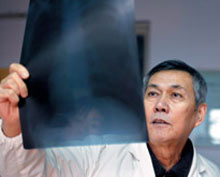
On June 11, 2004, during an inspection tour of Hubei Province, Premier Wen Jiabao of the State Council scheduled a visit with a professor at the Medical School of Wuhan University and the Zhongnan Hospital of Wuhan University.
Why did this particular academic warrant a visit by China's premier?
The professor is Gui Xi'en, a man who has dedicated his life to helping the disease afflicted and the first physician to recognize and work to alleviate the plight of the "AIDS village."
In summer of 1999, a student from Shangcai County, Henan Province, came to Professor Gui Xi'en to tell him of an epidemic that was ravaging his hometown. He explained that many of his fellow villagers of Wenlou Village were infected, suffering from fever and severe digestive disorders. No treatments had proved effective and some had died. "What was this disease?" The student pleaded.
In examining several of the infected, Professor Gui thought back to 1981. While then studying in the United States, his teacher described to him a newly-discovered epidemic - Acquired Immune Deficiency Syndrome (AIDS). Was this the disease of Wenlou Village?
Professor Gui took blood from five patients in Wenlou and returned with the samples to Wuhan. The test showed that two of the five were HIV carriers. Days later, he went again to the village and gathered another 20 blood samples. This time 10 persons were discovered to be HIV positive. A week later, he returned a third time and gathered blood from another 50 villagers. Disturbingly, he found that some children carried the virus.
Patients are primary purpose
In the preamble to the book, AIDS to the Best of My Knowledge, the content of which was compiled primarily by the professor, is this brief introduction:
"A native of Wuhan City, Hubei Province, he [Professor Gui] graduated from the Department of Medical Care of the Wuhan Medical College in 1960. He then dedicated 16 years to the prevention and clinical treatment of endemic diseases in Qinghai Province. In 1976 he joined the Zhongnan Hospital of Wuhan University. In 1999, he discovered HIV carriers among villagers in central China. He has since offered free examination and consultation services to the afflicted in AIDS-stricken areas..."
Gui's prior work in Qinghai Province cast a lasting influence on his life. Across the region's rural areas, he committed himself to the prevention and treatment of such epidemics as measles, typhoid fever and schistosomiasis. But it was battling the epidemic of AIDS that would become his primary field of study and treatment.
"My experiences in rural areas form the most precious memories of my life," Professor Gui said. "I'll retire in June or July this year. This means I will have more time to research AIDS." In fact, the 64-year-old professor could retire much earlier, but his selfless and relentless sense of dedication keeps him on the job.
Professor Gui was born into a noted family. His parents, both renowned professors, well known for their kindness and altruistic dedication to teaching, were honored by their home institution, Wuhan University, with scholarships named in their honor.
It was perhaps due to the influence of his family, that Professor Gui developed a sense of duty with no need for praise - excepting perhaps of the sort expressed by his patient's appreciation.
Professor Gui realizes that in combating AIDS the road ahead will be hard. And he is aware that effective prevention can only result from government effort and public education.
On October 31, Gui dispatched a letter along with his Wenlou Village research documentation to Li Lanqing, then vice premier of the State Council. In response, the vice premier delegated to the provincial government of Henan the task of responding to the issue.
Practicing prevention
On May 9, 2001, after five HIV carriers traveled to Wuhan seeking treatment, but instead faced discrimination, the professor invited the afflicted individuals to his home. The compassionate move generated much publicity across the nation. Never having dealt with the media in the past, in this instance the doctor welcomed the exposure and fully briefed reporters on his patients' ordeal. And he called on all citizens to respond with compassion, understanding and charity.
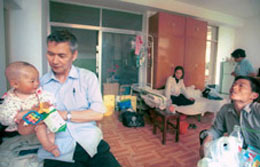
All their travel expenses paid by Professor Gui, after Cheng Jin and the four other HIV carriers from Wenlou Village completed the long journey to Wuhan for treatment, while staying in a dilapidated house soon to be demolished, they encountered resentment on the part of some neighbors, who were concerned about possible spread of the disease. To demonstrate by example that HIV does not transmit through casual day-to-day contact, it was then that Professor Gui invited the five HIV carriers to stay at his home. In the sitting room he temporarily set up beds for his two female patients, while Cheng Jin stayed in the study. The professor let "Ma Qiang" (a pseudonym) and his children sleep in his bedroom. Like a family, the professor and his patient-guests ate together and shared the same bath.
Blood samples were also taken in the house. "Gathering blood at home doesn't conform to regular procedures," said Professor Gui. "But this is our only choice." Extracting blood from AIDS patients requires utmost care, because the virus can be transmitted with a single prick from a used needle. For this reason, the professor never allows assistants to extract blood; but does so himself.
Perhaps he will not live to see the day when a cure for AIDS is discovered, Professor Gui explains, but he is confident that the disease will be defeated.
Thanks to his efforts, much national publicity was generated and Wenlou Village became the first village in China where AIDS patients receive free treatment.
A selfless servant
Professor Gui leads a frugal lifestyle in his modestly-furnished home, with perhaps the most expensive item being the television. A renovated old house, the residence displays no decorations and its walls are mismatched in color, due to haphazard past paintings. And this is the home of not one, but two renowned medical professionals - the second being Gui's wife, a professor in gynecology and obstetrics. Set upon the bedside table are two enlarged photos. One is of Professor Gui's entire family, nearly 100 people of varying nationalities. The other is of the professor with Cheng Jin and his son, both AIDS patients. According to Professor Gui, every patient is his friend - no matter that person's social status.
The professor's mother is an American and his grandmother is French. His daughter now works in the United States. Many of his relatives live abroad. It would not be surprising if the professor maintained a lifestyle luxurious in China. But, in fact, he is quite frugal with his own needs. Due to their busy schedules and dedication to work, steamed bread and instant noodles are what the professor and his wife typically eat.
On the first day after the five AIDS patients settled his home, the professor brought home a meal from a restaurant. This was a most "extravagant" dinner, he explained.
When he travels for business, Professor Gui brings along a pocket of steamed bread for provisions. And as his traveling partners check in to their hotel, the professor slips away to find less expensive guesthouse accommodations.
In the early 1980s, one of his relatives living in the United States presented the professor with an Apple computer, a rare and expensive appliance at the time. The professor donated it to the laboratory where he worked. The two new refrigerators in the department were also donated by the professor - although his family still uses a small unit that is nearly worn out.
But when it comes to the care of his patients, the doctor spares no expense. He has made 14 visits to Henan and examined more than 500 persons he deemed at high risk of contracting AIDS. For each patient, the expense of diagnosis is 600 yuan. All fees and costs were paid by the professor. This in addition to other financial assistance he has provided to poverty-stricken households.
There are few AIDS patients to have consulted with the professor who did not receive additional aid. Hearing that local government faced a financial shortage in helping patients, the professor contributed 10,000 yuan to civic welfare departments. During each visit to Henan, however, the professor would stay in the least expensive guesthouse. While there he would eat his steamed bread and instant noodles. Sometimes he would stay in the local homes of AIDS patients, thus earning even greater trust from the local villagers.
While a guest at the professor's home in Wuhan, his patient, Cheng Jin, noticed that Gui had not a single presentable shirt. As he left Wuhan, under Gui's pillow Cheng left a new shirt, which had been donated to him by news media organizations. An accompanying note read: "As a professional, you dress no better than me. This shirt may be more useful to you. I know you would not accept the shirt if I gave it to you before your eyes, so I left it under your pillow. This is the only way in which I can show my gratitude to you..."
Award and acclaim
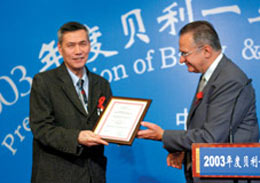
On February 28, 2004, Martin Gordon, of the Barry-Martin Foundation, a British charity institution, awarded the Barry-Martin Prize to Professor Gui for his outstanding work in combating AIDS and aiding the afflicted.
At the awards ceremony, Mr. Gordon said, in part, "Professor Gui is an excellent representative of those who work with great dedication in AIDS prevention in Hubei Province and across China. Through the professor I've come to know of China's achievements in AIDS prevention and control. I sincerely hope all of us can devote the necessary attention to AIDS, care for the patients... and contribute as needed to AIDS prevention and control."
According to Mr. Gordon, the 2003 Barry-Martin Prize was awarded to Professor Gui in recognition of the his tireless spirit and dedication. Mr. Gordon further expressed his intent to contribute ongoing financial support to the professor's good work. Predictably, Professor Gui contributed all awarded finds to the work of AIDS prevention.
Professor Gui and five AIDS patients compose a special family. Pictured is the professor playing with Ma Chao in the sitting room.
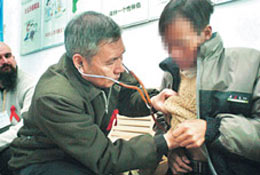
Professor Gui examines a patient while leading a crew of medical experts through AIDS-stricken areas in Henan Province.
On February 28, 2004, Professor Gui was honored by the Barry-Martin Foundation, a British charity institution. Pictured is Martin Gordon granting an award to Professor Gui (left).
(China Pictorial September 21, 2005)