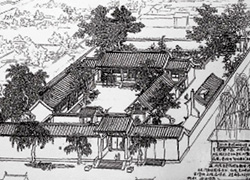
"If only I could still walk, I would race ahead of the bulldozers to capture sketches of more of the old Beijing hutong and siheyuan (courtyards) before they are crushed under the advance of modern development," said 64-year-old Zheng Xicheng, a lame artist, at an exhibition entitled "Beijing Forever in Our Hearts."
Standing beside his 100th painting of a siheyuan, on display at the show at Renmin University of China, Zheng sighed: "Most of the houses and courtyards I have painted have now been demolished."
Zheng is one of the increasing number of volunteer artists working desperately to preserve a record of old Beijing, with its 2,000 years of history as a city and its 800 years as the nation's capital.
Some of these volunteer artists displayed their photographs, paintings, sketches and models at the exhibition in order to attract more people to work on the preservation of the traditional features of old Beijing.
The event, organized by Humanistic Olympics Studies Center under Beijing-based Renmin University of China (RUC), ran from June 23 to July 2.
"But the struggle to protect old Beijing from bulldozers will last much longer," said Sha Lianxiang, a famous sociology professor at RUC and one of the exhibition organizers.
Race with bulldozers
Zheng, once an ivory sculptor, took up the cause of preserving old Beijing in 2001, when he had just survived a serious heart attack.
That year, Zheng read an article written by Hua Xinmin, a French writer and leading culture conservationist, describing how the owners of old private homes in Beijing could make money from them at the same time as preserving them.
Unfortunately, the article said, the value of these old private homes had not been appreciated by local governments and real estate developers, and these beautiful properties had been demolished with extremely low compensation and replaced by modern high-rises.
The article touched Zheng who was also worried about the fate of his house in the Xintaicang area of Dongcheng District, which was built by his ancestors in the Qing Dynasty (1644-1911).
Without the power to stop the bulldozers, Zheng decided to use his hands to preserve a record of the disappearing siheyuan and hutong.
"My conservationist friends, including Hua, would call me if they heard about some places that were going to be demolished. I would take sketches of them and then take the pictures to try to persuade the real estate developers to give up their demolition plans. Or if that was unsuccessful, I could at least leave the sketches for our descendants to see or use in their research in times to come," he said.
It is not an easy job. Zheng became lame in one leg when he was very young. Now he rides a bicycle to the demolition sites, no matter whether it's sunny, snowy, or windy.
Zheng sketches the old buildings using traditional Chinese painting techniques he learned in his youth. Many old siheyuan courtyards are now filled with various temporary additions built to handle the rising population. Tapping his memories and using his limited professional training, Zheng does his best to strip away the changes and present clear sketches of the original structures.
In most cases, the difficulties Zheng encounters go beyond just capturing the original structures. At many demolition sites, he has been refused entry, because developers dislike him and fear that his sketches may thwart their demolition plans.
"I try to persuade the guards to let me in, or I try to sneak into the courtyards," the old man said.
With his lame leg, Zheng has even climbed onto half-demolished walls or roofs to observe the traditional inner courtyards. The old man recalls that at one demotion site he suffered a minor heart attack but managed to finish his sketch with quivering hands.
"I had no choice, because the next day the old house might have disappeared," Zheng told China Daily.
Reviving old Beijing
Unlike Zheng, Yang Xin, an art editor with the popular Beijing Youth Daily, has focused his attention on people rather than buildings.
Born in a deep hutong, Yang is a professionally trained oil painter. Since the mid 1990s, Yang, faced with the rapid disappearance of old hutong and siheyuan, took up his camera to take photos of old houses and their residents. Sometimes he painted them.
"But I always felt that something was wrong. Later I realized it was the people. Many residents living in hutong are not the original inhabitants," Yang said.
In 1999, Yang gave up photography and the work of recording current life in Beijing's hutong. He wanted to track down and preserve a record of the traditional businesses and culture, which, although gradually disappearing, truly represent the spirit of Beijing.
After trying a variety of approaches, Yang finally settled on using a pen to draw cartoon-like pictures in which the major characters acquire a universal significance while the settings are quite accurately recorded.
The exaggerated images of people convey the optimistic, humble, and humorous spirit of Beijingers but the sketches of environment and landscape capture the historical details of the lanes and courtyard dwellings, Yang told China Daily during the show.
His first picture album, which was published in 2000, reflects the traditional life of Pengdu hutong, the small lane where he lived as a child.
In the hutong, every household had a big water jar. In winter, children ate bits of ice in the jar as their ice-cream. Life was simple but satisfactory. A child would burst into laughter once he or she was given a plane or windmill made of paper. Few people locked their doors and the children played wherever they liked, without worrying much about school grades, Yang said.
To his surprise, the book was a great success. Yang went on to work on another book, called "Beijing's Old Businesses."
This time, memories were not enough. Yang rushed into the sea of historical records.
Unfortunately, many old artists and businessmen did not keep written records. So Yang had to personally visit old men and women to hear their stories and record their memories of their ancestors' businesses.
In their narratives, one can catch a glimpse of the real old Beijing, a city without high-rises and busy white-collar workers, Yang recalled.
In his book Yang has drawn and described about 100 old businesses or cultural performance troupes in Beijing, most of which have disappeared. They include bowl repairers, jar makers and rope weavers, with each of them having his or her own tricks of the trade and code of ethics.
Old Beijingers were very polite when doing business. They were not eager to make money. Rather, they tried to impress consumers with their honesty and humbleness. They thought the money the consumers spent brought them not only certain goods, but a moral and emotional enjoyment.
"In my works, I attempt to accentuate the complex feelings of old-style business people. They were both proud and modest," Yang said.
The success of Yang's two books has encouraged him to continue his exploration into the traditional life of Beijingers. He has also established a workshop to collect, publish and promote his paintings and other traditional cultural items. So far he has authored four illustrated books.
"The market-oriented approach I have adopted in my works makes them attractive to readers, and through them the public has an opportunity to appreciate our traditions," said Yang.
Summer Palace Dream
The "Beijing Forever" art exhibition also attracted online educator Chen Yu, from Beijing Foreign Studies University.
Chen has been devoted to research and preservation of the Summer Palace for more than eight years.
Although Chen grew up in Beijing, he was educated in a foreign language, and he decided to use the multimedia approach to introduce Beijing's history and culture to the world.
In 1996 Chen worked on the production of China's first video disc on the Summer Palace. It was then that he realized that the Summer Palace abounded with knowledge, history and stories beyond imagination.
"Once my work began to tap the resources of the Summer Palace, I was immediately addicted and could not focus my interest anywhere else," Chen said.
For example, Chen said, just the Chinese name of the Summer Palace -- Yiheyuan -- offers enough material for a book.
Many researchers have worked on the Summer Palace, but their research is too specialized and limited to their own special areas of concern. For example, architects care only about buildings, while historians limit their research to Qing Government documents concerning the Summer Palace. Their research findings cannot be linked together and are beyond the appreciation of common readers, he said.
Chen found that the location of each of the trees around Kunming Lake in the Summer Palace had been carefully planned. Each tree was planted to fill a place in the overall scenery, to accord with the precepts of fengshui (geomancy), and to reflect cultural considerations and royal whim, as well as to ensure its safety from the threat of fire.
A striking example of the grandeur of the Summer Palace is its corridor paintings. There are more than 800 paintings in the long corridors of the imperial park.
They have been featured in publications, but according to Chen, "the books are not enough. In fact, these paintings are an integral part of the overall planned beauty of the garden, which is intended to relax dwellers and visitors, and, most importantly, to edify the emperors, their wives and their princes, and there is a purpose in the placement of every painting."
In addition to his overall research, Chen has been collecting old photos of the Summer Palace since the mid 1990s.
Last year, Chen published a book of old photos, but he says the photo album can only reflect the surface of the imperial park's history.
He also wants to write a novel based on his knowledge of the Summer Palace, with an exciting story line to attract people so that they will learn more about the Summer Palace.
"It is quite urgent because although the Summer Palace is unlikely to be demolished to make way for urban development, many secrets, cultural features and legends connected with the park may soon disappear if comprehensive preservation work is not undertaken immediately," Chen added.
(China Daily July 9, 2004)