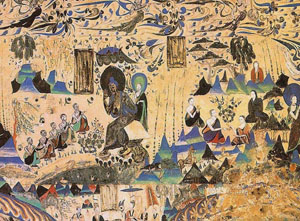
CCTV's recent live broadcasts from Dunhuang's grottoes may be the first time Chinese media have focused on these mysterious marvels. The programs, shown October 22 to 24, showed more than 10 grottoes that had never before been exposed to public view.
Dunhuang is located in Southwest China's Gansu Province. The ancient Silk Road passed through the area, after traversing the Gansu Corridor.
Dunhuang's greatest significance lies in its unique grottoes, located among a wilderness of yellow sands. Researchers say there are 735 grottoes in all, with the Mogao Grottoes providing a representative example. These caves were cut into a cliff 25 kilometers southeast of Dunhuang, part of Mingsha Mountain.
Over a period of approximately 1,000 years, beginning in AD 366, these stone caves were excavated in the area of Dunhuang, eventually forming a 1,680-metre-long south-north complex.
Dunhuang art reached its zenith during the Sui (581-618) and Tang (618-907) dynasties. It adopted Chinese delineation and Western patch coloring, creating depictions of human expressions that were remarkably life-like and elegant.
Dancing images, such as those of flying deities, were especially brilliantly executed, captivating all who have seen them.
Ravages of time
Unfortunately these beautiful images suffered great damage over the course of their long history, with some of them even removed and scattered around the world.
The beginning of the 20th century was the climax of the most shameful period in the Chinese history. In May 1900, the Eight-power Allied Forces intruded into Beijing, the capital of the Qing Dynasty (1644-1911).
Yet it was during this period of chaos that a Taoist priest called Wang Yuanlu accidentally stumbled upon the sacred Buddhist site of Dunhuang.
Wang had served in the army before converting to Taoism. Astounded by the site, Wang hired a man surnamed Yang to transcribe the writings found on the murals.
In 1900, the torch in Yang's hand illuminated an extraordinary and historic discovery -- a small cave containing thousands of preserved ancient sutra scrolls, paintings and sculptures. At the time, Chinese officials took little interest in the Dunhuang treasures.
In February 1906, Marc Aurel Stein, a Jewish employee of the British Government, came to China and -- learning of Wang's find -- rushed to Dunhuang. To his disappointment, he found Wang was personally difficult to deal with.
When Stein was finally allowed into the sutra cave, he was overcome with awe. He described the experience in his book "Travels in West Asia" in the following terms: "When I looked in through a small hole, my eyes opened wide in surprise." By the dim light of Wang's candle, ancient sutra scrolls could be seen heaped up in piles several meters high, over scores of square meters. During the next seven days, Stein rummaged among them. These ancient scrolls and beautiful frescoes, he said, far exceeded any discovery he had made before.
He left the cave with 3,000 sutra scrolls and 500 paintings packed in 29 huge wooden boxes, paying for the treasures with a relatively small amount of silver.
Sixteen months later, when the boxes arrived at the British Museum in London, the whole of Europe was astounded. Stein's discovery was viewed as one of the greatest findings of the 20th century.
The collection from Dunhuang in the British Museum sheds light on many different subjects. The documents in Chinese and minority languages such as Sanskrit cover almost all aspects of society: medicine, military affairs, literature, performing arts, arithmetic, calligraphy and legal transactions.
Other Western nations soon turned their eyes to Dunhuang, and explorers from France, Japan, Russia and the US rushed to the isolated site.
A French explorer, Paul Pelliot, recorded his experience in his diary: "It is a holiday today. I remained in the cave for a dozen hours without interruption, my excitement unabated."
Langdon Warner, an American, hurried to Dunhuang in 1924. He removed 26 of the best frescoes, as well as several colored statues. Warner took 6,000 valuable pieces from Dunhuang to Paris in 1908.
Meanwhile, Pelliot proudly showed off his acquisitions in Beijing, arousing the attention of the Qing Government. Looting continued in Dunhuang until 1909, when the Qing Government finally issued instructions that all remaining sutra scrolls be shipped to Beijing. However, along the way, thefts happened frequently. Out of 40,000 scrolls removed from the complex, only 8,697 arrived safely in Beijing.
The Fogg Art Museum in Harvard University still has parts of the murals that were removed by Warner. Due to air-raids during World War II, those Dunhuang pieces which had been taken to Japan were scattered among private collections for safety, making them very hard to trace.
The number of pieces from Dunhuang now strewn about the world is now unknown.
Furthermore, due to continuing weathering from desert winds, the caves themselves might collapse at any time. Villagers have sheltered their livestock in the Mogao Grottoes and set bonfires in them for cooking.
With Chinese society becoming more stable, Dunhuang's protection had taken on the status of an important national project. In 1943, the Dunhuang Art Institute was established and Chang Shuhong, an overseas student from Paris, was appointed to the job of preserving the site, a goal to which he remained devoted throughout his life.
Others following in his footsteps, included Duan Wenjie, Fan Jinshi and other scholars. Together they persevered in the task Chang had begun.
Since the Mogao Grottoes were first opened to the public in 1979, about 4 million visitors from over 80 countries and regions have come to marvel at the site. The number of visitors has risen particularly steeply in recent years, and it is estimated that
30,000 visitors now come to see the grottoes every year, a number that is expected to rise still further over the next decade.
Li Zuixiong, deputy president of the institute, said restrictions would be placed on access to the site in order to preserve the priceless treasures. Due to the warmth and vapor introduced by visitors, the frescoes could be damaged by excessive contact.
In addition, lack of awareness among visitors made further education necessary: monitoring by the institute showed about 3.9 per cent of the 18,212 visitors actually touched the frescoes.
Since April 2003, the institute has initiated an advanced booking scheme designed to control the number of visitors. A "virtual Dunhuang" system, allowing people to enjoy the art through audio-visual simulation using digital technology, is also being created.
(Shanghai Star November 11, 2004)