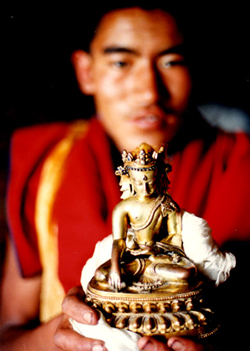
The reincarnation of the Living Buddha is a succession system that distinguishes Tibetan Buddhism from other religions or other forms of Buddhism.
Based on ancient Tibetan beliefs in the nature of the soul and the unique incarnation theory of Buddhism, it was established to solve the problem of leadership succession in various Tibetan Buddhist sects and monasteries.
The term "Living Buddha" emerged in the Yuan Dynasty (1271-1368). It was called sprul-sku in Tibetan, which was the abbreviation of sprul-pavi-sku, meaning "magical change" or "incarnation".
In the 13th century, Tibet became an administrative district under the central government of the Yuan Dynasty. Emperor Kublai Khan (1215-1294) honored Phags-pa, head of the Sa-skya-pa Sect, by granting him the title "Buddha of the Western Paradise". Thereafter, eminent Tibetan monks were referred to as "Living Buddhas."
In the mid 13th century, Yuan Emperor Monge Khan (1209-1259) honored Karma-pag-shi, leader of the bKav-brgyud-pa Sect in Tibet, as "State Tutor" and bestowed upon him a gold-rimmed black hat and a gold seal of authority, which helped the bKav-brgyud-pa Sect become a powerful religious sect with great influence.
In 1283, Karma-pag-shi passed away. Monks of the bKav-brgyud-pa Sect were not allowed to take wives, nor have children. As a result, leaders of the bKav-brgyud-pa Sect could not pass over the religious power to his blood disciples. To prevent power succession from masters to apprentices, which could lead to the malpractice of each sect establishing its own school of thought and the decentralization of power, Karma-pag-shi decided, prior to his death, to adopt the principle of reincarnation in solving the problem of leadership transmission and continuation in his own sect.
His disciples followed his order and located a boy who was determined the reincarnated soul boy of Karma-pag-shi, marking the starting point of the Living Buddha reincarnation system in Tibetan Buddhism. Thereafter, various sects of Tibetan Buddhism reacted to the Living Buddha reincarnation system by creating nearly one thousand similar systems.
After several centuries of practice, a relatively complete set of standards and procedures in searching for and confirming the identity of the reincarnated soul boy had taken shape.
After the death of a Living Buddha, there are various fixed religious practices and procedures to be followed: making funeral arrangements; displaying his body for the purpose of worship; praying and chanting Sutras; praying for his early rebirth; diving and consulting oracles; observing sacred lakes; searching for reincarnated soul boys within the territory of China; checking them repeatedly; asking them to identify the objects left by their previous incarnation and further testing to confirm the soul boy; having him tonsured and welcoming him into the monastery; conferring upon him a religious title; allowing him to be officially enthroned and so on.
Throughout history, central governments of various dynasties paid great attention to the administration over the Living Buddha reincarnation. Living Buddhas usually belonged to the middle or upper class of monasteries and some of them were sect leaders. They played key roles in Tibet's politics and religion and were important forces used by the central government in governing Tibet.
Emperor Kublai Khan of the Yuan Dynasty honored Phags-pa, head of the Sa-skya-pa Sect, as "Imperial Tutor" and authorized him to take charge of the nation's Buddhist affairs. Considering the large number of religious sects in Tibet, the Ming Court (1368-1644) adopted the principle of "conferring honorific titles upon many leaders of religious sects and having them participate in the affairs of the Tibetan government based on historical convention".
For example, the Ming Court conferred the honorific titles, such as the well-known "Three Great Princes of Dharma", the Great Treasure Prince of Dharma, the Great Vehicle Prince of Dharma and the Great Mercy Prince of Dharma upon leaders of the bKav-brgyud-pa Sect, the Sa-skya-pa Sect and the dGe-lugs-pa Sect in Tibet.
After taking power, the central government of the Qing Dynasty (1644-1911) enforced its governance of Tibet by supporting the dGe-lugs-pa Sect.
During that period, the Qing Government greatly enhanced the governing of Tibetan Buddhist Living Buddhas as well as affairs related to their reincarnation, and made governance standardized and systemized.
In 1653, Emperor Shunzhi (1638-1661) granted the Fifth Dalai Lama the honorific title of "the Dalai Lama, Overseer of the Buddhist Faith on Earth under the Great Benevolent Self-subsisting Buddha of the Western Paradise" and bestowed upon him a gold album and a gold seal of authority.
In 1713, Emperor Kangxi (1654-1722) granted the Fifth Panchen with the honorific title "Panchen Erdeni" and also bestowed upon him a gold album and a gold seal of authority. Thereafter, the titles and positions of the Living Buddhas of the Dalai and the Panchen were officially established by the central government of the Qing Dynasty.
Relying on the support from the central government, Grand Living Buddha of the dGe-lugs-pa Sect possessed great political and religious power in Tibet. Therefore, the reincarnation of the Living Buddha became a bone of contention within the privileged class in Tibet, which led to rampant corruption.
In an effort to turn the tide by overcoming the drawbacks that arose from the soul boys being nominated from the same tribes, the Qing Court decided to directly control the search and confirmation of the reincarnated soul boy of the Grand Living Buddha to tighten its governing of Tibet and improve stability along the country's southwestern borders.
In 1793, the Qing Court promulgated the 29-Article Ordinance for the More Efficient Governing of Tibet, establishing the rule of drawing lots from a gold urn. Article one of the Ordinance stipulates: in order to ensure that the Yellow Sect continues to flourish, the Grand Emperor bestowed upon it a gold urn and ivory slips for use in confirming the reincarnated soul boy of a deceased Living Buddha.
For this purpose, four major Buddhist Guardians will be summoned; the names of candidates, as well as their birth years, will be written on the ivory slips in three languages: Man, Han Chinese and Tibetan; the ivory slips will be placed in the gold urn and the learned Living Buddha will pray for seven days before various Hotogtu Living Buddhas and High commissioners stationed in Tibet by the Central Government officially confirm the reincarnated soul boy by drawing a lot from the gold urn in front of the statue of Sakyamuni in the Jokhang Monastery.
If there is only one candidate, his name should also be written on an ivory slip and put into the gold urn together with an empty ivory slip. If the empty ivory slip is drawn from the gold urn, then the boy should not be confirmed and the search for the reincarnated soul boy should continue.
The system of drawing lots from a gold urn ensured that the central government was in control of the search and identification of the reincarnated soul boys of the Living Buddhas of the Dalai and Panchen, further clarifying the subordinate relationship between the central government and Tibet.
The system not only helped maintain state sovereignty in Tibet but also helped avoid bribery and cheating in the reincarnation procedures. It showed a religious ideal that the deities' decisions were just and sacred, and conformed to the Tibetan Buddhist doctrines and religious practices and thus won the hearts of all Tibetans.
The Eighth Dalai and the Seventh Panchen then wrote articles to express their support to the system and gratitude to the Emperor for his concern. The Eighth Dalai issued an official statement, in which he pointed out the importance and necessity of the lot-drawing method and said "in this aspect, those who still confirm reincarnation arbitrarily according to the old custom will be severely punished without mercy".
From 1793 when the system of drawing lots from a golden urn was established up to the end of the Qing Dynasty, 91 reincarnated soul boys were confirmed for 39 Grand Living Buddha pedigrees by the Qing Court, of whom 76 were confirmed through drawing lots from a golden urn and 15 were approved by the central government to be excused from the lot-drawing method due to special reasons.
The central government of the Republic of China (1912-1949) continued the conventions and policies implemented by the Qing Court in the management of Grand Living Buddhas and the reincarnation affairs. The government issued the Regulation on the Management of Lama Monasteries and the Method for the Reincarnation of Lamas in 1935 and 1936 respectively.
It also promulgated methods for searching and confirming the reincarnated soul boys of the Dalai and Panchen and approved the reincarnated soul boys of the 13th Dalai and the Ninth Panchen.
Based on the policies of the previous central governments, especially the practice following the establishment of the system of drawing lots from a golden urn, there are five key points concerning the governing of the Living Buddha reincarnation system by the central government:
(1) The central government keeps under its control the affairs concerning the reincarnation of Grand Living Buddhas. Special commissioners sent by the central government to Tibet will help to implement it.
(2) The local government of Tibet will file a report to the central government for its approval. Then the reincarnated soul boy will be sought according to religious practices. Three boy candidates will be reported to the central government for approval after they were repeatedly examined.
(3) The central government will appoint special commissioners to preside over the lot-drawing ceremony and draw lots.
(4) The designated reincarnated soul boy will be reported to the central government for approval for him to be enthroned. The central government will dispatch officials to visit the soul boy and preside over the enthronement ceremony.
(5) The local government of Tibet will report to the central government for the approval of the reincarnated soul boy's Sutra teachers' names and the use of the seal owned by his previous incarnation.
The religious rituals concerning the reincarnation of Living Buddhas of Tibetan Buddhism and the historical conventions formed during the administration over the reincarnation of Living Buddhas exercised by central governments, especially the common rules followed by all Grand Living Buddha reincarnation systems, have become essential conditions in establishing the authority of the reincarnated Living Buddhas.
They have also become the faith of Buddhist followers. The system and the implementation of it fully demonstrate national sovereignty and the authority of the central governments. It not only helped to improve national unification and solidarity and maintain social stability in Tibet, but also helped to boost the healthy development of the Tibetan Buddhism and consolidate its position in Tibetan society.
(Xinhua News Agency December 20, 2007)