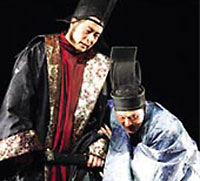
The ancient Chinese tale The Zhao Family Orphan is expected to undergo a new surge of popularity this year. Both the China National Modern Drama Theater and the Beijing People's Art Theater recently staged their interpretations of the play, and a 30-part TV version is in the offing. Famous director Tian Zhuangzhuang has also expressed an interest in making a film of the story.
The two Orphan stage dramas involved considerable innovation as regards plot, characters and theme, and convey different messages. The People's Art Theater performance focuses on conflicts between old and new values, and the confusion and perplexity they create. The focus of the National Theater version is on raising ethical awareness within a commercial society, and the universal significance of justice and honesty throughout history.
Eternal Appeal
The Zhao Family Orphan is regarded as one of China's ten foremost ancient tragedies. After being taken to Europe in the 18th century, it was adapted and performed in Paris in 1775 as the play, the Chinese Orphan.
It is a story known to every Chinese household, and is mentioned in the two ancient historical works Records of the Historian and Zuo's Commentary. Yuan Dynasty (1271-1368) playwright Ji Junxiang rewrote it as a zaju - a kind of poetic drama popular during the Yuan Dynasty, set to music, usually in four acts, with just one singing role in each act. The zaju Orphan was a tragedy with a particularly complex plot. More adaptations of the story into books and plays followed through the following dynasties, one of them the Ming Dynasty (1368-1644) The Eight Righteous Men. Since the Qing Dynasty (1644-1911) it has been performed in all forms of Chinese drama, but the Peking Opera version of the 1960s, with new characters played by contemporary Peking opera masters, was probably the most popular.
Yuan Zaju Version
The, long, intricate five-act zaju The Zhao Family Orphan is based on an account in the Records of the Historian of the fatuous and inept 6th century reigning monarch of the State of Jin Duke Ling, who puts his trust in a treacherous official, Tu Angu. According to the zaju drama, Tu is appointed Minister of Justice, and commander of the military. He has an ongoing feud with another official Zhao Dun, responsible for political affairs. Tu instigates Zhao's wrongful arrest on trumped up charges of treason, and as a result all 300 members of the Zhao family, apart from Zhao's pregnant daughter-in-law Princess Zhuang Ji, are executed. On giving birth to a boy whilst under house arrest, the princess consigns her baby to Zhao's henchman Cheng Ying's care and commits suicide.
On attempting to smuggle the baby out of the compound in a medicine chest, Cheng is discovered by the officer on guard, Han Jue. An upright and compassionate officer, he lets them go, but takes his own life as a penance for failure to perform his duty. Cheng then takes the baby orphan to Zhao's old friend Gongsun Chujiu.
After much fruitless searching for the child, Tu issues an order in the monarch's name, saying that unless the Zhao orphan is found, all infants in the state aged between one and six months will be executed. This forces Cheng and Gongsun to work out a painful strategy to avert this massacre. It entails Cheng's substituting his own son for the orphan, and acting as a treacherous informer by telling Tu Gongsun's whereabouts. Tu puts Cheng's son, to all appearances the Zhao orphan, to the sword, and Gongsun commits suicide by throwing himself down a flight of stone steps after bitterly reviling Tu. Completely fooled, Tu takes Cheng as his aide, and adopts his so-called son, who is actually the Zhao orphan.
When the orphan reaches the age of 20, Cheng draws him a picture that tells of the Zhao family tragedy, and explains to him everything that has happened. Filled with anguish and rage, the orphan vows to avenge his wrongfully executed ancestors. By this time Duke Ling had passed away, and the new monarch Duke Dao is mistrustful of Tu, with his imperious manner and powerful connections. One official who knows about the Zhao family history and the orphan's fate secretly tells the king, and works out a stratagem. In collusion with him, the orphan captures Tu, and Tu and his family are subsequently executed. Duke Dao names the orphan Zhao Wu, and rewards all who helped him.
Disparity Between the Script and Historical Records
The zaju play, The Zhao Family Orphan, differs in some ways from the story told in the Records of the Historian. In the historical account, it is the officer, Han Jue, who is the hero. He opposes Tu's conspiracy to frame the Zhao family, and warns the orphan's father about it. Zhao, however, refuses to flee, and entrusts Han to protect his son and take revenge. Fifteen years later, Han convinces the monarch that the mysterious illness he suffers is actually a curse emanating from the bitter Zhao family ghosts, and that his only cure lies in redressing the injustice. This is how Tu eventually gets his just desserts.
Another major difference between the script and the historical records relates to the character Cheng Ying. According to the Records of the Historian, after rescuing the orphan, Cheng conceals his identity and the two retreat to the mountains, where they live for 15 years in a cave in Yuxian County, in today's Shanxi Province. This was later called the Orphan Hiding Cave, and a temple was built there over 1,000 years ago to commemorate the orphan and those that sacrificed their lives to save him.
According to the Records, the infant killed in place of the Zhao orphan was not Cheng's son, and his identity is not specified. They also state that Cheng ultimately commits suicide to honor all those who sacrificed their lives to protect the orphan.
Rich Connotations
It is believed that the playwright, Ji Junxiang, made these changes to make the play more absorbing, and also to give voice to his own beliefs. Ji was one of the many Han scholars to suffer political persecution and social ostracism under the tyrannical Mongolians of the Yuan Dynasty. He was witness to the threat of eradication of Confucian ideology and traditional Han ethics.
It is significant that Ji based his play on the story The Zhao Family Orphan. The Song Dynasty (960-1270) that preceded the Yuan, was led by the Zhao family, whose ancestors established the State of Zhao during the Warring States Period (475-221 BC). The play therefore represents the author's nostalgia for the old regime and his desire for its reinstatement.
In the play the Zhaos -- orphan, father and grandfather -- are all avatars of justice and humanity, as advocated by Confucianism, and consequently win wide support and help, in contrast to the old monarch Duke Ling and Tu who are feared and despised for their ruthlessness and brutality. Ji's play features four, rather than the two martyrs mentioned in the Records, as a means to emphasize the Confucian virtues of loyalty, morality and courage. Ming Dynasty playwright Xu Jiuyuan redoubles the number of martyrs in his Eight Righteous Men.
Confucian Thought
The martyrs in the play are staunch exponents of Confucianism. Within this philosophy the virtues of justice, courage and honesty are regarded as essential to both individual comportment and effective government.
When Cheng and Gongsun devise a plan to save the orphan, Gongsun asks: "Which is easier, to die or to raise the child?" to which Cheng answers: "To die." Gongsun says: "As you have close ties with the Zhao family, you are obliged to take the more difficult course." In order to shield the orphan, Cheng endures 20 years of infamy for his feigned disloyalty and immorality -- a fate far more agonizing for a Confucian gentleman than death could ever be. Chinese ancients believed that a true gentleman defends his beliefs and moral character to the extent of being willing to sacrifice his life to them. Su Shi (1037-1101), a Song scholar, was quoted as saying: "A gentleman treasures most his reputation and integrity. They merit laying down his life for a just cause, dying to achieve virtue, and choosing death rather than suffering humiliation."
According to the Analects of Confucius, one of Confucius's students, Zi Gong, once asked him what was fundamental to effective governance. Confucius said: "Sufficient food and arms, and the people's trust." On Zi Gong's question, "Which is most important?" Confucius answered unhesitatingly, "People's trust. Everyone in the world will eventually die, but no one can maintain a place in society without trust." On another occasion Confucius raised the concept of "rule by justice" in response to a question on governance of a country by student Ji Kangzi. The sage upheld the principles whereby a ruler should be imbued with the virtues of probity, honesty and benevolence, as well as the courage to die for a noble cause.
Centuries ago, such concepts were regarded as sacrosanct by both rulers and the masses, and wielded tremendous influence over Chinese ideology throughout history. They still hold sway today. Regarded as moral norms, they define people's attitude towards crucial, fundamental issues.
A hymn to the faithful and noble, The Zhao Family Orphan embodies the glorious principles of traditional Chinese ethics. The Chinese Orphan was adapted by Voltaire in 1775. He described the story as "the morals of Confucius in five acts." His version encompassed war and love, but morality was its main focus.
The essential belief expressed in The Zhao Family Orphan is that good will eventually overcome evil, no matter what vicissitudes and tribulations history brings, and that justice and integrity never perish.
(China Today March 31, 2003)