Enter the Forbidden City from the north gate, turn right and walk alongside the red palace wall, first west, and then south.
After about five minutes' walk you will see on the left a door leading to a small courtyard.
With two or three one-storey houses in the shadow of giant ancient trees, the courtyard seems isolated from the buzzing crowds of tourists exploring the 600-year-old palace of Chinese emperors.
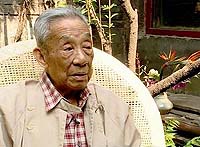
In that courtyard, renowned scholar Zhu Jiajin worked more than half a century, but on September 29 he passed away.
He recognized and retrieved vast numbers of cultural relics, many of them national treasures, from deserted warehouses, antique shops and flea markets and gave them a home in the Palace Museum.
He also donated cultural relics worth millions of dollars from his and his family's collection to public museums in China.
Among the treasures he re-discovered was the emperor's throne from the Taihe Hall, the main ceremonial hall in the palace.
The throne was lost for nearly four decades after 1915, when Yuan Shikai (1859-1916), who set himself up as emperor in 1915, replaced it for a sofa from Europe.
In the neglected warehouses of the palace were piled dozens of thrones, made of red sandalwood, rosewood and ivory, but they all seemed out of place in the hall.
It was not until 1959 that Zhu found among a pile of old furniture and wooden timbers in the warehouse of the palace the broken throne. He recognized it from a photo he had seen.
Widely respected as a "national treasure" himself, Zhu lived in a dilapidated house of 20 square metres in a hutong. In his friends' eyes, he was nothing more than an ordinary, happy Beijing laotour (old man) with a quirky personality.
Ma Zhefei, an old friend of Zhu and a veteran reporter with the China Cultural Relic News, quoted Zhu as saying: "Those who come to see me after my death must have liked me, and I will look ugly stretched out straight on the bed. So don't come. My friends can get together and look at my photos, taken when I was young, when I was a Peking Opera performer."
Ma said: "He had such a young heart and an open mind that his friends could never relate him with death."
Born in 1914 in Beijing, Zhu Jiajin belonged to the 25th generation of the descendants of Zhu Xi (1130-1200), a great Chinese philosopher whose influence on Chinese thought has continued to this day.
His father, Zhu Wenjun, an Oxford graduate in 1908, saved every penny he could to collect ancient books, Buddhist scrolls, paintings, bronzes, and jade and ceramic wares.
In the 1930s, Zhu's family owned "the ultimate" art collection in Beijing, said Qi Gong, a renowned calligrapher and scholar.
Zhu Wenjun started working in the Palace Museum in 1926.
Early impressions
Zhu Jiajin had a chance to enter the Forbidden City on the founding of the Palace Museum on October 10, 1925.
"The doors of the more than 900 houses in the palace were all opened, and I could see that the last emperor Puyi had lived like everyone else in his house called Yangxindian. He left in such a hurry in 1924 that a biscuit tin was left open on the table," he recalled in an interview this year with China Central Television.
He entered the Forbidden City for the second time at age 14. The student from a missionary school was touched when he read an imperial edict written by Emperor Kangxi (reigned 1661-1722).
The emperor was in sparsely populated Northwest China to do battle against a rebelling ethnic group. After a long, arduous journey across the desert, he reached a place called Elute and unexpectedly found there two giant stone tablets inscribed, "Emperor Yongle (reigned 1402-24) of the Ming Dynasty (1368-1644) fought here," recalled Zhu.
On the back of the tablets were four lines of poetry which read, "The Tianshan Mountains are the edge of my sword, / And the desert is the handle. / The country is to unify and bring peace / to this desert land forever."
"Kangxi was as deeply touched reading the inscription as I was as a teenager," said Zhu.
Zhu often recited the sentences, and the grand heart of that ancient emperor must have been with him through the rest of his life, said Ma.
During the War of Resistance Against Japanese Aggression (1937-1945), the then Chinese Government moved the national treasures from the Forbidden City to Southwest China to keep them out of the hands of the Japanese.
Expert in many fields
Zhu, who had been familiar with antiques since childhood, was invited to participate in the packing and labeling in Chongqing, in Southwest China in 1946, to prepare for the return of the treasures to Beijing.
"It was such a pleasant job. We took the ancient calligraphy works and paintings out of the closets with our own hands, spread them out, examined and labelled them, and put them into cases. It was an indescribable joy to be involved in this work," said Zhu.
"I can still feel my heart beat fast when I look at these works of art today. The only difference is that I didn't understand them as a young man, but now I do."
Unlike other researchers who specialize in one field, Zhu was an authority in almost all fields of research on the Forbidden City, including books, calligraphy works, paintings, bronzes, ceramics, jade wares, royal etiquette, the history of the royal family and also architecture.
From the 910,000 relics in the museum's collection, Zhu selected 100 and compiled a book titled National Treasures in 1983. The nation's leaders have given copies of the book to foreign dignitaries as gifts and translated versions of the book have become bestsellers abroad.
"The various fields of study in the Palace Museum are inter-related and expertise in one leads to research of others," said Shi Anchang, researcher with the museum.
Shi remembers a discussion between Zhu and himself about the Chunhuage Tie (Model Letters from the Imperial Archives in the Chunhua Reign). There are different versions of the calligraphic collection, which dates back over 1,000 years, in the archives of the Forbidden City.
Zhu suggested to Shi that he pay attention in his research to the version stored in Maoqindian, the emperor's office. "It must be good, as the emperor often used it," said Zhu.
"It was an inspiring thought to judge the value of relics by how they were used by the royal family," said Shi.
Great donation
Actually, one of the most valuable parts of the museum's collection of ancient calligraphy works was donated by Zhu's family. In 1953, collector Zhu Wenjun's four sons, Jiaji, Jialian, Jiayuan and Jiajin, gave the museum 700 rubbings of ancient tablet inscriptions in the family's collection.
"My father passed away in 1937, and I was no more than 20 when he promised Ma Heng, then the museum curator, to donate the collection after his death. We did what he wished when our mother mentioned the promise in 1953," said Zhu.
"The museum is the best home for such a systematic collection," he noted.
In 1969, the family gave a red sandalwood table that was widely known among collectors and dated back to the Ming Dynasty, to the Zhejiang Provincial Museum. They also donated an ink-slab used by Liu Rushi, a female poet who lived around the end of the Ming Dynasty.
In 1976, the family gave dozens of pieces of red sandalwood and rosewood wares of the Ming Dynasty and red sandalwood furniture of the Qing Dynasty (1644-1911), and a number of ancient artifacts such as an incense burner made in the Xuande period (1425-35) and famous ink-slabs of the Ming Dynasty to the Mountain Resort Museum in Chengde, in North China's Hebei Province.
"In the early 1920s, the greatest collectors of valuable furniture were from the Pu, Guo, Guan and Zhu families, and among them the Zhu's collection was the best in quality and the largest. Most of the collection is now in the Mountain Resort Museum," Wang Shixiang, a renowned researcher and connoisseur of ancient Chinese arts and artifacts said in "Jin Hui Dui," a three-volume collection of Wang's works.
In 1976, the family also donated tens of thousands of ancient rare books to the collection of the Institute of History of the Chinese Academy of Social Sciences.
In 1994, the last part of the family's collection was given to the Zhejiang Provincial Museum, including paintings by established artists of the Tang (AD 618-907), Song (960-1279), Ming and Qing dynasties, furniture used in royal gardens, ink-slabs and musical instruments.
From then on, the Zhus no longer collected art. "I have only a small house and the relics are better preserved in museums. I cannot sell them as I know they would surely go abroad, and it would be very difficult to get them back again," said Zhu, who led a thrifty life on a modest salary.
Zhu travelled across 25 provinces, regions and municipalities around China from 1992 to 1997 as a member of the expert team of the State Administration of Cultural Heritage, to help the provincial, municipal and county museums appraise their collections.
The team visited one county a day for almost eight months a year.
Ma, who accompanied Zhu to Baoding, in North China's Hebei Province, said it was freezing cold when they arrived there in the early morning. Ma suggested they rest for several hours before starting work around noon.
"No. The local museum has to pay a day's accommodation for us if we cannot finish today," said Zhu.
"They are already short of funds. We have to return to Beijing tonight," stressed the scholar and collector of national treasures.
(China Daily October 21, 2003)