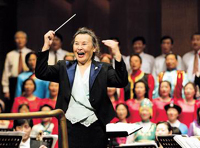
Zheng Xiaoying is one tough cookie. After retiring six years ago from the Central Opera House in Beijing, she has helped create the Xiamen Philharmonic Symphony from the ground up. But she didn't expect it to evolve into such a labor of love and pride.
In the male-dominated world of orchestra conductors, a 75-year-old woman can rest comfortably for her trailblazing contributions, but not Zheng Xiaoying.
On Saturday, Zheng led the six-year-old Xiamen Philharmonic Symphony Orchestra, China's youngest professional orchestra, for a performance at the ongoing Fifth Shanghai International Arts Festival. Their only concert won such thunderous applause in the He Luting Concert Hall of the Shanghai Conservatory of Music that the room was flooded with noise.
"Bravos" and "encores" echoed and rumbled throughout the hall. The first climax came when famous pianist, 62-year-old Yin Chengzong and Zheng harmoniously brought "Yellow River Piano Concerto" to a grand coda. Yin had two encores -- a short piece adapted from a Peking Opera aria and one from Tchaikovsky.
As audience members indulged in the excitement, Zheng and her young orchestra struck again with "Echo from the Hakka Earth Building," an award-winning symphony specially made for the orchestra. Composed by Liu Yuan, a graduate from the Shanghai Conservatory of Music, the symphony tells the legend of Hakka people who moved from central China to Fujian Province in the south hundreds of years ago.
"They left their hometown not because of harsh nature, weather or famine," Zheng said to the audience, "but because they didn't want to serve the new king after a war. They were intellectuals who brought rich culture to the then-isolated land of Fujian."
Zheng spoke articulately in standard Mandarin. Without a microphone, her resonant voice echoed in the hall and there was something touching in her voice -- a mix of pride and excitement. She said she too was a Hakka descendant and was proud to be from such hard-working, optimistic and strong-willed people.
Certainly, she shares those characteristics. She was the first female conductor in the country, one of the best conductors in China, and the only person who built a non-state-owned orchestra from the ground up in Xiamen.
Since the orchestra received no direct government funding, Zheng lobbied and raised money herself, a role she continues.
"There were some times I regretted why I ever started the job," Zheng said. "Sometimes, it seemed that I was begging for money from others, which I never thought would happen in my life."
In the first two years, the orchestra had no fixed place for rehearsals or performances. Zheng half-jokingly referred to the group as a "Gypsy" orchestra.
Motivated by the young musicians -- mostly fresh graduates from conservatories all around China -- she managed to keep it alive and help the orchestra evolve into something special.
The orchestra, which the Xiamen mayor enthused as "a pretty name card" for the coastal city, now has more than 100 repertoires and performs weekly in Xiamen, forming a concert-going habit among the locals. It also toured the country and Japan. Last year, they accompanied all the concertos in the Fourth International Junior Tchaikovsky Music Competition held in Xiamen.
"If it were not for Ms Zheng, I would not have played `Yellow River' in Xiamen, my hometown," said pianist Yin. "She is a tough woman with a strong will. You see, it is very hard to establish an orchestra in a completely strange city."
Six years ago, it was Yin who recommended Zheng to Xiamen, which never had an orchestra in its history. At that time, Zheng had just retired as the principal conductor at the Beijing-based Central Opera House where she worked for a few decades.
But Zheng denied that she accepted Xiamen's invitation because she was a Hakka descendant whose father came from a small Fujian town and later became one of the first group of Chinese students studying in the United States.
"For people like me, it is hard to tell where the real hometown is," said the Shanghai-born Zheng, who was raised in Chongqing, studied in Beijing and Moscow, worked in the capital and finally came to Xiamen. "I accepted the offer because the local government was very sincere in building an orchestra. And I took it as a challenge and opportunity."
However, destiny deemed Zheng use her musical clout to do something for the Hakka people. Three years ago, when she first visited her father's hometown in the west of Fujian, she was amazed by the round "tu lou" (earthen buildings) where groups of Hakka people used to live. The four-story house was decorated by exquisite paintings, calligraphy and wood sculptures.
"Suddenly I felt an urge to do something for my Hakka heritage," said Zheng. She invited Liu, who spent his childhood in Fujian but is not Hakka, to compose a song. The "Echo" symphony was the result.
The Xiamen orchestra debuted it three years ago at the 16th World Hakka People's Meeting in Fujian and it was an instant hit. Liu's work also won the Golden Bell Award, the highest honor for composition in China.
"Echo" had become a signature work of the Xiamen orchestra. Zheng brought it to many places around the country and eventually Japan and the United States.
"I feel very nervous bringing it to Shanghai, China's first city to embrace symphonic music," Zheng said before the concert.
However, the great success spoke for it all.
The grandiose symphony teemed with folk music influences. At the end of the second movement during the local concert, 74-year-old farmer singer Li Tiansheng chanted in Hakka dialect as a man said farewell to his lover and set off for Southeast Asia in hopes of making a better living. In the next movement, Zhan Jingjing, another senior Hakka, blew leaves to hum a lullaby echoed from hometown.
But nothing compared to the finale when more than 100 local amateur choristers stepped onto the stage and sang in unison in Hakka dialect, "No matter how high mountains are, people will dig their way out; No matter how deep water is, people will build bridges over."
Suddenly Zheng turned around from the podium and waved her hands toward the audience, signaling them to sing as well. Though the Shanghai audience could not speak the dialect, some mimicked the words and many clapped their hands rhythmically to the music beat. Finally the clapping turned into a long, standing ovation when the music ended splendidly.
Another two encores -- Ravel's "Spanish Rhapsody" and "Purple Bamboo Tune," a typical piece of Shanghai folk music, followed as the audience practically refused to let go of Zheng.
When the symphony was performed in Japan and the US, the Japanese and American choruses also sung the finale in Hakka dialect. When the work debuted at the Hakka meeting three years ago, the audience, mostly Hakka descendants, sung passionately with the chorus in the end.
"At that time, I thought if my father could see me from heaven," Zheng said emotionally. "He would be very proud of me." Zheng Xiaoying Mode In the Shanghai concert, before each movement of "Echo from the Hakka Earth Building," Zheng would explain the motif and sketch a scene for the next movement as she always does in concerts.
This practice, controversial as it is, has already been called "Zheng Xiaoying Mode," as she had lectured more than 300,000 people about the meaning of a symphony or opera before the performance. Zheng took up the practice more than 20 years ago, when she found that young people were unable to appreciate classical music in China in the late 1970s. "They talked, laughed and slept during the performances," said Zheng. "I remember a young man came up to the orchestra, pointed at me and said to his friend, `See why they play so well. There is a woman beating time'." Hurt by the ignorance, Zheng didn't lose heart began teaching audiences how to understand music and concert manners before each performance. She insisted regardless of the location -- musical halls or open space on campus, in villages or at factories. This practice is welcomed by newcomers to the music, but critics maintain that she destroys the audience's imagination. Nonetheless, she believes the public should be informed enough to understand and that the music is for everyone, not just privileged intellectuals. "As long as one person falls in love with classical music after my concert," said Zheng. "I think it is worth doing."
(eastday.com November 5, 2003)