On the Loess Plateau, a donkey carried cases of shadow play props while five players walked with musical instruments strapped on their backs.
They traveled through mountain passes and villages until, under the starry sky, they set up an oil lamp and paper screen on which they made cowskin figures dance. A vigorous cry transported the audience into a make-believe world populated by deities engaged in historical happenings.
This is a Daoqing shadow play from eastern Gansu Province in northwest China.
Centred in Huanxian County of Gansu Province, Daoqing music is a genre of narrative music popular not only in the eastern part of Gansu, but also in Yichi County of Ningxia Hui Autonomous Region and Dingbian County of Shaanxi Province.
As a saying goes, "Daoqing and shadow play can not be separated.'' The Daoqing shadow play genre of eastern Gansu is an art blending high-pitched, sonorous Daoqing music with delicate, vivid shadow play.
In Huanxian, there are still some 50 Daoqing shadow play groups performing in towns and villages. To probe this unique art, our group, consisting of six people engaged in the research of folk music and literature, took a three-day trip to the county last October.
Long traditions
Going through the Mu-Us Desert and entering the Loess Plateau, we seldom saw anyone except for an occasional shepherd or children on their way home from school.
When night fell we arrived in Huanxian, a hinterland on the Loess Plateau. The same night, at Huanxian Hotel, we saw the Shi family group, which was preparing a show for a conference held there.
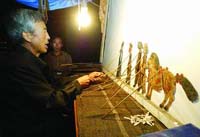
When we arrived, the "stage'' was already set up. It was simply two tables covered by a 2-metre-long and 1-metre-wide piece of rice paper. A lamp was hung behind the paper screen, projecting light onto the screen.
As the shadow puppeteer (tiao qian ren) moved his fingers, the figures came to life and their appearance, dress and movements could be clearly seen from the other side of the screen.
The puppeteer was also the lead singer. All the figures and props needed for the show were hung on ropes beside him.
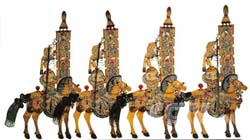
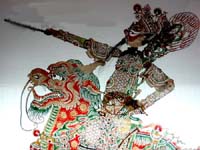
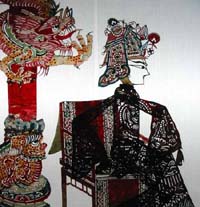
The figures, made of cowskins, go through processes of hair-removing and thinning before they're finally carved according to certain moulds.
Shadow play includes the role types of traditional Chinese opera: the sheng (male role), dan (female role), jing (painted-face role) and chou (clown role). The heads and bodies of the figures are disposed separately. A shadow play group usually has about 400 figure heads, 150 figure bodies and 100 other figure props like tables, chairs, horses and weapons.
Lead singer Shi Chenglin said his study of shadow play from his father started with recognizing these figures.
Endowing the figures with souls is the Daoqing music of eastern Gansu. The Daoqing style, born from the Taoist music of the Tang Dynasty (AD 618-907), was originally a kind of unaccompanied song preaching Taoist thoughts. Since the Southern Song Dynasty (1127-1279), Daoqing practitioners began to use percussion instruments such as the yugu (percussion instrument made of bamboo barrel) and jianban (percussion instrument made of two bamboo slices with a bell attached to each), while the themes expanded from Taoist stories to folk stories, fairy tales and legends.
Based on the dialect of eastern Gansu, the Daoqing falls between speaking and singing with its style of one note for one Chinese character.
The Daoqing of eastern Gansu is also characterized by its contrast between lead singing and group singing. The lead singing is unmetered and unaccompanied, while the group singing, sung by everyone in the group except the wind instrument players, is strictly rhythmic and more melodic.
The instruments used in the Daoqing of eastern Gansu include the drum, bangu (small drum), yugu, jianban, sixian (four-stringed plucked instrument), erhu (two-stringed bowed instrument), small gong, big gong, cymbal, suona (woodwind instrument), dina (small suona), bamboo flute and shuibangzi (wooden block and bell).
That night, the Shi family group performed excerpts from Three Battles with the White Bone Demon and Wang Qi Fears His Wife. The next day, at the County Culture Hall, they gave another performance, this time of a full play, Campaign to the Northern Pagoda.
According to Shi Chenglin, their repertoire consists of small plays (lasting for about three hours) like Campaign to the Northern Pagoda, middle plays (over four hours) like Going Back to Chang'an and Meeting in the Bamboo Forest, and big plays (over five hours) like Jiuhua Mountain and Leifeng Pagoda.
Besides being invited to perform at ceremonies such as weddings and funerals, shadow play groups also give shows at temple fairs. There are many temple fairs in Huanxian, the most famous being the Xinglong Mountain Temple Fair on every March 3 of the Chinese lunar calendar.
The Xinglong Mountain Temple Fair was established in the early Ming Dynasty (1368-1644). For hundreds of years it had been a meeting place for people from the area encompassing Gansu, Shaanxi and Ningxia, particularly monks and Taoists on their way to Xi'an or Yan'an.
The shadow players observe the habit of worshipping deities before a show.
Shi Chenglin said there are two reasons for this habit: first, the performances of shadow play rely on temple fairs; second, shadow players believe a troupe cannot exist or be succeeded without the blessing of deities.
In the repertoire of shadow play, there are some small pre-show dramas about deities. For example, Blessing from the Heavenly Governor tells about how the heavenly governor blesses the human world and protects the safety and health of the people.
Except in some new plays adapted from humorous folk tales, the themes of shadow plays are always related to ghosts and deities, on whom the people place their simple ideals of life. When there seems to be an irresolvable problem in the play, there will always be ghosts or deities to give the story a perfect ending.
Shi Chenglin is the leader of the Shi's Family band. In Huanxian, whoever has a "case'' can form a group and be the leader. Some groups are familial groups of stable members, while the players of some other groups are only hired by the leader before a show.
Shi believes the relationship within a familial group is often too complicated to guarantee a high-quality lineup, so he prefers to pick the best available players before a show.
Usually shadow play groups hire as few people as possible. Most musicians of Daoqing shadow play can play several instruments. A minimum number of five people are able to form a group with all the necessary instruments.
For a performance at a temple fair, a shadow play group can get 80 yuan (US$9.60). As both a group leader and lead singer, Shi earns about 5,000-6,000 yuan (US$610-732) a year. Most of the money goes into his case. Last year he bought some sound equipment, because sometimes there were so many people in the audience that the sound could not be heard by everyone.
The second day we were there, we saw a show performed by the Zhao family group led by 58-year-old Zhao Lianwu. The Zhao family group performed "Reforesting the Cultivated Land,'' a new work to publicize governmental policy, and a traditional play.
There are established rules about the program of shadow plays. Generally ghost plays or deity plays are performed at temple fairs, while plays about dutiful sons are performed on ceremonies held by sons for their late parents.
"Reforesting the Cultivated Land'' was written for the Shadow Play Art Festival in July, which indicated that in addition to temple fairs and life rituals, official activities have become a new source of revenue for the local shadow play groups.
Among the members of the Jing's family group, Jing Dengqi was best at playing various instruments, especially the sixian. All the young people of the Jing's family group studied with him.
Jing Dengqi was once an actor of Longju Opera and trained his two children to be professional actors of Longju Opera. Jing was recognized as a master lead singer. Daoqing music of eastern Gansu, after all, was the forerunner of Longju Opera.
Jing Dengqi was more reserved than the other members of the Jing's family group.
"My father travelled all the 70 li (35 kilometers) on the mountain road to see my performance with the Longju Opera troupe, but on the way back home he accidentally fell into a dried well and died,'' said Jing Dengqi. "This was the most painful incident in my life. I gave up an opportunity to perform in Italy after that.''
Jing seemed to be unable to shake off the pain. However, from the moment he opened his mouth to sing the Daoqing, passion poured forth from his inner world.
Jing Tingyou, Jing Dengqi's uncle, is the most extroverted of the Jing's family group.
Though he said he felt too old to perform, his eyes began to shine immediately when the music started.
"Whatever bitterness there is in life, you have to forget it as soon as you begin to perform or you won't get into the roles,'' he said.
Using different tones to depict the indecent looks of drunken people, he triggered endless laughter and applause from the viewers.
"I can play whatever the audience likes to see; I am a person of no embarrassment,'' he said.
Familial groups like the Jing's group helped preserve shadow play during the "cultural revolution'' (1966-76). The Jings' saved figures in good condition in one case, and handed in surplus props.
Lack of followers
However, though the Daoqing shadow play has been preserved, its succession has become a big problem. No one of the fifth generation of the Jing family group is performing now. Some of them became workers in the city, others became actors of Longju Opera.
Shi used to have students, but for instruments only because it's very difficult to be a lead singer who must remember all the lines, tunes, rhythmic patterns, characters' activities, scenes and props.
Shi said that to learn shadow play one needs strong interest and persistence, for it takes 10 to 20 years just to become adept at controlling the figures. A good memory is also essential, since a large play can last for seven hours.
In addition, one must be talented in performing to depict roles of different genders, ages, identities and personalities through speech and singing.
Unlike most other shadow players, Shi Chenglin finished primary school. He has read many books, including Method of Playing the Bamboo Flute and Method of Playing the Yangqin (dulcimer).
Hoping to pass on the Daoqing shadow play to the younger generations, he suggests the government should organize courses and invite folk artists to teach.
Good news is that Daoqing shadow play has been enlisted as one of the folk performing arts in a preservation project supported by the Ministry of Culture.
(China Daily January 6, 2004)