Amid both global objections and plaudits, the 1997 United Nations Kyoto Protocol to cut greenhouse gas emissions and reverse global warming finally came into effect on February 16.
Twelve days later, China's renewable energy law was approved by the Standing Committee of the National People's Congress (NPC). It is scheduled to take effect at the beginning of next year.
Chinese environmentalists and experts see the protocol an opportunity for China to better develop its resource-saving techniques and industries. The newly-approved law came just as another incentive.
The protocol not only sets obligation for developed countries to cut emissions, but also calls for help to developing countries like China to pursue renewable energy so that greenhouse gas emissions caused by burning fossil fuels can be cut, Greenpeace China said after the law was approved.
Renewable energy is a vital solution to global warming and a must for countries to pursue sustainable development, it said, adding that the law will play a major role in China's economic development plans.
"China could and should be a world leader in the development of renewable energy," said Greenpeace energy policy adviser Yu Jie in Beijing.
Li Ganshun, an environmental and economic expert with Hebei University, said the protocol will bring heightened renewable energy awareness.
Li pointed out that solar energy is very likely to become a major sector in China.
That is because as much as 66 percent of the country's land area enjoys sunshine for more than 2,000 hours a year.
In addition, Li said that with the rapid development of photovoltaic techniques and materials, the costs of solar energy are dropping dramatically.
He predicted that prices will drop substantially, perhaps even below those of coal-burning power within the next decade.
Wang Zhongying, director of the Centre for Renewable Energy Development under the Energy Research Institute of the National Development and Reform Commission, said China's chances lie in following the clean development mechanism of the protocol.
The mechanism crucially allows trading in emission reductions.
Wang said that as costs for emission reductions in developed countries become much higher than those in developing countries, developed countries will tend to invest in and transfer techniques to developing countries to receive reduction credits.
The Kyoto Protocol stipulates that developed countries have to cut their emissions by 5.2 percent, from their 1990 levels by 2008-12, while developing countries, including China, are not bound by specific reduction obligations.
From now through 2012, China can carry out additional mechanism trading projects related to renewable energy so that its techniques can be upgraded and the industry improved, Wang said.
Currently, such techniques in China lag far behind international levels, he said.
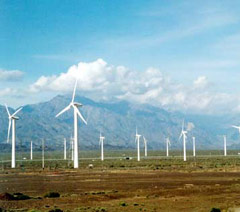
For example, domestic producers can only manufacture wind power generators that have a capacity of 600 to 750 kilowatts. But overwhelmingly-used generators around the world have a capacity of more than 1.5 megawatts.
By the end of last year, 82 percent of wind power generators in China were imported.
China should be prepared as early as possible in terms of cutting greenhouse gas emissions, Wang said.
Although there are no specific obligations for China now, the country will have to cut emissions in the future, he added.
Some Chinese companies working within renewable energy also consider the Kyoto Protocol an opportunity.
Sources with the Tianwei Yingli New Energy Resources Company, based in Baoding, North China's Hebei Province, believe the protocol offers unprecedented chances for the introduction of foreign funds and techniques.
The company is now spending 400 million yuan (US$48 million) to expand its production line.
After the expansion, the company can produce 70-megawatt silicon wafers, 50-megawatts solar sells, and 100-megawatt solar modules. The company currently builds 6-megawatts silicon wafers and solar cells and 50-megawatt solar modules.
Green chances
Gao Guangsheng, director of the office of the National Co-ordination Committee on Climate Change, said that encouraging the use of renewable resources is a major measure for China to deal with climate changes.
He admits that challenges are ahead for China to reduce greenhouse gases as the world's most populous country industrializes and faces huge energy consumption needs.
"The consumption is inevitable because traditional fuels are consumed for some Chinese just to sustain a living," said Gao.
Despite that, Gao said China is mapping a comprehensive, concerted and sustainable strategy to deal with climate change.
The country will continue to promote energy efficiency and the development and utilization of new and renewable energy, carrying out reforestation activities vigorously and thereby making contributions to mitigate and adapt to climate changes.
Liu Jiang, deputy minister of the National Development and Reform Commission, described the Kyoto Protocol as "hard won" and he expects that China will co-operate with the international community with regard to technology transfer and funds.
"Without any doubt, we have to depend on science and technology to meet the challenges of climate change," said Liu.
Nowadays, large-scale infrastructure construction is ongoing in developing countries including China, and less sophisticated technology will lead to emissions of greenhouse gas for decades to come, if advanced and environmentally friendly technologies are not introduced.
"Technology does exist but often it is the mechanism for technology dissemination and transfer that is missing," said Liu.
He also said that China will help other developing countries adapt to climate change while taking the lead in emission reduction activities.
"All in all, emphasis shall be put on specific actions," said Liu, referring to the fact that the protocol, as well as numerous decisions and action plans, has been entered into force.
"Our actions are still not enough," said Liu.
He said that international communities need to set up more co-operative mechanisms that suit the situations of different countries as well as mobilize their enthusiasm.
"Furthermore we need to enable the government sectors and private sectors to participate more fully in activities dealing with climate change," said Liu.
International help
The international community has been helping China to better understand the mechanism and develop renewable energy.
In 2001, the World Bank and the German and Swiss governments offered funds to China to conduct such studies. An English report on the results of the project was published last year.
In early February, the Chinese edition of the report was published. Experts and officials hope it can be a theoretical and technical guide for the development of mechanism projects in China.
Meanwhile, a project on capacity building for the rapid commercialization of renewable energy in China was launched in 1999 with the support of the Global Environment Facility, the government of the Netherlands and the Australian government.
The facility is an independent financial organization that provides grants to developing countries for projects that benefit the global environment and promote sustainable livelihoods in communities.
The project hopes to drive forward the widespread commercialization of renewable energy technology applications using market-driven mechanisms.
Wang Zhongying, also the national co-ordinator of the project, said the project will wrap up this year.
(China Daily March 6, 2005)