A rusty broadsword hangs in the Military Museum of the Chinese People's Revolution, dozens gather to stare.
The broadsword looks dark and its blade blunt. Yet, according to the museum guide, Chinese soldiers used the weapon against Japanese troops in the first days of the War of Resistance against Japanese Aggression (1937-1945) in north China.
In the memoirs of general Qin Dechun (1893-1963), then vice-commander of the 29th Army fighting around Lugouqiao Bridge (Marco Polo Bridge) in southern suburban Beijing, he described Chinese broadsword troops assaulting a Japanese position: "Who said the Japanese 'royal' soldiers were not afraid of death? They kowtowed before Chinese broadsword holders to beg for mercy."
Lugouqiao Incident
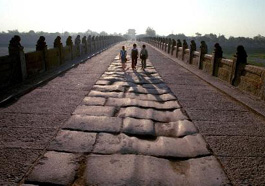
Standing above the Yongding River, Lugouqiao Bridge has long been a major icon of the capital. The landscape around it is famous for its serene and peaceful atmosphere.
But on the night of July 7, 1937, this sense of tranquillity was shattered. With the Lugouqiao Incident, Japan started its all-out invasion of China, while the Chinese had to make the choice between subjugating themselves to Japanese rule or uniting to fight for the country's dignity and independence.
For Chinese living in northeast China, September 18, 1931, was a day of humiliation. On that day, the Japanese occupied and began supporting an illegal Manchurian kingdom in northeast China.
In the following years, Japanese troops in north China there as a result of unfair foreign treaties Qing Dynasty (1644-1911) and warlord governments signed with Japan in the early 20th century tried to provoke the Chinese Government.
Under strong military and diplomatic pressure, the then Kuomintang (KMT) government under Chiang Kai-shek (1887-1975) made concessions time and time again. "As soldiers who had the responsibility of defending our land and sovereignty, we had to make concessions repeatedly. The sorrow and regret were imaginable," Qin said in his memoirs.
However, Japanese generals were not satisfied with China's concessions. In 1936, Japanese troops conducted provocative war exercises in Fengtai in the southern suburbs of Beiping, the name of Beijing at the time, and ignited a bloody conflict with Chinese troops.
Soon after, the Japanese occupied Fengtai.
Beginning in late June 1937, several hundred Japanese soldiers were deployed to the west end of Marco Polo Bridge while Kuomintang forces, garrisoned in Wanping Town near the bridge, watched closely.
At midnight on July 7, the Japanese army telegraphed the KMT forces saying that a soldier was missing and was believed to be hiding inside the town. The Japanese demanded that its army should be allowed to enter the town to search for the missing soldier.
Colonel Ji Xingwen (1908-1958) denied the request.
In the early morning of July 8, Japanese artillery started shelling the town and invading infantry, supported by tanks, marched across the bridge at dawn. Ji ordered the KMT forces, made up of about 1,000 soldiers, to hold the Japanese back at all costs. By the afternoon, Japanese forces had partially overrun the bridge and the surrounding area. KMT troops, with fresh reinforcements, outnumbered the Japanese and retook the bridge the next day.
It was during this battle that broadsword troops were thrown into the fight, and they succeeded in beheading many of the Japanese invaders.
Just days later, a song called the "Broadsword March," which went: "Assault, assault, with our broadswords, striking the heads off Japanese invaders," had spread across the whole country.
Manifesto
In the years since China's victory in the war, debate has raged over the incident with some historians, particularly those from Japan, claiming that it was unintentional.
Li Zhongming, a historian with the Institute of Modern History under the Chinese Academy of Social Sciences, believes the incident was a result of Japan's long-term planning to invade China.
In appearance, the incident was no different from previous military skirmishes aroused by the Japanese military's provocative actions. But records show that on the second day of the incident, Japan decided to move its troops from occupied Northeast China to Beiping and just four days later, Japanese Prime Minister Fumimaro Konoe (1891-1945) moved to increase Japan's military presence in North China.
"Without long-time preparation, it would have been impossible for a country to launch such a massive war over such a short period of time," Li told China Daily.
Hou Xiguang, a historian from the Beijing Academy of Social Sciences, quoted the memoirs of Takeo Imai, a Japanese military intelligence officer, in an article to prove that before the July 7 Incident, rumour had been spreading among officials in Tokyo that an attack against the Chinese army would take place on July 7.
Li Huaxing, a historian with the Shanghai Academy of Social Sciences, said that the Lugouqiao Incident was the starting point of China's comprehensive defence against Japanese troops across the country.
On July 8, the Central Committee of the Communist Party of China, which for years had been calling on the country to unite to fight Japan's aggression, issued a manifesto to the whole nation calling for a war of resistance. The manifesto reads in part:
"Fellow countrymen! Beiping and Tientsin (Tianjin) are in peril! Northern China is in peril! The Chinese nation is in peril! A war of resistance by the whole nation is the only way out
"Let the people of the whole country, the government, and the armed forces unite and build up the national united front as our solid Great Wall of resistance to Japanese aggression! Let the Kuomintang and the Communist Party closely cooperate and resist the new attacks of the Japanese aggressors!"
What was unfolding also proved that the Lugouqiao Incident was merely a ploy by the Japanese to launch an all-out invasion of China.
On July 8, negotiations were held between general Hashimoto, the commander of all Japanese forces around the cities of Beiping and Tientsin, and general Zhang Zizhong (1891-1940), a subordinate of general Song Zheyuan (1885-1940), commander-in-chief of the 29th Army. Song was then still away in Shandong on holiday.
On July 9, the Chinese side accepted the Japanese request to retreat to the bases they held before the July 7 Incident. However, during the negotiations, two Japanese divisions were on the march to north China from northeast China, or so-called Manchuria, and Korea, then a colony of Japan.
On July 11, Japanese Prime Minister Fumimaro Konoe issued an order to increase Japan's military presence in north China. By July 24, Japanese troops in nearby Beiping had surpassed 100,000, equipped with artillery, tanks, and bombers.
On the other side, the 29th Army, although more than 100,000 strong, was equipped with only rifles and barely enough mortars and heavy machine guns. Between July 11 and 23, Song failed to prepare for the coming conflict, believing it would be another small-scale affair like those of previous years, which were all solved diplomatically.
But the time for diplomacy had passed.
On July 17, Chiang Kai-shek published his "A Serious Declaration on the Lugouqiao Incident," stating that Chinese people loved peace, but would not pursue peace when their territory was invaded.
Japan's demands following the Lugouqiao Incident were more than China could accept; the Rubicon had been crossed.
On July 25, in Langfang, then a small town about 100 kilometers east of Beiping, Japanese troops attacked Chinese soldiers defending the railway station. The conflict soon spread to Beiping.
During the night of July 27, Japanese troops began comprehensive attacks against the Chinese military in Beiping. Supported by bombers and tanks, Japanese troops occupied Nanyuan, a military fort in southern suburban Beiping.
Fierce battles raged.
General Tong Linge (1892-1937), vice-commander of the 29th Army and general Zhao Dengyu (1898-1937), a divisional commander of the 29th Army, both lost their lives in the fight for the city. Meanwhile, some 5,000 Chinese officers and soldiers were either killed or wounded.
Despite a brave defence, Song decided to withdraw his main force from Beiping on July 28.
Throughout the night of July 29, Chinese troops began the fight back against Japanese troops in Tianjin. The battle lasted nearly 20 hours before Chinese troops were forced to withdraw in the face of superior firepower and numbers.
On August 1, the remaining Chinese soldiers in Beiping pulled back, leaving the ancient Chinese capital to the Japanese.
On August 13, a bloody battle broke out between Chinese and Japanese forces in Shanghai. Chinese soldiers were ordered to attack, with light weapons, Japanese positions equipped with modern weapons of war. More than 500,000 Chinese soldiers were killed or wounded in the intense fighting.
The stance of the KMT government, with support from the Communist Party and other organizations, then became clear China would not give in to Japanese military strength. The KMT government began to assemble its troops across the country and moved vital industrial equipment to mountainous Southwest China then in China's rear.
Meanwhile, the Japanese Government passed several acts between July and September 1937 increasing the budget for its invasion of China, stopped demobilizing soldiers, and began calling up more men to the army.
By mid-1938, 95 percent of Japanese ground forces had been sent to the China front.
Yet, after the Lugouqiao Incident, the ferocious and modern Japanese army bogged down in the vastness of China and they came up against strong resistance from the Chinese people.
Eventually, the Japanese were forced to suffer what they had sown, bitterly, said general Li Zongren (1891-1969), former vice-president of the KMT government, in a chapter of his memoirs on the Japanese invasion.
(China Daily July 7, 2005)