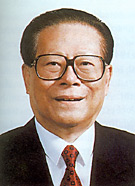
 Jiang Zemin (1926- ), native of Yangzhou, Jiangsu Province.
General Secretary of the Central Committee of Communist Party of China (CPC); President of People's Republic of China (PRC); Chairman of CPC Central Military Commission; Chairman of PRC Central Military Commission.
Jiang was re-elected general secretary of 15th CPC Central Committee, chairman of the CPC Central Military Commission, and Standing Committee member of Political Bureau in September 1997; and president of the People's Republic of China and chairman of the PRC Central Military Commission on March 16, 1998 at the First Session of the Ninth National People's Congress (NPC).
In China, Jiang Zemin is generally regarded as "the core of the leadership of the third generation" since, in people's eyes, he is the top leader succeeding Mao Zedong and Deng Xiaoping, at the center respectively of China's leadership of the first and second generations.
Jiang's re-election as president of the People's Republic of China and chairman of the Central Military Commission is a common wish of the Chinese people.
In the past nine years since Jiang became the country's top leader, China has been stable socially and politically, its economy has continued to develop, its national strength has continuously increased, its government has been extremely active diplomatically and the people's living standard has risen steadily.
During this period, the country's gross domestic product (GDP) grew at an average annual rate of about 11 percent. Not only did the economy undergo a rapid growth, but inflation was brought under effective control. It is a common wish of the Chinese people of all ethnic groups to maintain the current momentum of development.
Jiang was born in August 1926 to an intellectual family in Yangzhou, a historically and culturally famous city at the lower reaches of China's Yangtze River. The cultural background of his family with a long tradition of learning enabled him to read extensively Chinese and foreign literary masterpieces and thus to have a solid foundation in literature.
However, he chose Shanghai Jiaotong University, a prestigious university of engineering in China, with electrical engineering as his major.
It was Jiang Shangqing, his uncle and foster father, who exerted a great influence on his becoming a career revolutionary later. His uncle, a Communist, who led a regional anti-Japanese armed force in the northeast of Anhui Province and north of the Huai River in China, sacrificed his life for the country in a battle in 1939.
Jiang graduated from Shanghai Jiaotong University in 1947. During his college years, he participated in the CPC-led students movement against Chiang Kai-shek's autocratic rule, and joined the Communist Party of China in 1946.
After the founding of New China, Jiang served as an associate engineer, head of a workshop and deputy director of a factory in Shanghai. In 1955, he was sent to the Soviet Union to work in Moscow's Stalin Automobile Works as a trainee for one year.
After his return home in 1956, he served as director of factories and research institutes in the big industrial cities of Changchun, Shanghai and Wuhan. Later, he was transferred to Beijing to take charge of the Foreign Affairs Department of the First Ministry of Machine-Building Industry under the State Council.
After 1980, he served successively as Deputy Director of the State Import and Export Administration and the State Foreign Investment Administration, Vice-Minister and Minister of Electronics Industry, Mayor of Shanghai, Secretary of the CPC Shanghai Municipal Committee, and member of the Political Bureau of the CPC Central Committee.
He was co-opted Standing Committee member of Political Bureau, and elected General Secretary of the CPC Central Committee in June 1989 at the 4th Plenary Session of the 13th CPC Central Committee. He was appointed Chairman of the CPC Central Military Commission in November 1989 at the 5th Plenary Session of the 13th CPC Central Committee. In March 1990, He was elected Chairman of the PRC Central Military Commission at the 3rd Session of 7th NPC. He was elected Standing Committee member of Political Bureau, and General Secretary, of CPC Central Committee, and chairman of CPC Central Military Commission. in October 1992. On March 27, 1993 Jiang was elected PRC President and chairman of PRC Central Military Commission at the 1st Session of 8th NPC.
Jiang' family background and unique personal experience have made him always cherish a lofty ideal to enrich the people, strengthen the nation and rejuvenate China. When Deng Xiaoping put forward his initial ideas to build special economic zones (SEZ), Jiang, serving as a leading official at that time in the State Import and Export Administration and the State Foreign Investment Administration, was resolute in their implementation without the least hesitation.
Facing a wilderness-like Shenzhen then, he made a clear proposal: "All development projects in the SEZ should be started from a long-term point of view and should not follow the traditional system." Now, China's first special economic zone, Shenzhen, which is adjacent to Hong Kong, has developed into a bustling metropolis with a population of over one million.
While he was in office in Shanghai, he won public praise from the more than 12 million Shanghai residents for his remarkable achievements.
Above all, the relatively backward condition of urban construction and infrastructure in Shanghai had to be changed so as to expedite city development. Jiang together with his colleagues drew up a plan to transform municipal infrastructure with the help of international capital, using external investments of over three billion US dollars for the construction of key projects such as a subway, Nanpu Bridge, water pollution treatment, airport expansion and program-controlled telephone exchanges.
Now, people marvel at rapid developments in Shanghai, where "there is a change in a year and a big one in three years." This has to be attributed to the new thinking of utilizing external funds and the new mechanism of "borrowing, spending and repaying money by oneself." These policies were made while Jiang held office in Shanghai.
After he came to Beijing, Jiang's ability to manage Party and state affairs was further put to good use. Under the leadership of the CPC Central Committee with Jiang at the core, China's reform, opening up and the modernization drive moved forward uninterruptedly. Based on Deng Xiaoping Theory, a major policy decision was made under his direction to establish a socialist market economy, and an Outline of the Ninth Five-year Plan (1996-2000) for National Economic and Social Development and Long-Range Objectives Through the Year 2010 were formulated.
On the basis of summing up the experience of the reforms and opening up, he expounded in an all-round way 12 major relationships in China's economic and social development and pointed out that a proper balance between them should be maintained. Especially in his report delivered to the 15th National Congress of the CPC, Jiang, holding high the great banner of Deng Xiaoping Theory, drew up a series of important guidelines for an all-round advancement of the cause of building socialism with Chinese characteristics into the next century.
Particularly in economic restructuring, new significant advances have been made. Not only has it been established that to keep public ownership in a dominant position and to have diverse forms of ownership develop side by side is China's basic economic system for the primary stage of socialism, but also it is clearly pointed out in the report that public ownership can and should take multiple forms and that all government methods and organizational forms that reflect laws relating to socialized production, including the joint stock system and the joint stock cooperative system, may be utilized boldly.
It is further clarified that the non-public sector is an important component part of the socialist market economy and should continue to be encouraged and guided to a healthy development. In the reform of the political structure, new progress has also been made.
It is clearly pointed out in the report that the scope of democracy should be further extended, ensuring people the rights to hold democratic elections, make policy decisions in a democratic manner, and institute democratic management and supervision. Ruling the country by law should be upheld and great efforts be made to promote socialist democracy with Chinese characteristics.
His report of more than 30,000 Chinese characters has been regarded as "a political declaration and program of action of the third generation of the collective leadership of China leading the nation toward a new century."
In leading China's reform, opening up and modernization drive, Jiang has paid close attention to the correct handling of the relationship between material progress and cultural and ethical progress. He has said that economic backwardness is not socialism and nor is spiritual deficiency socialism.
In recent years, the CPC Central Committee under his direction made a series of major policy decisions to develop socialist culture and ethics, and to strengthen and improve the leadership of the Party.
These measures have helped China improve its social atmosphere. Paying attention to ethics and civilities has become common practice.
The anti-corruption campaign has also won positive results. Such major cases as that of Chen Xitong, a former member of the Political Bureau of the CPC Central Committee and former Secretary of the Beijing Municipal Committee of the CPC, have been investigated and dealt with according to law. All these moves have won popular support.
Jiang is fully aware that in order to carry out the modernization drive in a big country with a population of 1.2 billion, social stability is a prerequisite.
Hence, he lays particular stress on the need to balance reform, development and stability, and has formulated the basic principle of "seizing the current opportunity to deepen reforms and open China even wider to the outside world, promoting development and maintaining stability."
Even though China's political situation has become more stable, its economy prospered and people's living standards improved day by day, Jiang as China's top leader has never been intoxicated with successes, and has constantly exhorted leading cadres at all levels: "We should have the awareness of hardships and think of danger in times of safety."
With regard to contradictions and difficulties existing in economic and social life, he always keeps a clear head and exerts himself to resolve them.
In the past nine years, he has traveled to all of China's provinces (except Taiwan), autonomous regions and municipalities directly under the Central Government, and gone deep into grassroots units for investigation and study as well as for the understanding of social conditions and popular will.
Wherever he goes, he will invariably visit those workers whose enterprises have not extricated themselves from difficulties, and express his sincere concerns. He pays special attention to the life of those people who live in poor areas of remote provinces.
The Chinese Government under his direction worked out a very ambitious "plan to alleviate poverty" and was determined to accomplish in the main the task of providing adequate food and clothing for the needy in rural areas within this century.
In the diplomatic field, the third generation of collective leadership with Jiang at the core has demonstrated its outstanding capability to cope with the international situation and handle all kinds of complex international affairs.
In the past nine years under his leadership, China has scored a series of diplomatic successes. China's international standing has risen increasingly and its influence on international affairs has kept growing.
China's relations with all countries in the world have further developed on the basis of the Five Principles of Peaceful Coexistence. The good-neighborly relations with surrounding countries have further consolidated, and solidarity and cooperation with the vast number of developing countries have greatly strengthened.
In particular, his successful state visit to the United State in 1997 made the Sino-US relations enter a new stage.
Jiang as a statesman of the new generation has the distinct makings and style of a scholar. He has extensive knowledge. He loves reading, and the most he reads are the latest books on economics, science and technology, politics and culture.
While in office in Shanghai, he wrote papers such as On the New Features of the Development of World Electronic Information Industry and Strategic Problems of the Development of China's Electronic Information Industry, the Trend of Energy Development in the World and Main Energy-Saving Measures, which were published in the Shanghai Jiaotong University Journal.
He can use English, Russian and Romanian, and knows some German and Japanese. In meeting with foreign guests, he often expresses his viewpoints in foreign languages.
He is highly accomplished in famous works of classic Chinese literature and often quotes in talks well-known lines from exponents of various schools of thought as well as Tang, Song and Yuan poetry.
He also reads extensively famous works of Western literature. He loves to read novels by Mark Twain, and can recite passages from Hamlet by Shakespeare and verses from "Ode to the West Wind" by Shelley. He also knows very well works by Leo Tolstoy, Pushkin, Chekhov and Turgenev.
He not only loves literature, but has a wide range of other interest. He likes both erhu tunes by A Bing, a great master of Chinese folk music, and symphonic music by Mozart and Beethoven, great masters of Western music.
At leisure, he may play erhu and bamboo flute, traditional Chinese musical instruments, as well as the Western musical instrument piano. He thinks that art treasures of Chinese and Western cultures are the common spiritual wealth of mankind.
Jiang has a warm, harmonious and happy family. He and his wife Wang Yeping have two sons, a grandson and a granddaughter. In his spare time, Jiang often indulges in sporting with these "pearls in his palm" in great joy, tells them stories and teaches them to recite ancient poetry and read English, thus enjoying the traditional Chinese family life of "several generations living under one roof."
In April of 1998, the UN Food and Agricultural Organization presented its "Agricola" medal to Jiang for his outstanding contribution to increasing food production and eliminating poverty and hunger.
In 1999, he attended the Macao handover ceremony as a member of Chinese Government Delegation.
|