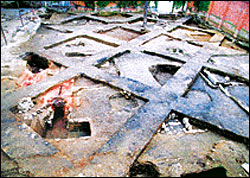
China's Top-Ten archaeological discoveries of 2004 were announced in Beijing on April 17, 2005:
1. Prehistoric Site at Beifudi, Yixian County, Hebei
Province.
2. Neolithic Cemetery in Ruicheng County, Shanxi Province.
3. Palatial Site at Erlitou of Xia and Shang Dynasties, Yanshi, Henan Province.
4. Burial Site from the Bronze Age, Lop Nur, Xinjiang.
5. Ruins from the Western Zhou Period, Tanheli, Ningxiang County, Hunan Province.
6. Tombs for Nobles of the Yue State, Wuxi City, Jiangsu Province.
7. Southern Gate of Longcheng Palace in Chaoyang City, Liaoning Province.
8. Southern Han Mausoleums in Guangzhou, Guangdong Province.
9. Southern Song Imperial Road Remains in Hangzhou City, Zhejiang Province.
10. Winery Remains in Mianzhu City, Sichuan Province.
1. Prehistoric Site at Beifudi, Yixian County, Hebei Province.
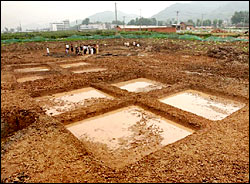
The Neolithic site (dating back about 7,000-8,000 years) was excavated by a team from the Cultural Relics Research Institute of Hebei Province, led by Duan Hongzhen.
The Beifudi site, first discovered in 1985, is by far one of the most important prehistoric sites in Hebei Province, boasting great significance in the research on prehistoric civilization in North China.
The first-phase Neolithic site is the most significant discovery of the three prehistoric digs made between 2003 and 2004, as it contains relics of a culture that existed close to the Cishan and Xinglongwa cultures of about 6,000-5,000 BC, which fills up the regional blanks between the two cultures.
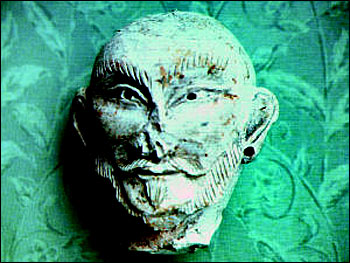
A great number of dwellings and ash-pits were excavated, as well as sacrificial sites, jade and stone pieces, pottery, and carved ceramic masks. The masks are so far the earliest and the most well-preserved masks from prehistoric times, providing new important material for the study of primitive religion and wizardry, and shedding light on early Neolithic culture in North China and the spiritual life of the ancients.
The Beifudi site at is located where the three prehistoric cultures of the Central Plains, North, and Shandong meet, which makes it important in the study of the comprehensive relations among the three cultures. The site is the remains of a large Neolithic village.
2. Neolithic Cemetery in Ruicheng County, Shanxi Province.
In October 2003, a team from the Shanxi Provincial Cultural Relics and Archaeology Institute conducted a small-scale excavation at a Neolithic cemetery first found in 1955. The cemetery of the Miaodigou II Culture is located to the northeast of the Qingliang Temple, a Yuan Dynasty Buddhist monastery, in Ruicheng County in north China's Shanxi Province, covering an area of nearly 5,000 square meters.
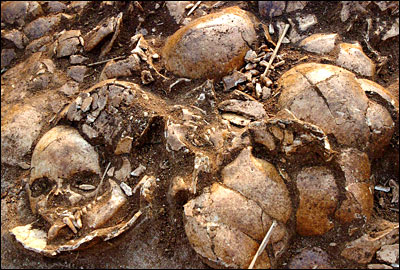
The following year, the team launched a second excavation project, digging the cemetery more extensively. By November, they had unearthed a total of 262 tombs, and found more than 200 funerary objects made of jade.
According to team leader Xue Xinming, in general, the larger tombs were 1.3-1.8 meters wide and 2.3-2.6 meters long. They were arranged in proper order and those buried must have belonged to the same tribe. Archaeologists also found two sets of smaller more ancient tombs, about 0.5-0.8 meters wide and 2 meters long.
The cemetery was created during a period of great change for the Central Plains (a birthplace of the Chinese civilization, referring to the middle and lower reaches of the Yellow River). During this time, different cultures met and mingled here. The finds in the cemetery have shed new light on the study of the origin of the Chinese civilization.
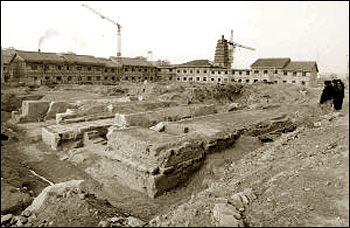
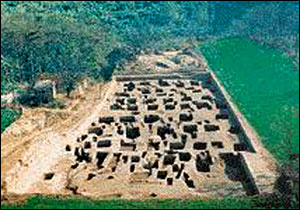
3. Palatial Site at Erlitou of Xia and Shang Dynasties, Yanshi, Henan Province.
In July 2004, a team from the Archeological Research Institute of Chinese Academy of Social Sciences, led by Xu Hong, discovered the remains of a palace at Erlitou in Yanshi City in central China's Henan Province.
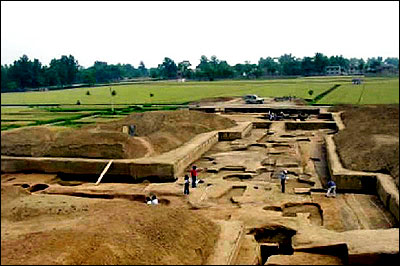
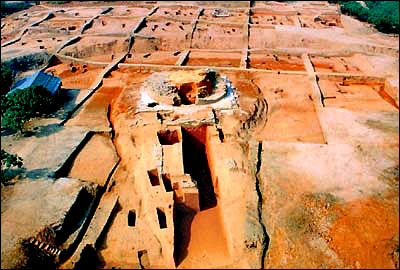
Covering 108,000 square meters, the rectangular city was about 300 meters wide from east to west, and 360 meters long from north to south. In the palace grounds, nine large building sites have been dug up, two of them revealing obvious axial lines. The ruined sites, dating back about 3,600 years to the era of Xia (21-16th century BC) and Shang (16-11th century BC) dynasties, reportedly make up the earliest palace grounds ever found in China.
Criss-crossing roads formed the transportation network in the palace's central area. The square-shaped palace complex and the roads were all lined up in an orderly way, indicating that the palace grounds had a clear layout, which might have served as the model for the construction of later imperial palace grounds.
Important relics, such as wheel tracks, and the remains of turquoise ware making workshops, were also found. The discovery of two-wheeled tracks pushes back the appearance of two-wheeled vehicles in China to as early as the Xia Dynasty.
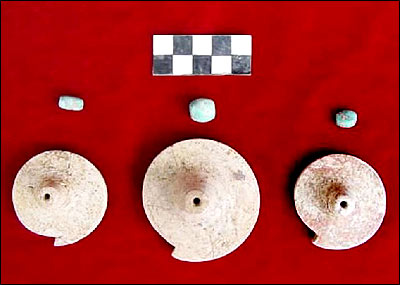
In addition to the discovery of the said tracks, a large turquoise dragon ware was excavated, which is believed to be the earliest dragon-shaped totem. The dragon, about 70 centimeters long and made up of 2,000-odd various fine pieces of turquoise, is a rare antique in terms of scale, exquisiteness, and weight.
4. Burial Site from the Bronze Age, Lop Nur, Xinjiang.
A local hunter found the location of the tomb complex in 1910, and later guided Swedish explorer and archeologist Folke Bergman there in 1934.
The full-scale excavation project was launched in October 2003 by the Xinjiang Cultural Relics and Archaeology Institute, led by Idresi Abdulres, with the approval of the State Administration of Cultural Heritage.
A total of 167 tombs have been dug up since the end of 2002. In addition, the excavated complex has revealed hundreds of smaller tombs built into several layers, and other precious relics.
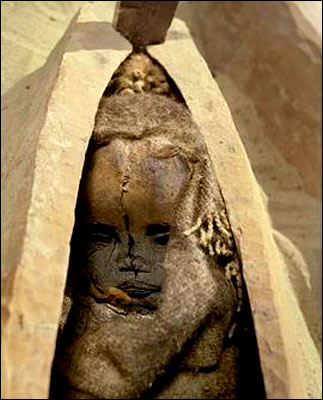
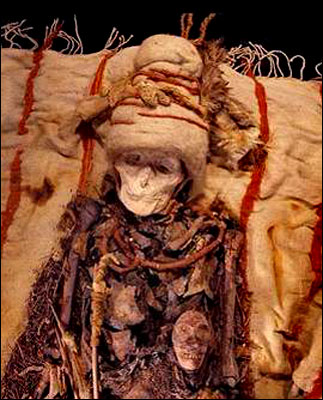
The exterior of the site is an oblong sand dune, from which more than 30 well-preserved mummies have been excavated. The mummies were buried in air-tight ox-hide bags.
The Xiaohe Tomb complex, which sprawls over 2,500 square meters, actually contains about 330 tombs. Unfortunately, about 160 of them have been desecrated by grave robbers.
The most startling discovery was four wooden coffins buried in the deepest layers of the complex. The bodies of four women lie in four boat-like coffins with woolen mantles, gold earrings and caddice necklaces. What makes this discovery so startling is the fact that not a speck of dust has sullied any of the coffins.
Tall timber structures symbolizing the reproductive organs of males and females stand atop the sand dune.
The Xiaohe tomb complex is 175 kilometers from the ruins of the Loulan Kingdom, an ancient civilization that vanished 1,500 years ago. The rediscovery of the tombs will no doubt play a very important role in the research of the Loulan civilization and climatic changes that have taken place in Lop Nur.
5. Ruins from the Western Zhou Period, Tanheli, Ningxiang County, Hunan Province.
The site was excavated by the Cultural Relics and Archeological Research Institute of Hunan Province in 2004. The excavation team was led by Xiang Taochu.
The team found a city wall from the Western Zhou Period (11th century-771BC) at Tanheli, Ningxiang County, Hunan Province. Part of the discovery included two large-sized artificial building sites, consisting of yellow earth, and two larger-sized sites, possibly palatial dwellings. Remains of moats from the same period were also discovered both inside and outside the city. Seven small tombs for nobles and lords were dug up in the highlands outside the city, from which a large number of bronze and jade wares were also excavated.
This was the first time that the ancient city ruins of the Western Zhou Period were discovered in Hunan Province. The site is of great significance to the study of Hunan's regional history, bronze culture, and the formation of early state and society. The site also provides important material objects for researching the bronze civilization in the Western Zhou Period in the Xiangjiang River valley and the southern area as a whole.
6. Tombs for Nobles of the Yue State, Wuxi City, Jiangsu Province.
The tombs at Hongshan Town, Xishan District, were excavated jointly by the Nanjing Museum Archaeology Institute and Xishan District Cultural Relics Management Committee of Wuxi. Leading the project was Zhang Min.
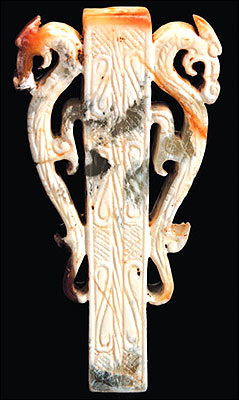
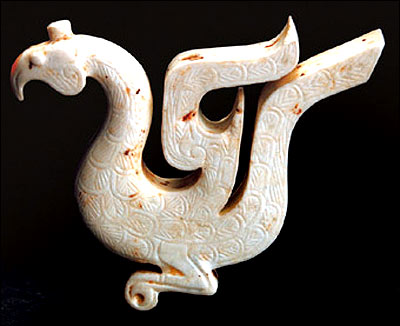
The findings give clues on the burial rites for nobles of the Yue State (770-446BC). The tombs are of varying sizes, presumably in accordance with the ranking of the nobles, of which there were five. More than 2,000 pieces of burial articles were found in the seven tombs successfully excavated.
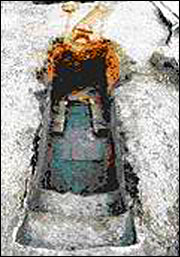
One of the tombs at Qiuchengdun stretches some 57 meters in the shape of the Chinese character "zhong" (which means "center" and characterized by a rectangle with smooth edges and a long line down the middle). It is the second largest ever made for a noble of the Yue State, second in size only to the tomb of the King of Yue at Yinshan, Shaoxing in Zhejiang Province.
A total of 1,100 funerary articles were found, including complete sets of pottery, musical instruments and jade wares. The 500-odd porcelain musical instruments, about 10 varieties, make the tomb the largest underground storehouse of ancient instruments ever discovered, which includes the yongzhong (a type of bell) and qing (chime stone) from the central plains, chunyu (a metal percussion instrument), dingning (a bell with a handle), duo (big bell) and ling (little bell), which were made in typical Yue style. More significant was the discovery of the fou, a clay musical instrument whose existence could not be confirmed until now.
The site can be compared, in terms of number and variety of musical instruments, with the Mausoleum of Marquis Yi of the Zeng State (around 433 BC), which is famous for its Zeng Houyi Bells, the largest set of bronze bells excavated in the world, and its stone chimes.
The site's four spherical pottery pieces in red, blue, and white glaze, each made of eight coiling snakes, are rare research materials that can aid in the study of the origin of glass and the cultural exchanges between China and other countries.
The tomb site dates back to the early years of the Warring States Period (475-221BC), possibly during the reign of King Goujian who took the throne in 496 BC. The findings mark the most important archaeological discovery on the State of Yue to date. The site not only has far-reaching significance on the study of Yue history and culture, but may also help rewrite part of the ancient history of not only this region, but also that of music and porcelain making.
7. Southern Gate of Longcheng Palace in Chaoyang City, Liaoning Province.
Following a brief unification during the Western Jin Dynasty (265-316), the country was divided once again. South China came under the rule of the Eastern Jin Dynasty (317-420), while 16 ethnic regimes, known as the Sixteen States (304-439), were established one after another in the north.
Chaoyang City in northeast China's Liaoning Province was the capital -- then named Longcheng (Dragon City) -- of Pre-Yan (337-370), Post-Yan (384-407) and Northern Yan (407-436), three of the 16 ethnic regimes. The municipal government started a resettlement project in 2003 to give the 1,600-year-old city a facelift. In a coordinated effort, from July 2003 to December 2004, a team from the Liaoning Provincial Cultural Relics and Archaeology Institute dug a total area of over 10,000 square meters at 11 sites of the ancient capital, and unearthed a number of relics dating from the Sixteen States to the Qing Dynasty (1644-1911).
Of the discoveries, one still stands on what is known today as Beidajie (Northern Street), and archaeologists think it might be the south gate of Longcheng Palace. This gate is believed to be one of the most important finds of the year-long excavation project.
"This gate was initially built in the Pre-Yan, reconstructed during the Post-Yan, Northern Yan, Northern Wei (386-534), Tang (618-907), Liao (or Chitan, 916-1125) and Kin (1115-1234) dynasties, and completely discarded in the Yuan Dynasty (1279-1368)," said team leader Tian Likun. Its well-preserved gateway provides significant clues to the study of ancient cities in north China during the Sixteen States era. And more important, the discovery of the southern gate will help in the restoration of Longcheng's original overall arrangement.
8. Southern Han Mausoleums in Guangzhou, Guangdong Province.
From June 2003 to October 2004, a team from the Guangzhou Municipal Cultural Relics and Archaeology Institute conducted a survey and salvage excavation project in tandem with the construction of the Guangzhou University Town on the Xiaoguwei Island in Guangzhou, the capital of south China's Guangdong Province.
The dig turned out to be extremely fruitful with the discovery of two large brick tombs, which were later determined by archaeologists to be the royal Deling and Kangling mausoleums of the Southern Han (917-971).
The short-lived Southern Han state was a separatist state established in south China during the Five Dynasties and Ten States (902-979) period. It's the second local regime in Chinese history that established its capital in Guangzhou following the Southern Yue (204-111 BC) era. In its heyday, the Southern Han territory covered today's Guangdong and Hainan provinces and Guangxi Zhuang Autonomous Region as well as parts of Yunnan and Guizhou.
The Kangling mausoleum, in which King Liu Yan was buried in 942, is situated on the southern slope of the Daxiang Hill. A park covering an area of some 5,550 meters was built on the grounds, while the underground coffin chamber measuring 11 meters long, 3.15 meters wide and 3.3 meters high was constructed with bricks and decorated with murals. A tablet inscribed with a funeral oration unearthed from the tomb is the oldest to have been found in China.
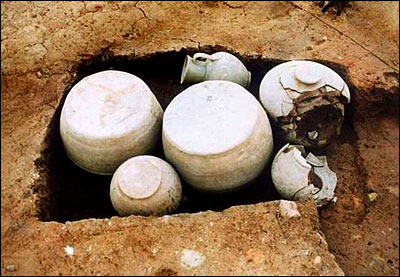
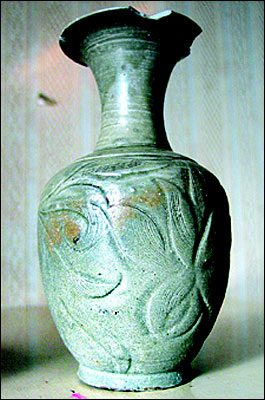
The Deling, in which King Liu Yin, Liu Yan's brother, was buried, is on the northern slope of the Qinggang Hill, only 800 meters away from Kangling. Although it is not as large as Kangling, 190 celadon pots and 82 glazed ceramic jars were found in the well preserved mausoleum, all of which were fired in the court’s porcelain kilns.
Team leader Feng Yongqu said the finds at the two mausoleums are of great value in studying the history of the "mysterious" Southern Han, about which researchers have little knowledge.
9. Southern Song Imperial Road Remains in Hangzhou City, Zhejiang Province.
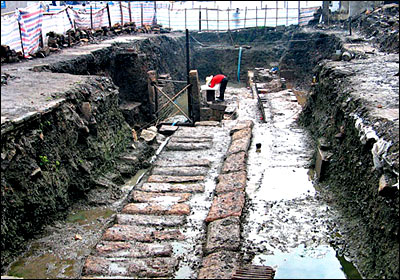
Lin'an, the capital of the Southern Song Dynasty (1127-1279), is today Hangzhou in Zhejiang Province. In coordination with the construction of the Wansongling Tunnel in the city, a team from the Hangzhou Municipal Cultural Relics Conservation and Management Office conducted a salvage excavation along the Yanguan Lane from December 2003 to August 2004, and found for the first time ruins of the Southern Song "imperial road".
When Lin'an City was being constructed, open alleys gradually replaced the previously enclosed lanes. The unearthed road for the emperor's carriage served as the city's north-south axis. According to historical records, on both sides of it stood government offices and shops in great numbers.
The remains of the road are 400 meters north of the imperial palace and 100 meters south of the imperial ancestral temple. Based on what has been unearthed so far, team leader Du Zhengxian inferred its total width to be over 20 meters.
Archaeologists also found remains of river courses and piers, indicating that both land and waterway modes of transport were used in the ancient capital.
10. Winery Remains in Mianzhu City, Sichuan Province.
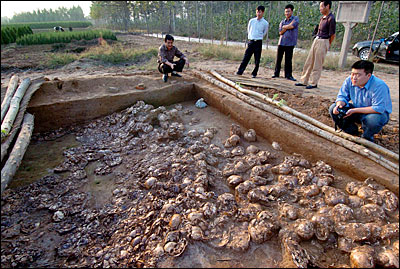
Mianzhu City in southwest China's Sichuan Province boasts a 4,000-year-old history of wine-making. When demolishing its old factory buildings in April 2003, the Mianzhu-based Jiannanchun Group Ltd Co found the ruins of a winery measuring some 12,000 square meters. Immediately, a joint team from the Sichuan Provincial Cultural Relics and Archaeology Academy, and the Deyang Municipal Cultural Relics and Archaeology Institute began a survey and trial excavation of the site that lasted until August. The excavation resumed from August to November in 2004.
In total, they dug an area of 800 square meters, unearthing wells, wine cellars, stoves, barns, distillation equipment, ditches, building foundations and roadbeds dating back to the Qing Dynasty (1644-1911), according to team leader Chen De'an.
The well-preserved remains indicate that the winery was composed of a number of small workshops in which different kinds of liquor were produced. The striking finds at the site helped to restore the traditional wine-making technology and in learning more about the development of the handicraft industry that existed at the time.
Further excavation might reveal more clues that could extend the history of the remains back to the Ming (1368-1644) and Song (960-1279) dynasties, said Ning Zhiqi, head of Mianzhu's cultural relics conservation and management office.
(China.org.cn July 7, 2005)