Population: 5,813,947
Major areas of distribution: Inner Mongolia, Liaoning, Jilin, Heilongjiang, Xinjiang, Henan, Hebei, Gansu, Qinghai, etc.
Language: Mongolian and Han
Religion: Lamaism
The Mongolians live mostly in the Inner Mongolia Autonomous Region, with the rest residing in Liaoning, Jilin, Heilongjiang, Xinjiang, Qinghai, Gansu, Ningxia, Hebei, Henan, Sichuan, Yunnan and Beijing. Having their own spoken and written language, which belongs to the Mongolian group of the Altaic language family, the Mongolians use three dialects: Inner Mongolian, Barag-Buryat and Uirad. The Mongolian script was created in the early 13th century on the basis of the script of Huihu or ancient Uygur, which was revised and developed a century later into the form used to this day.
The largest Mongolian area, the Inner Mongolia Autonomous Region with its capital at Hohhot, was founded on May 1, 1947, as the earliest such establishment in China. This vast and rich expanse of land is inhabited by 23.84 million people, of whom over 3.57 million are Mongolians and the rest are Hans, Huis, Manchus, Daurs, Ewenkis, Oroqens and Koreans.
The Inner Mongolia Autonomous Region is located in the northern part of China. Covering 1.2 million square km and rising 900 to 1,300 meters above sea level, it has vast tracts of excellent natural pastureland with numerous herds of cattle, sheep, horses and camels. The Yellow River Bend and Tumochuan plains, known as a "Granary North of the Great Wall," are crisscrossed with streams and canals. Over southwestern Inner Mongolia flows the Yellow River, which is, among other things, famous for its carp and the well-developed irrigation and transport facilities it has provided for the area. Inner Mongolia also has several hundred richly endowed salt and alkali lakes and many large freshwater lakes, including Hulun Nur, Buir Nur, Ulansu Nur, Dai Hai and Huangqi Hai. More than 60 mineral resources such as coal, iron, chromium, manganese, copper, lead, zinc, gold, silver, tin, mica, graphite, rock crystal and asbestos have been found. The Greater Hinggan Mountain Range in the east part of the region boasts China's largest forests, which are also a fine habitat for a good many rare species of wildlife. This unique natural environment makes the region a famous producer of precious hides, pilose antler, bear gallbladder, musk, Chinese caterpillar fungus (Cordyceps sinensis), as well as 400 varieties of Chinese medicinal herbs, including licorice root, "dangshen" (Codonopsis pilosula), Chinese ephedra (Ephedra sinica), and the root of membranous milk vetch (Astragalus membranaceus). Specialities of the region known far and wide are mushrooms and day lily flowers, which enjoy brisk sales on both the domestic and world markets.
Following the founding of the Inner Mongolia Autonomous Region, autonomous prefectures and counties were established in other provinces where Mongolians live in large communities. These include the two Mongolian autonomous prefectures of Boertala and Bayinguoleng in Xinjiang, the Mongolian and Kazak Autonomous Prefecture in Qinghai, and the seven autonomous counties in Xinjiang, Qinghai, Gansu, Heilongjiang, Jilin and Liaoning. Enjoying the same rights as all other nationalities in China, the Mongolians are joining them in running the country as its true masters.
History
Mongol was initially the name of a tribe roaming along the Erguna River. Moving to the grasslands of western Mongolia in the 7th century, the Mongols settled in the upper reaches of the Onon, Kerulen and Tula rivers and areas east of the Kentey Mountains in the 12th century. Later, their offshoots grew into many tribal groups, such as Qiyan, Zadalan and Taichiwu. The Mongolian grasslands and the forests around Lake Baikal were also home to many other tribes such as Tartar, Wongjiqa, Mierqi, Woyela, Kelie, Naiman and Wanggu, which varied in size and economic and cultural development.
Early in the 13th century, Temujin of the Mongol tribe unified all these tribes to form a new national community called Mongol. In 1206, he had a clan conference held on the bank of the Onon River, at which he was elected the Great Khan of all Mongols with the title of Genghis Khan. This was followed by the founding of a centralized feudal khanate under aristocratic rule, which promoted the development of Mongolian society. Military conquests ensued on a large scale soon after Temujin's accession to the throne. In 1211 and 1215, he launched massive attacks against the State of Kin (1115-1234) and captured Zhongdu (present-day Beijing). In 1219 he began his first Western expedition, extending his jurisdiction as far as Central Asia and southern Russia. He died in 1227.
In 1260, Kublai Khan (1215-1294) became the Great Khan and moved his capital from Helin north of the Gobi Desert to Yanjing, which was later renamed Dadu (Great Capital). In 1272 he founded the Yuan Dynasty (1206-1368), and in 1279 he subdued the Southern Song (1127-1279), bringing the whole of China under his centralized rule.
The subsequent Ming Dynasty (1368-1644) placed the areas where Mongols lived under the administration of more than 20 garrison posts commanded by Mongolian manorial lords. In the early 15th century the Wala (Woyela) and Tartar Mongols living west and north of the Gobi Desert pledged their allegiance to the Ming empire.
In the Qing Dynasty (1644-1911) more Mongol feudal lords dispatched emissaries to Beijing and presented tributes to the Qing court. Later, some Jungar feudal lords of the Elutes, incited by Tsarist Russia, staged rebellions against the central government. They were put down by the Qing court through repeated punitive expeditions and the Mongolian areas were reunified under the central authorities.
To tighten its control over the various Mongol tribes, the Qing government instituted in Mongolia a system of leagues and banners on the basis of the Manchu Eight-Banner Institution.
The Mongolians have a fine cultural tradition, and they have made indelible contributions to China in culture and science. They created their script in the 13th century and later produced many outstanding historical and literary works, including the Inside History of Mongolia of the Mid-13th Century and the History of the Song Dynasty, History of the Liao Dynasty and History of the Kin Dynasty edited by Tuo Tuo, a Mongolian historian during the Yuan Dynasty. The reign also enjoyed a galaxy of Mongolian calligraphers and authors like Quji Wosier who was credited with many works and translations done in the Han and Tibetan languages. Da Yuan Yi Tong Zhi (China's Unification under the Great Yuan Dynasty) was a famous work of geographical studies compiled under the auspices of the Yuan court. Mongolian architecture in the construction of cities and especially of palaces at that time was also unique.
Further advances in culture were made by Mongolians in the Ming Dynasty. Apart from such great literary and historical works as the Golden History of Mongolia, An Outline of the Golden History of Mongolia and Stories of Heir Apparent Wubashehong, Mongolian scholars produced many grammar books and dictionaries, as well as translations of the Inside History of Mongolia and the Buddhist Scripture Kanjur done into Chinese. These works enriched Mongolian culture and promoted cultural exchanges between the Mongolian, Han and Tibetan people.
The development of Mongolian culture in the subsequent Qing Dynasty was represented by a greater number of dictionaries and reference books like the Principles of Mongolian, A Collection of Mongolian Words and Phrases, Exegesis of Mongolian Words, Mongolian-Tuote Dictionary, Mongolian-Tibetan Dictionary, Manchurian-Mongolian-Han-Tibetan Dictionary, Manchurian-Mongolian-Han-Tibetan-Uygur Dictionary, Manchurian-Mongolian-Han Tibetan-Uygur-Tuote Dictionary and A Concise Dictionary of Manchurian, Mongolian and Han. Noted literary and historical works included The Origin and Growth of Mongolia, Peace and Prosperity Under the Great Yuan Dynasty, Random Notes from the West Studio, Miscellanies from Fengcheng, A Guide to a Means of Life, A One-storied House, and Weeping Scarlet Pavilion. Mongolian scholars also translated such Chinese classics as A Dream of Red Mansions, Outlaws of the Marsh, Romance of the Three Kingdoms and Pilgrimage of the West.
The Stories of Shageder, also produced in this period, has been regarded as the most outstanding work in the treasure-house of Mongolian literature. Other great works of folk literature include the Story of Gessar Khan of the 11th century, the Life Story of Jianggar, an epic of the 15th century.
Mongolians owed their achievements in medical science, astronomy and calendar to the influence of the Hans and Tibetans. Mongolian medicine has been best known for its Lamaist therapy, which is most effective for traumatic surgery and the setting of fractured bones. To further develop their medical science, the Mongolians have translated into Mongolian many Han and Tibetan medical works, which include Mongolian-Tibetan Medicine, A Compendium of Medical Science, The Secret of Pulse Taking, Basic Theories on Medical Science in Four Volumes, Pharmaceutics and Five Canons of Pharmacology. Outstanding contributions have also been made by the Mongolians in the veterinary science. In the field of mathematics and calendar, credit should be given to the Mongolian astronomist and mathematician Ming Antu. During the decades of his service in the Imperial Observatory, he participated in compiling and editing the Origin and Development of Calendar, Sequel to a Study of Universal Phenomena and A Study of the Armillary Sphere. His work Quick Method for Determining Segment Areas and Evaluation of the Ratio of the Circumference of a Circle to Its Diameter (completed by his son and students) is also a contribution to China's development in mathematics. He also made a name for himself in cartography. It was due to his geographical surveys in Xinjiang that the Complete Atlas of the Empire, the first atlas of China drawn with scientific methods, was finished.
Customs and habits
Mongolians grow up on horsebacks and horses thus play an important part in their life. Every Mongolian loves to prove his worth by showing good horsemanship and archery as well as wrestling.
"Nadam," meaning games in Mongolian, is the name of a traditional Mongolian fair, which is held in July and August each year. At the fair, people wearing their holiday best, participate in horse racing, archery, singing, dancing, chess playing and wrestling.
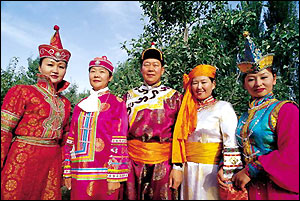
The life of the Mongolians is unique. Those in the pastoral areas wear fur coats lined with satin or cloth or nothing at all in winter and loose, long-sleeved cotton robes in summer. Mongolian costume is generally red, yellow or dark blue in color. A red or green waistband, flint steel, snuffbox and knife in an ornate sheath for cutting meat are accessories common to all men and women. Knee-high felt boots are a type of common footwear. Mongolians, men and women, wear cone-shaped hats in winter; they also like to wear silk or cloth turbans. Girls wear their hair parted in the middle, embellished with two large beads and agate, coral and green jade ornaments.
In pastoral areas, beef, mutton and dairy products are the staple food, while in the farming areas, people like to eat grain. Tea is indispensable. Dried cow dung is a common cooking fuel.
Mongolian herdsmen used to live in felt yurts, which were usually seven to eight feet high and ten feet in diameter. With an opening in the top of the umbrella-shaped roof, they give ideal ventilation and good protection against wind and cold.
After the mid-20th century, as more and more herdsmen ended their nomadic life and settled down, they began to build yurt-like houses of mud and wood and one-storied houses, each with two or three rooms like those in other parts of the country.
The Mongolians are warm-hearted and straightforward. They welcome strangers traveling on the grasslands to stay for the night in their yurts and treat them to tea with milk, mutton and milk wine. Upon leaving, the guests will invariably be given a warm send-off by the hosts.
Culture
Mongolians believed in shamanism in ancient times. The red sect of Lamaism began to find its followers among the Mongolian rulers in the 13th century. In the 16th century, many feudal lords as well as herdsmen shifted to the yellow sect. Lamaism was later protected and encouraged by the imperial court of the Qing Dynasty. Different titles, posts and privileges were granted to high-ranking lamas, who gradually formed a ruling feudal stratum existing side by side with the ruling feudal lords. These rulers not only rode roughshod over the people but took possession of numerous herds and large tracts of land. Their influence could be felt in every aspect of Mongolian life. The feudal rulers encouraged young people to become lamas, who neither got married nor took part in physical labor. As a result, the number of lamas increased to as many as one third of the Mongolian population during the Ming and Qing dynasties, seriously impeding the development of production and the growth of the population.
Mongolians practice monogamy. Before the mid-20th century, intermarriage between nobles and common people was permitted except that daughters of Zhasake lords were not allowed to marry common people. Marriage was generally arranged by parents, or local feudal lords as in the case of the western grasslands, with costly betrothal gifts demanded. Before weddings, Buddhist scriptures would be chanted and heavenly protection sought.
A Mongolian family usually consists of the parents and their children. When the son gets married he usually lives in a separate home close to his parents. There are also families formed of several married brothers and sisters-in-law in the farming and semi-farming areas.
The Mongolians have been known as "a people of music and poetry." Their singing, sonorous, bold, passionate and unconstrained, is the true reflection of the temperament of the Mongolian people.
"Haolibao" is a popular Mongolian form of singing to set melodies with the words improvised extemporaneously. Also very popular are many other forms of singing including "Mahatale" (paean), "Yurele" (congratulation), "Dairileqi" (antiphonal singing), riddles, proverbs, stories, legends, fairy tales and fables.
Mongolian dances are known far and wide. The best ones include the "Saber" dance, "Ordos" dance, "Andai," "Buryat Wedding," "Horse Breaker" and "Little Black Horse." "Wine Cup" and "Chopsticks," widely recognized as the most lively Mongolian dances, are known for their brisk steps which are characteristic of the candor, warmth and stoutness of the Mongolian people.
Horse-head fiddle is a musical instrument favorite with the Mongolians. It provides fine accompaniment to solos with its low and deep, broad and melodious sounds.
Since 1978, the "job responsibility system," under which the earnings of the herdsmen and peasants are linked with the amount of work they put in, has been implemented in the region. This has further fired the enthusiasm of the Mongolian people.
All this has brought tremendous changes to the life of the Mongolian people. In the old days, the majority of them lived in hunger, being deprived of the essential means of life such as an old yurt. Today they have well-furnished yurts with clean beds and new quilts. Sewing machines, radios, TV sets, telescopes and cream separators are no longer novelties to the ordinary Mongolian herdsmen. Many new houses with paned windows have been built in the Mongolian settlements.
(China.org.cn June 21, 2005)