Population: 308,839
Major area of distribution: Yunnan and Sichuan
Language: Naxi
Religion: Doba and Lamaism
The Naxi ethnic minority has a population of 308,839, most of whom live in concentrated communities in the Lijiang Naxi Autonomous County in Yunnan Province, the rest being scattered in Weixi, Zhongdian, Ninglang, Deqin, Yongsheng, Heqing, Jianchuan and Lanping counties in Yunnan, as well as Yanyuan, Yanbian and Muli counties in Sichuan Province. A small number live in Mangkang County of Tibet Autonomous Region.
The Naxi areas, traversed by the Jinsha, Lancang and Yalong rivers, and the Yunling, Xueshan and Yulong mountain ranges, have a complicated terrain. There are cold mountainous areas, uplands, basins, rivers and valleys, averaging 2,700 meters above sea level. The climate varies from cold and temperate to subtropical. Rainfall is plentiful.
Agriculture is the main occupation of the Naxi people. The chief crops are rice, maize, wheat, potatoes, beans, hemp and cotton. The bend of the Jinsha River is heavily forested, and Yulong Mountain is known at home and abroad as a "flora storehouse." The extensive dense forests contain Chinese fir, Korean pine, Yunnan pine and other valuable trees, as well as many varieties of herbs including fritillary bulbs, Chinese caterpillar fungus and musk.
There are rich reserves of such non-ferrous metals as gold, silver, copper, aluminum and manganese. Water resources are abundant.
The Naxi language belongs to the Chinese-Tibetan language family. More than 1,000 years ago, the Naxi people had already created pictographic characters called the "Dongba" script and a syllabic writing known as the "Geba" script. With these scripts they recorded a lot of beautiful folklore, legends, poems and religious classics. However, they were difficult to master, and in 1957 the government helped the Naxi design an alphabetic script. Over the past few hundred years, as the Naxi people have come into closer contact with the people in other parts of China politically, economically and culturally, the oral and written Chinese has become an important means of communication in Naxi society.
History
According to historical documents, the forefathers of the Naxi people were closely related to a tribe called "Maoniu Yi" in the Han Dynasty (206 BC-AD 220), "Mosha Yi" in the Jin Dynasty (265-420) and "Moxie Yi" in the Tang Dynasty (618-907).
Between the early 10th century and the middle of the 13th century, production in the Lijiang area underwent marked changes, as agriculture replaced livestock breeding as the main occupation of the people. Scores of agricultural, handicraft, mineral and livestock products were turned out, and the county presented a picture of prosperity. During that period, a number of slave-owning groups in Ninglang, Lijiang and Weixi counties gradually grew into a feudal manorial lord caste.
In 1278 the Yuan Dynasty (1206-1368) established Lijiang Prefecture representing the imperial court in Yunnan Province. This resulted in closer links between the Lijiang area and the center of the empire.
In the early Ming Dynasty (1368-1644), the leader of the Naxi people, named Mude, was made the hereditary chieftain of Lijiang Prefecture, exercising control over the Naxi people and other ethnic groups in the vicinity. Throughout the Ming Dynasty, the hereditary chieftains from the Mu family kept taxes and tribute flowing to the Ming court in the form of silver and grain. The Ming, in turn, relied on the Mu family as the mainstay for the control of the people of various ethnic groups in northwestern Yunnan Province.
Later, with the development of the productive forces, buying, selling and renting of land began to take place in the Naxi areas, marking the beginning of a landlord economy.
From 1723, during the Qing Dynasty (1644-1911), hereditary local chieftains in the Lijiang area began to be replaced by court officials and the hereditary chieftain surnamed Mu thus became the local administrator.
Art and literature
Naxi literature is rich in form and content. Besides works by Naxi scholars and writers, there is a repository of oral folk literature. "Genesis," "The Rich Steal Oxen," "Revenge" and "Song of Elopement" are characterized by simple and fresh expressions, and distinctive national flavor. The "Dongba Scripture," a religious work, dates back to the Tang Dynasty. Written in the pictographic script, it describes the various aspects of life of the Naxi people during their long transition from slavery to feudalism. It is extremely important for the study of Naxi literature, history and religion.
The Naxis are fond of singing and dancing, especially at weddings and funerals. The most popular songs are descriptive and short. They are sung at very high pitch and with strong rhythms, to the accompaniment of simple dances. The most common musical instruments are flutes, reed pipes and wind-string instruments. The ancient musical piece, "Baishaxiyue," which dates back to the Yuan Dynasty, was rediscovered and preserved after the founding of the People’s Republic of China.
Naxi architecture, sculpture and painting have reached fairly high standards. Moreover, they are mixed with the traditional styles of the Hans and Tibetans. Some famous buildings preserved in Lijiang, such as the "Dabao Palace," "Glazed Hall," "Dading Pavilion" and "Five-Phoenix Chamber," were all built during the Ming Dynasty. All the murals in these buildings have the concise and harmonious strokes of Tibetan painting, and the style of Taoist and Buddhist paintings of the Tang Dynasty. Modern Naxi painting has made fresh progress since 1949.
Religion
Before 1949, most Naxi people were followers of the "Dongba" religion, which was a form of Shamanism. Sorcerers, called "Dongba," were invited to chant scriptures at weddings, funerals, the New Year Day and other festivals. Some of the Naxis were followers of Lamaism. Buddhism, Taoism and Christianity only had limited access to the Lijiang area.
Customs and habits
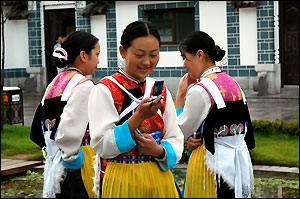
Naxi women wear wide-sleeved loose gowns, with jackets and long trousers, tied with richly decorated belts at the waist. They often wear sheepskin slung over the shoulder, on which are seven stars exquisitely embroidered, with sun and moon symbols, one on each side. This reflects the Naxis' admiration for diligence -- "people start working early in the morning and do not stop until late in the evening." Women in Ninglang County wear short jackets and long skirts reaching the ground, with many folds. They wrap large black cotton turbans around their heads and wear big silver earrings. Men's garments are similar to those of the Han people.
The traditional festivals include the "Farm-Tool Fair" in January, "God of the Rain Festival" in March, and "Mule and Horse Fair" in July. There are also the Lunar New Year, the Pure Brightness Festival, the Dragon Boat Festival, the Mid-Autumn Festival and the Torch Festival -- all being the same as those of the Hans.
Cremation has been a tradition since ancient times, but in some of the Naxi areas the custom of burying the dead was adopted in the late Qing Dynasty. It was common in the past to chant scriptures at the funeral ceremony to expiate the sins of the dead.
The monogamous family under the feudal landlord economy was the main type of Naxi family in Lijiang, Weixi and Yongsheng counties before liberation. However, the man enjoyed a predominant status in the family while the woman had little say and was denied the right to inherit property. Young people's marriages were all arranged by their parents.
Among some of the Naxi people in Yongning County in Yunnan Province and Yanyuan County in Sichuan Province, there still existed remnants of a matriarchal family structure until the eve of the democratic reform after liberation. The pedigree of the family was traced back through the maternal line, and children lived with the mother. The woman was the head of the family, and the property was passed to the children through the mother, or to the nephews through the mother's brothers. Women comprised the main labor force, respected at home and in outside society.
Social economy
The Naxi communities had reached the stage of feudal society long before the nationwide liberation in 1949, though the stages of development were not the same. In Lijiang, southern Weixi and Yongsheng counties where a feudal landlord economy was prevalent, certain factors of capitalism began to take shape. In Jinjiang and Sanba in Zhongdian County the remnants of manorial economy could still be found. In northern Weixi and part of Ninglang counties in Yunnan Province and Yanyuan County in Sichuan Province, the main form of economy was manorial.
The level of agricultural production was higher in the landlord economy areas. The landlords and rich peasants, who accounted for 10 percent of the population, owned 60 to 70 percent of the land. They exploited the peasants through land rent, usury and hiring them as farmhands. The rates of the rent ranged from 50 to 80 percent of the crops harvested and the annual interest rates of the usury reached as much as 300 percent. They also exploited the peasants through their privileges, with the backing of reactionary political rulers. They forced the peasants to work for them without pay, to present them with gifts, and to render various kinds of corvee labor.
In the manorial economy areas, the manorial lords owned almost all the land, water resources, grasslands and forests. In some places, each peasant had to do as many as 150 days of unpaid labor a year. The manorial lords in the Yongning area invented 35 pretexts to exploit the peasants. They included the so-called fish tax, water tax, firewood tax, death tax, and passer-by tax.
Under the manorial lord, the commoners were second-class citizens. Generally, the commoners did not own any land, and only after they had accepted merciless exploitation, such as heavy taxes and corvees, were they given a small piece of land. In this way they actually became serfs tied to the land of the lords. If they failed to pay their debts or committed crimes, they could be reduced to the status of household slaves. Completely under their masters' disposal, they could be sold, bought, exchanged or given as presents.
During the War of Resistance Against Japan in the 1930s and 1940s, foreign trade in China's southeastern coastal area came to a standstill and transport between China and Myanmur was blockaded by Japan. This resulted in an unprecedented boosting of Sino-Indian trade, and Lijiang became a trading center for India, Tibet and China's interior. Millionaire businessmen (some being Naxis) began to appear.
Lijiang County had a more developed handicraft industry than the other Naxi areas where landlord economy predominated. It covered iron, copper, carpentry, tanning, textiles, papermaking, tailoring, construction and sculpture. Copper articles and leather products were particularly famous.
(China.org.cn June 21, 2005)