Population: 406,902
Major area of distribution: Guizhou and Guangxi
Language: Shui
Religion: Polytheism
There are in China 406,902 Shuis, the majority of whom dwell on the upper reaches of the Longjiang and Duliu rivers that meander across plains and rolling land interspersed with vast expanses of forests in southern Guizhou Province. They live in compact communities in the Sandu Shui Autonomous County and in Libo, Dushan and other counties. Some Shuis have their homes in the northwestern part of the Guangxi Zhuang Autonomous Region.
The areas in which the Shuis live are a land of plenty, abounding in fish and rice. Wheat, rape, ramie are also grown besides a great variety of citrus and other fruits. The forests are a source of timber and medicinal herbs. The Duliu and other rivers teem with fish.
The Shui language belongs to the Zhuang-Dong branch of the Chinese-Tibetan language family. The Shuis used to have an archaic writing script. Some of their words were pictographs, while others resembled Chinese characters written upside down. Except for scores of these ancient words that are still used for religious purposes, the Shuis use Chinese in their daily lives.
The Shuis boast a treasure house of colorful oral literature and art. Their literature includes poetry, legends, fairy tales and fables. Among the various forms, poetry, which consists of long narrative poems and extemporaneous ballads, are generally considered the most prominent.
Stories and fables in prose style praise the diligence, bravery, wisdom and love of the Shui ethnic group and satirize the stupidity of feudal rulers. With rich content and vivid plots Shui tales are usually highly romantic.
Their songs, which are usually sung without the accompaniment of musical instruments, fall into two categories. The "grand songs" are sung while they work, whereas the "wine songs" are meant for wedding feasts or funerals.
The Shui people are good dancers. "Lusheng Dance" and "Copper Drum Dance" are the most popular dances enjoyed by all on festive occasions. Traditional musical instruments include gongs, drums, lusheng, huqin and suona horns. The Shui people make beautiful handicrafts – embroideries, batiks, paper cuts and woodcarvings.
Life style
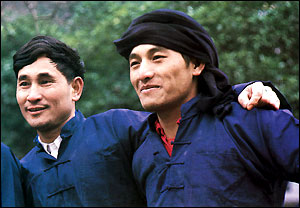
The Shuis usually dress in black and blue. Men have long gowns and black turbans, and women wear collarless blue blouses, black trousers and aprons, all of which are embroidered. On festival occasions, the females put on skirts and a variety of silver earrings, necklaces and bracelets. They usually wear their hair in buns.
Shui diets consist of rice and fish, supplemented with corn, barley, wheat and sweet potatoes. A kind of liquor made of rice goes to entertain guests or is offered to dead ancestors at sacrificial ceremonies.
A Shui house is either a one-storied affair or a two-storied building. Dwellers of two-storied houses usually live upstairs and reserve the ground floor for livestock, dogs and chickens.
Monogamy is practiced. Young people had the freedom to choose their spouses three centuries ago. Such freedom came to an end with the growth of the feudal economy, and children of rich landed families could only marry those of wealthy ones, and marriage was arranged by parents.
On wedding day, the groom's family sent some unmarried men to escort the bride home. The bride walked all the way to her husband's home under an umbrella and returned to her parent's home on the same day or the day after. The bride, as a rule, did not live very often with her husband until six months after marriage. Such feudal ways as parental arrangement of children's marriages and extortion of big payments by parents of brides from the grooms' families have ceased to exist following the establishment of the People's Republic in 1949.
Shui funerals used to be extremely elaborate. Livestock were killed as sacrificial offerings to the dead. Singing, dancing and performance of local operas went on and on until an auspicious day was found to bury the dead. Such wasteful funerals have been simplified in the post-1949 years.
The Shuis are believers of polytheism. In former days a shaman would be employed to say prayers and animals slaughtered to be offered to evil spirits when someone fell ill or died or when something bad happened. Catholicism that came to the area in the late Qing Dynasty (1644-1911) won very few converts.
The Shuis have a calendar of their own which takes the ninth lunar month as the beginning of a new year, and their biggest festival is the "duan" holiday which is celebrated with great pomp after the autumn harvest at the beginning of the 11th lunar month every year. Garbed in their colorful costumes, the Shuis gather in their village to watch horse races and plays, and to feast for days on end.
History
The Shuis are probably the descendants of the Luoyues, one of the early tribes that lived along China's southeastern coast before the Han Dynasty (206 BC-AD 24). They adopted their present name at the end of the Ming Dynasty (1368-1644).
In the Song Dynasty (960-1279) villages were formed and rice growing began. By the end of the Song, the Shuis had entered the early stage of feudalism. The nobles bearing the surname of Meng initiated in the upper reaches of the Longjiang River a feudal system which bore the distinctive vestiges of the communal village. The Yuan rulers (1271-1368) established local governments at the prefectural level in an attempt to appease the ethnic groups. The Ming period witnessed a marked economic growth in Shui communities. The introduction of improved farm tools made it possible for farmers to open up paddy fields on flatland and terraced fields on mountain slopes. The primitive "slash and burn" farming gave way to more advanced agriculture characterized by the use of irrigation and draught animals. As a result, grain output increased remarkably.
The Ming imperial court followed the preceding dynasty's practice of appointing hereditary Shui headmen. Under this system, the Shuis had to pay taxes to and do corvee for these court-appointed headmen as well as for the imperial court.
During the two centuries between 1640 and 1840 the Shui economy continued to develop. Farm production registered a marked increase, with per hectare yield of rice on flatland reaching 2,250 kilograms. Some quit farming and became handicraftsmen.
After the Revolution of 1911, national capitalism gained some ground in the area. In what is now the Sandu Shui Autonomous County, iron mines and plants processing iron, mercury and antimony were set up, but later they were either taken over by Kuomintang monopolist capital or went bankrupt. The comprador capitalists plundered the rich natural resources, while big landowners annexed large areas of farmland. Ruthless exploitation through usury, hired labor and high land rent robbed farmers of 60 to 70 percent of their crops, thus ruining a great many farmers.
Changes after 1949
The founding of New China brought a revival and further growth in production. During the land reform in the early 50's, full respect for Shui customs was emphasized and public land was reserved for festive horseracing and dancing. In 1957 the Sandu Shui Autonomous County was established.
Formerly only 13 percent of the arable land was irrigated. Now thousands of water conservancy facilities have been built to bring most arable land under irrigation.
Abundant mineral resources have been found and mined. Today local industries include chemical fertilizer, coalmining, farm machinery, sulfur, casting, sugar refining, winemaking and ceramics. Handicraft industries such as ironwork, masonry, silver jewelry, carpentry, textiles, papermaking, bamboo articles have also developed.
In the past, transportation was very difficult in this mountainous area, with only one 17-km highway traversing the county. Now all the seven districts in the county are connected by highways or waterways, and many towns and factories have bus services. The Hunan-Guizhou and Guizhou-Guangxi railways have further facilitated the interflow of commodities between the Shui community and other areas and strengthened ties between the Shui and other ethnic groups.
Before 1949 there were few schools in the area. By 1981, apart from 10 secondary schools and 145 primary schools with a total enrolment of 27,700, there was one ethnic minority school and one ethnic minority teachers' school. Officials of the Shui people now number over 1,000, or over 30 percent of the county's total administrative staff.
In the past malaria was rampant in the area with an 80 percent incidence rate, but the only medical facility was a small hospital with three medical workers. After 1949 a large number of clinics and hospitals were set up. Thanks to the persistent efforts in the past years, malaria has been brought under control.
(China.org.cn June 21, 2005)