Population: 13,719
Major area of distribution: Gansu
Language: Yugur and Han Chinese
Religion: Lamaism
Nearly 90 percent of the Yugur people live in the Sunan Yugur Autonomous County, and the rest in Huangnibao area near the city of Jiuquan in western Gansu Province.
Due to historical reasons, this ethnic minority uses three languages: a Turkic branch of the Altaic language family (Raohul) used by the Yugurs in the western part of the autonomous county; a Mongolian branch of the same language family (Engle) by those in the eastern part of the county; and the Chinese language by those in Huangnibao. Chinese is also a common medium of communication among all Yugurs.
Origins
The Yugur ethnic minority can trace its origins to the nomadic ancient Ouigurs in the Erhun River valley during the Tang Dynasty (618-907). In the mid-9th century, the ancient Ouigurs, beset by snowstorms, feuding within the ruling group and attacks from the Turkic Kirgiz, had to move westward in separate groups. One of the groups emigrated to Guazhou (present-day Dunhuang), Ganzhou (present-day Zhangye) and Liangzhou (present-day Wuwei) in the Hexi Corridor – the most fertile area in central-western Gansu Province – and came under the rule of Tubo, a Tibetan kingdom. They were thus called the Hexi Ouigurs. Later, they captured the city of Ganzhou and set up a khanate – thus they were also called Ganzhou Ouigurs.
The Hexi Ouigurs had all along maintained very close ties with the central empire and regarded these ties as relations of "nephew to uncle." During the Northern Song Dynasty (960-1126), the Khan of the Ganzhou Ouigurs often sent special envoys to the imperial capital to present tribute to the emperor, and, in return, the Song court gave "the nephew Ouigur Khan in Ganzhou" special products from central China. The Khan's emissaries went to the capital of the Song Dynasty on several missions to offer camels, horses, coral and amber as tribute to the imperial court in the fifth year (980) of the reign of Emperor Taizong and the third year (1010) of the reign of Emperor Zhenzong.
In the mid-11th century, the Western Xia Kingdom conquered Ganzhou and toppled the Ouigur regime. The Hexi Ouigurs then became dependants of the former and moved to pastoral areas outside the Jiayu Pass. However, their links with the Song court were still maintained. Ouigur envoys came to the Song capital with tribute again during the first year of the reign of Emperor Shenzong (1068) and requested a copy of a Buddhist scripture. According to an envoy in 1073, there were more than 300,000 Ouigurs at that time. In 1227 the Mongols conquered Western Xia Kingdom and put the Hexi Ouigurs under their direct rule.
Part of the Hexi Ouigurs were assimilated with neighboring ethnic groups over a long period of co-existence from the mid-11th to the 16th century, and developed into a community – the present-day Yugurs. They lived around Dunhuang in western Gansu and Hami in eastern Xinjiang.
The Ming (1368-1644) rulers moved many of the Yugurs farther east as the frontier became unsettled.
The Yugurs underwent changes in the mode of economic production after their eastward move. Those in the Huangnibao area, availing themselves of exchanges with the Hans, learned farming and gradually substituted it for animal husbandry, while those in the Sunan area still engaged in livestock breeding and hunting. Thanks to the introduction of iron implements from the Hans, the Yugur peoples' skills in farming, animal husbandry and hunting all improved.
The Qing government (1644-1911), in an attempt to strengthen its rule, divided the Yugurs into "seven tribes" and appointed a headman for each and a powerful chieftain – the "Huangfan Superintendent of the Seven Tribes" – over them all.
The Qing government made it a law for the Yugur tribes to offer 113 horses every year in exchange for tea. At first, they got some tea, but later, virtually none. The horses thus contributed were tribute pure and simple. The tribute demanded by the central government also included stag antlers, musk and furs. The Suzhou Yugurs had to deliver grain or silver.
Lamaism began to get the upper hand in the Yugur area in the Ming and Qing dynasties. Each tribe had its own monastery. The lamas worked closely with the chiefs in important tribal matters; some tribes practiced integration of religion and politics. The Lamaist monasteries had their own feudal system of oppression and exploitation: courts, prisons and instruments of torture. They could order compulsory donations and gratuitous forced labor, and compel children to join the clergy. Some lamas extorted large amounts of money and property out of the common people by way of fortune telling and exorcism. Donations for religious purposes accounted approximately for 30 percent of the annual income of a middle-class family.
All these hardships reduced the ethnic group virtually to extinction. At the time of the mid-20century, its population was less than 3,000.
Development
In February and April of 1954, the Sunan Yugur Autonomous County and Jiuquan Huangnibao Yugur Autonomous Township were established. This development ushered in a new period of cultural progress and economic growth among the Yugur people.
Culture
The Yugurs have a rich literary tradition handed down orally, such as legends, folk tales, proverbs and ballads. The folk songs feature uniquely simple yet graceful tunes, and vivid content.
They are skilled at the plastic arts, weaving beautiful patterns on bags, carpets and harnesses. Vivid patterns in harmonious colors of flowers, grass, insects, birds and domestic animals are woven on women's collars, sleeves and cloth boots. Geometrical patterns made of coral beads, seashells and green and blue stone chips, and silk threads in bright colors are used as hair decorations.
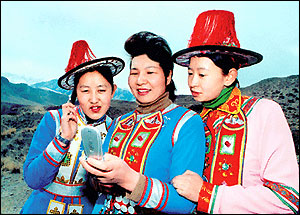
The Yugurs have their own peculiar way of dressing. A typical well-dressed man sports a felt hat, a high-collared long gown buttoned on the left, a red-blue waist band and high boots. A woman of marriageable age combs her hair into many small pigtails which are tied up into three big ones, with two thrown over the chest and one over the back after marriage. The women usually wear a trumpet-shaped white felt hat with two black lines in front, topped by red tassels.
In the last few decades, wool shearing has been mechanized, animal stocks improved and steps taken to have the herdsmen settle down and pastures grazed by rotation. Reservoirs have been built, ponds dug and underground water tapped to irrigate large tracks of dry pastures and provide drinking water for animals. The situation of "worried herdsmen having sheep but no water, wandering from place to place" has been fundamentally changed.
The Yugurs used to hunt wild animals without trying to domesticate any, but in 1958 they began to set up farms to domesticate wild deer.
In industry, the area now has farm and livestock-breeding machinery factories, carpet, fur, and food processing industries, and coal mining. Electricity reaches all townships and most Yugur homes. Wool shearing, threshing and fodder-crushing machines are now in extensive use.
There is a developed network of highways now. Before 1950 there was "not a meter of smooth ground and not a single bridge across the rivers" as the saying went. Merchants made use of this backwardness to exploit the local Yugurs: a mere five or six pieces of brick tea could buy a horse.
At the time there were only four primary schools with a total student body of 70, mostly children of tribal chiefs, herd owners and landlords. In the early 1980s Sunan County had two senior middle schools, eight junior middle schools and 76 primary schools. Many young Yugurs were able to finish secondary technical or college education. The ethnic group now has its own teachers as well as technicians.
Medical care has markedly improved, whereas, in the old society, people's only recourse was to pray to Buddha when they suffered from illnesses.
(China.org.cn June 21, 2005)