Who created the earth and the sky? Why is there a night and day? What is the meaning of life and death? Why does one year bring good rains and a bountiful harvest, while another brings massive flooding, yet another brings drought and yields no harvest?
In distant eras long past, men's hearts were filled with these mysteries, and the world was a maze of unanswerable questions. It was impossible for one individual to grasp to complexities of fate, and this lead to the belief in living spirits among the myriad things of nature and the worship of ancestors. Set rituals began to emerge, and there were prayers, offerings and shamanic rites for every problem, every triumph and every issue that faced the people. The people believed that these rituals could effect the omnipotent gods and bestow them with legitimacy.
The ancient Yunnan plateau was one of the early breadbaskets of humankind; it nurtured early primitive human cultures. It has been recognized as the original birthplace of tea, and as one of the sites for the development of grain cultivation. Japanese academics have labeled it as the distribution center for continental Asia's water cycle, the "cistern of Asia". It was a center for the migration and interaction of ancient peoples. The unique geographical position and rich cultures ensured it a central role among surrounding regions.
There are 25 distinct indigenous peoples in Yunnan with hundreds of sub-branches. Each of these peoples has their own unique social structures, ways of life, historical developments, customs and cultural arts. The socioeconomic development histories of these peoples are also unbalanced, making it a "living history of societal development". They each have their own religious beliefs, presenting a rich tapestry of religious phenomena, covering the whole spectrum from animist and shamanistic religions on to more organized ones such as Daoism, Buddhism, Islam and Christianity.
Because of the barriers created by tall mountains and raging rivers, the changing forces of time lose their intensity when they reach Yunnan. Many ancient rituals, chants and dances have been remarkably preserved here, glimmering with the brilliance of ancient cultures and exposing the flavors of more barbarous times.
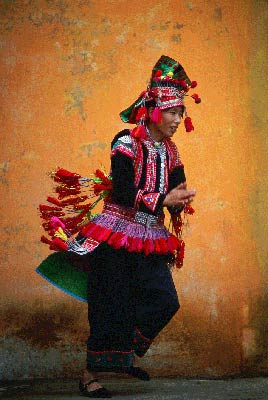
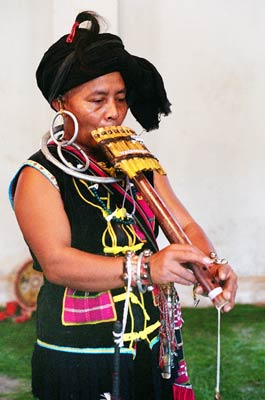
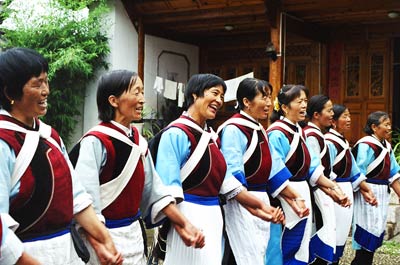
The artists are members of Yunnan Yuansheng Indigenous Music and Dance Studio, a newly established non-profit organization under BAMA Mountain Culture Research Institute at the Yunnan Academy of Social Sciences.
It is comprised of indigenous Yi and Wa artists from remote villages throughout Yunnan Province. These artists were members of Yunnan Ethnic Culture Preservation Institute (1993-2000) founded by the late Mr. Tian Feng, a well-known Chinese composer, situated in the town of Anning, outside of Kunming. The Institute was created in 1993 in order to preserve and teach the cultural traditions of Yunnan's ethnic groups. After Mr. Tian's death in early 2001, a businessman, Mr. He Jinxin, tried to sustain the institute. However, by the end of 2002, this nine-year effort came to a close. Professor Lan-Lan Wang of Connecticut College, with the support of a Rockefeller Foundation grant, and with the help of China Yunnan International Culture Exchange Center and Yunnan-based filmmaker Liu Xiaojin, gathered 20 artists from the Institute who are now scattered throughout the western region of China in preparation for a planned United States tour in 2005.
This gathering encouraged and inspired these artists to form an organization: Yunnan Yuangsheng Indigenous Music and Dance Studio, with the purpose of preserving, presenting, teaching and documenting the indigenous cultural traditions of the villages where the artists live and work. The artists invited Liu Xiaojin who spent seven years documenting the process of Yunnan Ethnic Culture Preservation Institute, to serve as their director. This new organization is now formally established and registered with an advisory board consisting of cultural specialists and researchers from Yunnan.
The artists who have come together for this US tour were originally members of the Yunnan Ethnic Culture Preservation Institute. The tour marks the beginning of their new journey; the newly established organization, Yunnan Yuansheng Music and Dance Studio, serves as a base to support these culture bearers in their mission to preserve and sustain the traditions of Yunnan ethnic cultures in the communities that created them.
Director:
Liu Xiaojin was born in Tianjin, China, and received her BA degree in Chinese Literature from the Yunnan University in 1982. Since 1984 she has been a director for documentary films for the Yunnan Television Station; she has been producing independent films since 1990 and worked with China Central Television in Beijing in 1995. She was an Asian Cultural Council grantee in 2000 and spent seven months in New York City studying American documentary films. Her documentary credits include "Chronicles of the Minority Institute," screened at the 2003 Taiwan International Ethnographic Film Festival and "Mask: A Field Report on Masked Performance," shown at the Margaret Mead Film & Video Festival at the American Museum of Natural History in 2003.
Artists:
Yi
Ah Jiawen holds the title of "Yunnan Master Folk Artist" granted by the Yunnan Provincial Government. He is 66 years old, and lives in a farming village in Shiping County. He was never formally trained in the musical arts of his village, instead learning by hearing older players and his general love for his traditional music. He later went on to become a locally famous folk musician and maker of musical instruments. He previously served as a teacher at the Yunnan Ethnic Culture Preservation Institute, and has traveled to Beijing, Changchun, Guangzhou, Hong Kong and Taiwan to perform. He is an expert of the four-string Moon Guitar melodies of the Sandao Hong Yi ethnic group, and has been referred to as the foremost instrumentalist of Southern Yunnan.
Cha Yongying was a student at the Yunnan Ethnic Culture Preservation Institute. She can sing and dance many of the Weishan Yi country stomp rhythms, most of which she learned from Luo Fengxue. In addition, she has learned the Sandao Hong Tobacco Box Dance, the songs of the Huayao Yi, the Spirit Drum of the Luchun Yi and Sandao Hong Yi embroidery. She acquired the majority of these skills while at the Yunnan Ethnic Culture Preservation Institute. She has performed in Beijing, Changchun, Guangzhou, Hong Kong and Japan. She currently resides in her home village in Weishan County, where she is famous for her artistic talents. She often teaches classes on ethnic music at the Yunnan Art Institute School of Music as a guest lecturer.
Hou Baoyun holds the title of "Yunnan Master Folk Artist" granted by the Yunnan Provincial Government. He lives in a farm village in Shiping County. After completing secondary school at the age of 18 he sought out local artisans Li Fazhong and Li Zhengchang to teach him the folk music he so loved, and went on to learn the rhythms and dances of the Sandao Hong Yi ethnic group from teachers around the area, eventually learning from six artisans from separate villages. He is an accomplished singer, dancer and instrumentalist, is especially gifted at singing duets, and can sing all of the Four Great Melodies of the Sandao Hong canon: Old Mountain Melody, Song of Five Mountains, Cold Melody and Sea Grass Melody. He is a very versatile and locally famous musician. He was once a teacher at the Yunnan Ethnic Culture Preservation Institute, and taught the songs and dances of the Yi ethnic group's Sandao Hong branch to many students including Li Huaixiu and Pu Meifang. He has performed in Beijing, Guangzhou and Hong Kong.
Li Huaixiu comes from a small village in Lungmin Township of Shiping County in Honghe Prefecture. She began learning Yi folk songs from village artists at the age of twelve. In 1993 she began studying at the Yunnan Ethnic Culture Preservation Institute, where she absorbed the folk music of the Sandao Hong and Haoyao branches of the Yi ethnic group. She can sing, dance, and create the intricate embroideries of her ethnic costumes. Her extraordinary talent was seen after four years and she became instructor for twenty some students at the Institute. She and her teacher, Shi Wanheng, received the golden award at China Central Television's first Western Folk Song Competition held in Beijing in January 2004; she and her brother, Li Huai Fu, were honored with first prizes in the second China Western Folk Song Competition held in Shaanxi in August 2004. As of May 2004, she became a member of the Yunnan Honghe Prefecture Song and Dance Troupe. Her expertise includes Yi ethnic group's Sea Grass Melody, the Snuff Case Dance and traditional love songs. Through her intensive studies, she has become a renowned and versatile artist. She has performed in Beijing, Changchun, Guangzhou, France, Japan, Hong Kong and Taiwan.
Luo Fengxue comes from a small village in a farm village in Dali Weishan County. He has learned many of the festival dances, or country stomp rhythms, of the Weishan branch of the Yi ethnic group from his older brother, a famous musician in his home village. He came to the Yunnan Ethnic Culture Preservation Institute with his brother in 1993, where he continued to learn his traditional music. Later, his brother returned home but Luo Fengxue continued at the Institute. Aside from his own traditional music, he has also learned to play the leaf harp, gourd pipe, bamboo flute and other traditional instruments, most notably the Shaman Drum Offering rituals, incantations, songs and dances of the Liangshan Yi, which were once on the verge of extinction; as well as many instrumental pieces of the Hani ethnic group. He has performed in Beijing, Guangzhou and Hong Kong. He still resides in his home village in Weishan County, where he is famous for his artistic achievements. He often teaches classes on ethnic music at the Yunnan Art Institute School of Music as a guest lecturer.
Pu Fazheng is a member of the Huayao branch of the Yi ethnic group residing in Honghe Prefecture. At a very young age, she began learning the traditional arts of her ethnic group from her grandfather, Zhang Shilin, who is a famous local artisan and who knows the lyrics and rhythms to nearly one hundred different epic poems. She arrived at the Yunnan Ethnic Culture Preservation Institute in 1993 with her grandfather, where she continued her studies. In addition to her song and dance skills, she is also knowledgeable about the meanings and uses of these songs in the lives of her people. She is also skilled in the traditional embroidery of the Huayao Yi. She now resides in her home village in Shiping County, where she is renowned for her artistic achievements.
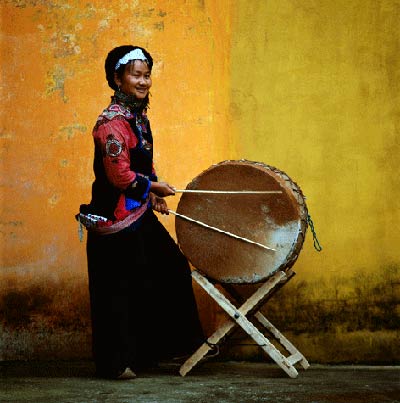
Pu Jiufen is from a remote Yi village in Luchun County near the Vietnam border. Her village is home to a set of 24 drum rhythms which have been passed down for many generations, known as the "Spirit Drum." According to traditional custom, these rhythms are taught only to women, and can only be performed during certain agricultural events and very special celebrations. When Tian Feng (founder of the Yunnan Ethnic Culture Preservation Institute) arrived in this village in 1992 seeking traditional folk music, there were only three women who still remembered the rhythms of the spirit drum, all in their sixties. Pu Jiufen and two of her friends from the village came to the Institute in 1993 to study under the tutelage of those three women. By 2000, she had taught the ancient skill of the Luchun Spirit Drum to more than 40 girls from various villages and ethnic groups around Yunnan. During her seven years at the Institute, she also learned the moving "Weeping at the Wedding" of her home village, the songs of the Huayao and Weishan Yi, and embroidery skills from Luchun. She has performed in Beijing, Changchun, Guangzhou, Hong Kong and France. She currently resides in her home village and is renowned for her art in Luchun County.
Pu Meifang comes from a small village in Lungmin Township of Shiping County. She was a student at the Yunnan Ethnic Culture Preservation Institute, where she absorbed the "Four Great Melodies" of the Sandao Hong, the Tobacco Box Dance and the rhythms and dances of the four-string Moon Guitar. She can sing, dance and play various instruments, and is particularly skilled at Sandao Hong love songs and traditional handicrafts such as embroidery. She has performed in Beijing, Changchun, Guangzhou, Japan, Hong Kong and Taiwan. She is locally renowned as a skilled and versatile artisan.
Pu Yanfang was a student at the Yunnan Ethnic Culture Preservation Institute, where she studied under Zhang Shilin. After the Institute was disbanded in 2000, she returned to her home village to continue learning traditional ethnic arts from her aunt. She sings the music of the Huayao Yi, and her voice is unique and moving. She has also learned the Luchun Spirit Drum, the Wieshan Country Stomp, and Huayao embroidery. She has performed in Beijing, Changchun, Guangzhou, Hong Kong and Japan. She currently resides in her home village in Shiping County.
Shi Wanheng holds the title of "Yunnan Master Folk Artist" granted by the Yunnan Provincial Government. He lives in a farm village in Shiping County. The famous "Sea Grass Melody," one of the "Four Great Melodies" of Southern Yunnan, is sung in an extremely high vocal register. Shi Wanheng is one of a very small number of people who can sing it. He is a versatile musician. He once taught at the Yunnan Ethnic Culture Preservation Institute, and traveled with them to Beijing, Changchun, Guangzhou, Hong Kong and Japan to perform. With the recommendation of the Director of the Shiping Culture Bureau, he and his student, Li Huai Xiu entered the first China Central Television Western Region Folk Song Competition held in Beijing in January 2004, and received the golden award. He is an expert of the music of the Yi ethnic group's Sandao Hong branch, including the renowned Tobacco Box Dance.
Wa
Yang Bing, 59, is a member of the Wa ethnic group. His father is headman of a Wa tribe in Ximeng County Wa Autonomous Region. His love for music emerged at an early age, and because of his family he was able to absorb the traditional songs, rhythms and instrument making of the Wa. He can play more than different instruments, and is fluent in both Wa and Mandarin Chinese. He is also knowledgeable in Wa script and Chinese calligraphy. He worked for the Ximeng County Culture Department for over thirty years, specializing in collecting and cataloguing Wa music and musical instruments. He is the most famous Wa artisan in Ximeng, where he is known as the King of Wa Music. His elder brother Sui Ga began serving as the first Ximeng County Governor in 1950. The two brothers have always been enthusiastically dedicated to spreading traditional Wa culture. They brought 20 students to the Yunnan Ethnic Culture Preservation Institute in 1997 on invitation from founder Tian Feng to form the first Wa class there. Yan Bing has performed in Beijing and Hong Kong.


(China.org.cn September 22, 2005)