国内精品一区二区三区最新_不卡一区二区在线_另类重口100页在线播放_精品中文字幕一区在线

Tools: Save | Print | E-mail | Most Read
Chinese Animation: Splendid Past, Bitter Present
Adjust font size:
The animated cartoon industry began in France in 1888, invented by Emile Reynaud and established in China in the 1950s. In addition to having a glorious age, Chinese animation now faces severe competition as the international industry is dominated by massive Japanese and US animation output. More and more Chinese children are fascinated by Transformers, Dragon Ball Garfield as well as Snoopy. So, what are the options for China's animation industry now?


History


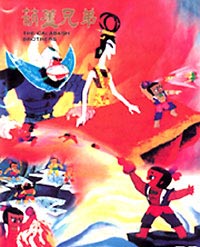
Before 1949, animation did not make any headway in China. The Wan Brothers' Princess Iron Fan was representative of this period (taking three years, 237 artists and 350,000 yuan to make, Princess Iron Fan retold part of the popular Chinese folk-tale Pilgrimage to the West). In the period between the 1950s and the 1980s, China entered a golden era of animation. Many popular cartoon films were made, such as Scatterbrain and Crosspatch (1962) (video) and The Cowboy's Flute (1963) (video). Only in the decade between 1949 and 1959, the Shanghai Animation Film Studio produced nearly 100 films. Roughly estimated, since China's animation made its debut on the world movie circle, it has won 57 international awards and more than 200 local prizes. Its unique artistic style is known as the "Chinese School" worldwide.


Let's see some typical examples of China's animation over its glorious age.


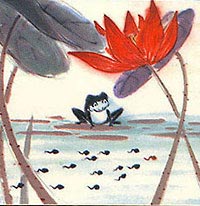
Little Tadpole Looking for Mummy (1960)


In spring, many little tadpoles swim to and fro in the water. Seeing a group of chickens embracing their mother affectionately on the bank, they begin to look for their own mother. With the help of an "uncle shrimp", goldfish, crab and turtle, they finally find a frog -- their beloved mother. This ink painting animation which is only 14 minutes long is well known all over the world as the Chinese unique ink painting is for the first time used in the single-line brush animation. Nearly every scene is a beautiful ink painting.


The film, directed by Tang Cheng and Te Wei, won best animation movie in the first Chinese Hundred Flowers Awards. Established in 1962 by the Popular Movies magazine, the awards, an annual event, are decided by the number of votes submitted by the general public.


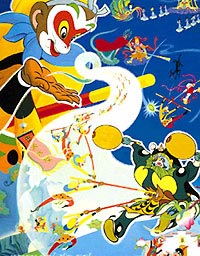
Uproar in Heaven (1961, 1964)


Screenplay by Li Keruo and Wan Laiming. Directed by Wan Laiming. Uproar in Heaven is based on the famous novel, Pilgrimage to the West, the amazing adventures of the monk Xuanzang as he travels westward in search of Buddhist sutras. With him are his three disciples: the irreverent but competent Monkey -- Sun Wukong, the gluttonous Pig -- Zhu Bajie and the dependable Friar Sand -- Sha Heshang. The journey takes the foursome through all kinds of harrowing ordeals and exciting trials as they defend themselves against monsters and spirits hungry for a taste of the monk's flesh. It relates how Sun Wukong borrows the golden cudgel from the Dragon Palace; takes a poor position in Heaven and then is demoted and even gets unfair punishment; and how he is pushed beyond the limit of endurance and makes a big scene in Heaven. Finally Sun returns to the Mountain of Flowers and Fruit, entitling himself a king equal to Heaven.


Uproar in Heaven won the best animation film in the second Hundred Flower Awards and is regarded as one of the most successful animations for it creates a cartoon hero Sun Wukong (monkey king) which has become a household word in China.


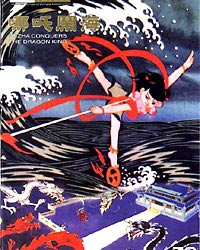
Nezha Conquers the Dragon King (1979)


Li Jing is the general military leader in Chentangguan. After three and a half years' pregnancy, his wife gives birth to a flesh ball and a boy jumps out from the ball. A Taoist named Taiyi Zhenren comes to express congratulations. He names the boy Nezha and gives him a universe ring and firing wheels, accepting Nezha as his disciple. When Nezha is seven years old, the area is afflicted with severe drought, while the dragon king of the eastern sea keeps a blind eye to it and refuses to give an artificial precipitation and worse that he asks Yecha (an evil spirit) to snatch little children from the beaches. The virtuous Nezha kills Yecha and the son of the dragon king, Aobing. The dragon king goes to Heaven to bring a case but is beaten brutally by Nezha. Afterwards, the dragon king invites his three brothers in revenge, flooding Chentangguan and asking for Nezha's life. Nezha wants to fight back but is refrained by his father. Therefore he bravely commits suicide by cutting his throat in defense of all residents in Chentangguan. After that, Taiyi Zhenren lets Nezha be revived from death by rebuilding his body with fresh lotus roots and lotus flowers. The revived Nezha, portrayed as a divine warrior with three heads and six arms, destroys the dragon palace and rids the people of a scourge by defeating the dragon king.


Nezha Conquers the Dragon King, directed by Wang Shuchen, Yan Dingxian and Xu Jingda is the first wide-screen animated feature produced in China, wining the best animation film in the third Hundred Flower Awards in 1980. The production of animation was suspended for almost 10 years during the Cultural Revolution. So Nezha's return is of far-reaching importance to China's animation as well as China's cultural circle. 


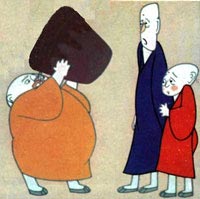
Three Monks (1980)


A young monk lives a simple and peaceful life in a temple on the top of a hill. He has one daily task that irks him: he has to haul two buckets of water up the hill. He tries to share the job with another monk who comes to the temple later, but the carrying pole the monks use is only long enough for one bucket. The arrival of a third monk prompts everyone to expect that someone else will take on the chore. Consequently, no one fetches water though everybody is thirsty. At night, a rat comes to scrounge and then knocks the candleholder, leading to a devastating fire in the temple. The three monks finally unite together and make a concerted effort to put out the fire. Since then they understand the old saying "unity is strength" and begin to live a harmonious life. The temple never lacks water again.


Three Monks, directed by late cartoonist A Da, won the best animation film in the first Golden Rooster Awards. Established in 1981 by the China Film Association, the award is so named because 1981, according to Chinese lunar calendar, was the year of rooster. The yearly awards are decided by a special committee composed of film experts.


Three Monks also won a Silver Bear for Short Film at the 32nd Berlin Film Festival in 1982.


Calabash Brothers (1987)


Legend has it that two ogres were jailed in the Calabash Mountains, one a scorpion spirit and the other a snake spirit. One day, a pangolin happens to drill a hole on the slope and the two spirits escape from the cave and cause grave harm to the nearby residents. The pangolin hurries to an old man and says that only by growing calabashes in seven colors can they annihilate the devil spirits. So the old man spares no time in growing seven calabashes in red, orange, yellow, green, cyan, blue and purple. This has been noticed by the spirits via a fortune-teller mirror. After failing to destroy the calabashes, they seize the old man as well as the pangolin and take them away. Later on, the calabashes are ripe one after another and fall off their stems to the ground, becoming seven boys in suits of different colors. In order to save the old man and the pangolin out, they go to fight against the evil spirits one by one. Each of them has his unique ability as well as disadvantage. With concerted effort and a united mind, they exploit everyone's advantage to the full and finally defeat the scorpion and the snake.


As one of the most popular animated cartoon series in China, Calabash Brothers, directed by Hu Jinqing, Ge Guiyun and Zhou Keqin, is a typical Chinese paper-cut animation, winning third class award at the Cairo International Children's Film Festival in Egypt.


Present


Then what are the main obstacles for the development of Chinese animation today? Following are some key reasons, according to the insiders:


First, lack of individual characteristics both in story and characters. Actually, animation in every country has its own characteristic. For instance, Iron Boy from Japan, Blue Fairy from France, and The Mole from the Czech Republic and Teenage Mutant Ninja Turtles from the United States obviously have different styles and characters.


In a recent survey, 1,753 respondents aged 10 to 35 ranked eight Japanese animation productions among the 10 most popular animated cartoons. The other two were Tom and Jerry and Mickey Mouse and Donald Duck from the United States. Today if you ask the average primary school student in China about his most favorite cartoon hero, you'd likely hear a large of variety, but few of them would be created locally.


Second, dryness of content and persistent education. Chinese people usually attach importance to education, especially to children's education. They are in the long habit of saying: you should do A and not B. As a result of such blunt demands, all demon characters in Chinese movies inevitably have the unambiguous look of "bad people". While Chinese children are just not as stupid as they can be made out to be, the kids gradually notice that the simple but very "meaningful" cartoons have insulted their intelligence, and they immediately throw them away without mercy, no matter how "meaningful" it is. Wouldn't it be better to let children differentiate between good and evil, and experience life and understanding by themselves?


"Foreign productions are far more original and entertaining," said Sun Lijun, dean of the Animation School of the Beijing Film Academy. "They focus on adolescent exuberance, and glorification of fine dreams and the imagination of the young, whereas ours tend to be too educational and political."


Furthermore, we should get rid of the long-standing mistaken idea that the cartoon is the preserve of children. Animation belongs to everyone, not only just for the kids, but for men and women, young and old. Each person can find some happiness in seeing a wonderful cartoon movie as well as being enlightened from an intriguing plot.


Third, shortage of funds and animators. Compared to the west, professional animators in China earn only 100 yuan ($12) per frame. According to Professor Huang Huilin of Beijing Normal University, China's animated cartoon industry currently has as many as 150,000 job vacancies.


Shanghai Animation Film Studio now has 10-plus animation directors. Surprisingly, the average age of them is over 50! A deeper crisis in China's animation industry is hidden behind the wholehearted spirits of these senior directors. We are now badly in need of animation directors who are familiar with modern life and culture, sharp-sighted in the international market, humorous and originally witty, for the most effective way to revive and secure the survival of Chinese animation is to train professional animators.


(China.org.cn by Li Xiao, January 18, 2004)

(video source: Shanghai Animation Film Studio)

Tools: Save | Print | E-mail | Most Read

Related Stories
Paper-cut Animated Films
Traditional Ink-and-Wash Animated Films
Movies Originated from Chinese Shadow Puppetry

Product Directory
China Search
Country Search
Hot Buys
SiteMap | About Us | RSS | Newsletter | Feedback
SEARCH THIS SITE
Copyright ? China.org.cn. All Rights Reserved ????E-mail: webmaster@china.org.cn Tel: 86-10-88828000 京ICP證 040089號
国内精品一区二区三区最新_不卡一区二区在线_另类重口100页在线播放_精品中文字幕一区在线
亚洲第一av色| 蜜桃视频在线观看一区二区| 日韩欧美一级二级三级久久久| 91麻豆精品秘密| 国产黄色精品视频| 秋霞国产午夜精品免费视频| 一区二区成人在线视频 | 日韩一区二区视频| 欧美午夜一区二区| 97精品国产露脸对白| 国产精品一区二区久久不卡| 免费xxxx性欧美18vr| 亚洲国产一区二区三区青草影视| 国产精品免费视频观看| 国产日韩欧美电影| 精品少妇一区二区三区日产乱码| 在线播放日韩导航| 在线不卡一区二区| 在线播放中文字幕一区| 欧美日韩另类一区| 欧美美女黄视频| 制服丝袜亚洲播放| 日韩一级高清毛片| 日韩亚洲欧美成人一区| 欧美一区二区三区免费大片| 91麻豆精品国产91久久久使用方法| 欧美三级在线看| 欧美性一二三区| 欧美三电影在线| 欧美日韩免费电影| 欧美一区二区三区视频在线| 欧美一区二区三区的| 日韩欧美一区在线| 久久一留热品黄| 欧美国产精品久久| 日韩欧美国产综合| 亚洲一区在线电影| 99久久精品国产毛片| 亚洲精品一区二区精华| 亚洲成人av免费| 99热精品一区二区| 久久久久九九视频| 久久国产视频网| 69p69国产精品| 亚洲一区二区黄色| 99久久精品免费精品国产| 精品国产乱码久久久久久免费 | 最近日韩中文字幕| 国产精品正在播放| 久久综合九色综合久久久精品综合 | 亚洲成av人片一区二区| www.成人在线| 亚洲三级在线免费| 亚洲综合久久久| 精品在线免费观看| av在线不卡免费看| 宅男在线国产精品| 国产精品欧美久久久久一区二区| 亚洲视频一区在线| 日韩高清不卡在线| 国产精品一区二区三区99| 99re免费视频精品全部| 欧美精品丝袜久久久中文字幕| 欧美精品一区二区三区在线| 亚洲欧美在线高清| 香蕉av福利精品导航| 国产精品亚洲一区二区三区妖精| 日本伦理一区二区| 欧美成人精品二区三区99精品| 国产精品久久久久影院亚瑟| 亚洲bt欧美bt精品| 岛国av在线一区| 91精品国产综合久久精品| 国产日韩成人精品| 五月天视频一区| 成人av在线影院| 日韩亚洲欧美一区| 亚洲人快播电影网| 国产一区二区三区综合| 在线观看国产精品网站| 337p粉嫩大胆色噜噜噜噜亚洲 | 老司机免费视频一区二区| 91在线观看下载| 精品国产99国产精品| 亚洲综合色网站| 国产精品18久久久久久久久久久久 | 国产成人综合精品三级| 欧美精品久久99久久在免费线 | 欧美日韩亚洲综合一区二区三区| 国产欧美日韩综合| 麻豆成人久久精品二区三区小说| 97久久精品人人澡人人爽| 久久影视一区二区| 日韩专区一卡二卡| 在线免费观看不卡av| 亚洲国产精品av| 激情偷乱视频一区二区三区| 欧美男女性生活在线直播观看| 国产精品久久久久久久蜜臀 | 国产精品麻豆视频| 欧美精品三级在线观看| 成人性生交大合| 日日骚欧美日韩| 国产精品视频一区二区三区不卡| 欧美色欧美亚洲另类二区| 高清不卡一二三区| 日韩成人午夜电影| 综合久久久久久久| 久久久久国产精品麻豆ai换脸| 91国产视频在线观看| 粉嫩嫩av羞羞动漫久久久| 日本网站在线观看一区二区三区 | 麻豆精品一区二区三区| 亚洲精品免费在线观看| 久久精品网站免费观看| 欧美一区二区在线视频| 在线观看免费一区| 99久久久久久| 成人免费毛片嘿嘿连载视频| 久久99久久久久久久久久久| 亚洲高清免费在线| 成人免费在线视频| 国产视频不卡一区| 欧美成人精精品一区二区频| 欧美日本国产视频| 欧美在线高清视频| 色婷婷综合久久久久中文| 成人免费黄色在线| 高清免费成人av| 国产成人综合自拍| 国产成人免费网站| 国内精品伊人久久久久av影院| 日韩一区精品视频| 青青草国产成人99久久| 亚洲大片一区二区三区| 亚洲午夜电影在线观看| 亚洲小少妇裸体bbw| 亚洲影院理伦片| 亚洲综合成人在线视频| 亚洲香肠在线观看| 亚洲国产精品久久久久秋霞影院| 亚洲黄色小视频| 一区二区在线观看av| 亚洲精品视频免费观看| 日韩伦理免费电影| 亚洲一二三级电影| 三级久久三级久久久| 日本一区中文字幕| 激情综合网天天干| 国产成人一级电影| 99热在这里有精品免费| 在线中文字幕一区| 欧美日韩一区精品| 日韩小视频在线观看专区| 欧美一级日韩一级| 久久久久9999亚洲精品| 亚洲欧美在线视频观看| 亚洲一区二区高清| 九九在线精品视频| 99麻豆久久久国产精品免费 | 国产一区二区伦理片| 粉嫩蜜臀av国产精品网站| 91在线国产福利| 欧美一区日韩一区| 国产情人综合久久777777| 中文字幕一区二区三区乱码在线| 一区二区三区四区中文字幕| 天天综合天天综合色| 国产乱对白刺激视频不卡| 99麻豆久久久国产精品免费| 欧美日韩国产高清一区二区三区| 欧美精品一区男女天堂| 亚洲精品老司机| 精品一区二区三区久久久| 91免费视频大全| 日韩一区二区免费在线电影| 中文字幕av一区二区三区高| 一区二区三区精品在线| 国产自产2019最新不卡| 色八戒一区二区三区| 久久综合色天天久久综合图片| 亚洲激情图片qvod| 狠狠网亚洲精品| 欧美视频一区在线观看| 亚洲国产精品99久久久久久久久| 五月婷婷激情综合| 色综合天天综合色综合av| 精品久久五月天| 亚洲国产精品久久一线不卡| 成人一区二区三区中文字幕| 91精品国产色综合久久不卡蜜臀 | 国产精品乱码人人做人人爱 | 欧美一区二区大片| 亚洲精品成人精品456| 国产乱码精品一区二区三区av| 欧美剧在线免费观看网站| 亚洲色图一区二区| 成人午夜在线免费| 久久精品一区二区三区不卡牛牛 | 欧美天堂一区二区三区|