In May 2001, the UNESCO for the first time awarded the title of "Masterpieces of the Oral and Intangible Heritage of Humanity" to 19 outstanding cultural forms of expression from different regions of the world. Kunqu Opera, a school of traditional Chinese opera, was among them. It is so far the only Chinese art form listed as the common cultural heritage of humankind.
Criteria used in the selection process were: outstanding value, roots in cultural tradition, affirmation of cultural identity, source of inspiration and intercultural exchange, contemporary cultural and social role, excellence in the application of skills, unique testimony of living cultural tradition, and risk of disappearing. This initiative to help preserve traditional and popular culture is intended to complement UNESCO's World Heritage List of natural and cultural sites. Inclusions under this category are items concerning languages, stories, music, games, dances, customs and various performing arts.
Origins and Development
Kunqu is one of the earliest forms of traditional Chinese drama, having a history of more than 600 years. Its operatic melodies originated from Kunshan in Jiangsu Province. After extensive exploration and reworking by its performers, it gradually developed into today's Kunqu.
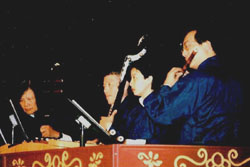
Before the mid-Ming Dynasty (1368-1644), Kunshan melodies were popular in central Jiangsu, until Wei Liangfu, a singer of melodies in the northern style, migrated to Kunshan from Nanchang, Jiangxi Province. Together with performing singers of southern melodies, he made major changes to the songs of Kunshan. By keeping Kunshan tunes as a base, Wei and his friends absorbed the best features of Haiyan and Yuyao airs and combined with northern singing techniques to create a new singing genre. In order to make the accompanying music suit these new songs, Wei also reformed the musical instruments of the time, with the help of Zhang Yetang, a celebrated musician. This was how Kunqu, a new form of drama blending both the northern and southern musical characteristics, came into being.
At that time, Kunqu was a form of singing only, with no costumes, makeup or acting. It was Liang Chenyu (1519-1591), a Kunshan native, who transformed it into stage drama. Liang was a famous playwright who also excelled at poetry and music. Wei's achievements in transmuting Kunqu melodies had a great influence on Liang, who, together with several accomplished musicians, wrote the Kunqu Opera Washing the Silken Gauze. The main character of this opera was the legendary beauty, Xishi. After its successful performance, Kunqu became quickly popular, with numerous new plays created and staged. During the early years of Emperor Wanli's reign, Kunqu spread to various locations in Jiangsu and Zhejiang, eventually becoming a dominant performing art. Later, Kunqu was introduced to Beijing, where it became one of the two official forms of drama allowed to stage in the imperial court. Consequently, it became a nationwide favorite. A large number of Kunqu and performers emerged, along with new plays. Kunqu was so popular in Jiangsu and Zhejiang that even the most illiterate rural people could sing one or two lines of the songs from major works. In the following more than 200 years, Kunqu held its position as the most popular national style of drama, leaving a glorious page in the Chinese history of performing arts.
Decline
Kunqu Opera gradually declined from its zenith, due to external and internal factors. From the late Ming Dynasty onwards, Kunqu was often performed for the privileged families and the imperial court. Thus it was no longer an entertainment for the common people. In the mid-Qing Dynasty (1644-1911) it underwent a decline.
The lyrics of Kunqu, which were originally elegant and flowery, eventually became obscure and incomprehensible, while its melodies slowed down to a funereal level. Kunqu therefore became unacceptable to all but a few dedicated aficionados. The scope of themes also became narrower, and some plays were overlong. Peony Pavilion, for instance, consisted of 55 acts, and one performance could last as long as more than 20 hours. All these factors restricted the opera's further development and popularity. By the late 18th century, competition between huabu (the miscellaneous genre) and yabu (the elegant genre) accelerated the decline of Kunqu.
Huabu refers to the local tunes of various places, such as jingqiang (Beijing tunes), qinqiang (Shaanxi tunes), bangzi (clapper opera) and the erhuang style. Yabu refers to Kunqu. Huabu had the common people as its main audience. The words of its local tunes were easily understood and their plots were very also easy to catch.
Within this competitive scenario, the superiority of Huabu was obvious. A turning point was marked by the Anhui Opera performance of Huabu in Beijing in 1790, an instrumental event in the development of the Peking Opera's musical style. Later, several Anhui Opera troupes came to perform in Beijing, their art form evolving into the Peking Opera.
Variation and Evolution
Peking Opera absorbed the melodies from various local operas, its prototype being based on those of Anhui and Hubei operas, but the Kunqu melodies also constituted an important facet. The Kunqu style of performance was also the basis of the distinctive Peking Opera acting technique, and the Peking Opera repertoire retained the superior Kunqu arias. Consequently, an aria performed by Kunqu actors was called Kunqu, while the same aria performed by actors of Peking Opera was called Peking Opera. Students of Peking Opera were for many years required to learn Kunqu skills, and some Peking Opera masters, such as Tan Xinpei and Mei Lanfang, could sing both Kunqu and Peking Opera. Even today, some of the scenes within Peking Opera are borrowed from Kunqu, and many plays, such as Storming of the Zhu Village, are still performed by both Kunqu and Peking Opera troupes.
Although Kunqu has declined, it is still considered an elite strand within Chinese drama. It is very popular in Suzhou, its birthplace, and a growing number of enthusiasts decide to learn this peculiar form of performing art.
Kunqu was dubbed the "teacher of various drama forms," as its performers worked dedicatedly to pass on their art throughout China. Some performers gave shows in central Hebei Province after they left the imperial court and princes' mansions. They performed both Kunqu and Gaoqiang Opera, and formed a new genre -- northern Kunqu Opera. Since then, Kunqu has been divided into two schools, the northern and southern Kunqu.
After the founding of the People's Republic of China in 1949, the Chinese government made great efforts to protect and develop the art of Kunqu. In the early 1950s, the government organized Kunqu artists into various theatrical troupes. In the mid-1950s several Kunqu theatrical festivals were held in Shanghai and Beijing, and in 1956, the Guofeng Kunqu Troupe from Jiangsu performed Fifteen Strings of Copper Coins in Beijing. The opera, which tells of an upright official, Kuang Zhong, who reversed an unjust verdict after disputing it with his superior, put forward a rational argument. The performance was a great success and caused a sensation in the national capital, where it was jocularly claimed that one performance had saved an entire genre of drama. In 1957 the Northern Kunqu Theater was established in Beijing, and in 1960 the Shanghai Youth Kunqu Troupe was founded. Later, Kunqu troupes were established in Jiangsu, and Hunan's Chenzhou, and amateur troupes sprang up in diverse places. A new generation of Kunqu performers grew up during this period, such as Shanghai's Hua Wenyi and Yue Meiti, Beijing's Cong Zhaohuan, Hou Shaokui and Hong Xuefei, and Jiangsu's Zhang Jiqing.
Kunqu Repertoire: A Treasure House of Drama and Literature
In its 600-year history, Kunqu has accumulated a repertoire of more than 400 zhezixi (highlights from operas), including many written by outstanding playwrights. Guan Hanqing, for instance, wrote more than 60 zaju (poetic dramas), including The Injustice to Dou E (also known as Snow in Midsummer). The Kunqu repertoire contains 18 of his preserved poetic dramas, some of which continue to be performed on stage.
Other masterpieces include The West Chamber by Wang Shifu, Peony Pavilion by Tang Xianzu, The Palace of Eternal Youth by Hong Sheng, and The Peach Blossom Fan by Kong Shangren.
The West Chamber tells the romance of a young couple pursuing their rights to freedom of marriage. This opera has become popularly known among the Chinese for over 1,000 years. This poetic drama attained an extremely high artistic level as regards its lyrics, music, plot and performing skills. It is one of China's classic dramas.
The Model of Performing Art
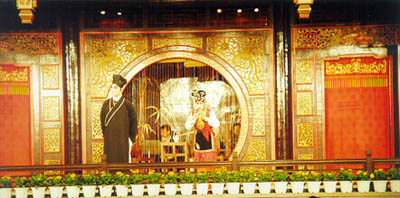
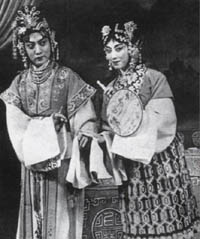
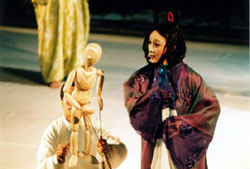
In the performance of Kunqu, refinement and rigor are emphasized. A standard Kunqu scenario is very intricate. A Kunqu program not only details the arrangements of acts, verses, and the names of tunes to which verses are set, but also defines the roles, stage settings, costumes, props, and performers' movements, even going so far as to explain the significance of the positions that performers take on stage.
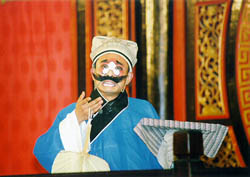
The roles of Kunqu are broadly divided into seven categories, including sheng (male roles), dan (female roles), jing (painted face), mo (middle-aged male roles), chou (clowns), wai, and tie, and each category has further subdivisions. For instance, the sheng roles have laosheng (aged male roles), wusheng (male warriors), and xiaosheng (young male roles), each of which is further divided according to the characters' prominence within the play. The xiaosheng -- young male role -- is divided into daguansheng (big hat role), xiaoguansheng (small hat role), jinsheng (kerchief role), qiongsheng (pauper role) and zhiweisheng (a warrior whose helmet decorated by a pheasant tail feather). The dan roles are divided into six sub-categories.
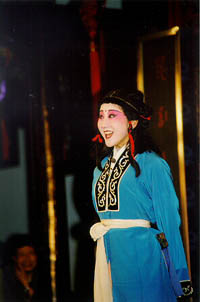
The Kunqu style of stage makeup is mainly used for jing and chou roles, and occasionally for sheng and dan roles. The three predominant colors are red, white and black. The shades of blue, green, purple and gold are used to portray forest brigands, or ghosts and demons. As in Peking Opera, the color red represents loyalty and justice, black conveys uprightness and straightforwardness, white signifies cunning and shrewdness, and yellow indicates a fierce, tough character. Most of the patterns and techniques of Peking Opera's facial makeup have evolved from Kunqu, and some were just copied from it.
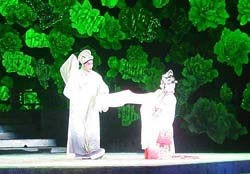
The most prominent characteristic of Kunqu performance is its lyricism, where the posture of each role is in a dancing mode. Almost all traditional Chinese dramas have elements of dance, and in some plays dances have been added, but these are unlike Kunqu, where every physical movement from beginning to end is in the mode of dancing, thus creating a complete scope of performance technique.
Mei Lanfang, a great master of Peking Opera, also learned Kunqu, and had a deep understanding of both. He said, "In Peking Opera, postures are relatively unrehearsed, with no structured choreography, but Kunqu is quite different in this respect. The performer match specific postures to each aria. Kunqu truly integrates singing and dancing into each individual performance, with equal emphasis on singing and acting. The performing of Kunqu is particularly demanding because the actor is, in effect, dancing from beginning to end."
Kunqu dance is divided into two categories. One is mime, used to interpret to the audience the verses the performer sings; the other is lyrical, to describe scenery, the characters' situation, and their emotions.
One zhezixi (opera highlight), Zhaojun Leaves the Pass, tells of Wang Zhaojun, a beauty at the Han-dynasty imperial court, on her way to marry the Xiongnu Khan, in order to cement relations with the rulers of ethnic minorities in the border regions. The drama describes Zhaojun's complex emotions and the hardships of the journey. On stage, Zhaojun sings while dancing, and her attendant turns somersaults throughout the performance. This opera is seldom performed today because few performers are able to fulfill its demands.
Plays in this genre are not only taxing for the performers, but also for the audience, since the lyrics are difficult to understand, and the singing is slow and drawn out -- a challenge to concentration and patience. In addition, a drama is generally quite long. In June 2001, Peony Pavilion was performed in Berlin, Germany, and lasted 19 hours. The local newspaper dubbed it as "a drama marathon." It is rare to see a full performance of this play at one sitting. Usually only a few acts are staged at one time, each lasting 30 to 40 minutes.
Revitalization
Kunqu has for several centuries, undergone ups and downs, but its supreme status has never been challenged. It has played a guiding role in the creation of other forms of traditional opera, and it has generated a dedicated following of devotees.
In recent years, following the Chinese people's rapid and dramatic change in concepts and lifestyles, Kunqu has to face an enormous challenge for survival. Within this harsh environment, however, it has preserved its ancient tradition, and its supreme artistry is acknowledged the world over.
June 2001 marked the 44th anniversary of the founding of the Northern Kunqu Theater in Beijing. On hearing the news that Kunqu had been listed as a world cultural heritage, people in the Kunqu circles were ecstatic, and a grand celebratory performance was held. Officials from the Beijing Cultural Bureau promised that it would, within the coming year, set aside a venue for Kunqu performance, and work out a series of protective measures and policies. On June 9, the Chinese Ministry of Culture listed Kunqu as a key protected art form and promulgated eight concrete measures.
(China.org.cn June 24, 2004)