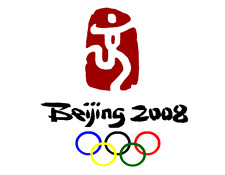
The Beijing 2008 Olympic emblem was finally unveiled. It was showed to the public at the solemn ceremony held at 8:30 PM, August 3, 2003 in the park of Temple of Heaven, Beijing. When a Chinese statesman and an official of the International Olympic Committee (IOC) lifted the yellow wrapping satin, unlocked the rosewood box, and took out a crystal-clear Chinese seal carved with Hetian jade, the audience could no longer hold their excitement. With eager eyes, they watched the two men wet the seal with red inkpad and stamped a seal on a piece of Xuan paper. So there it was, the emblem signaling the 2008 Beijing XXIX Olympic Games.
The main part of the official emblem, a red dancing figure, resembles the Chinese character Jing (Beijing, capital), its free-style strokes symbolizing the energetic and open city of Beijing. The design well represents the spirit, characteristics and verve of the Chinese culture. It also indicates the Chinese capital city's determination to have a New Beijing and a Great Olympics, and to make the 2008 games a Green Olympics, High-tech Olympics and People's Olympics. This is exactly the Olympic spirit -- friendship, peace and progress.
The creation of a wonderful Olympic emblem is the first step for hosting a most successful Olympic Games. On July 2, 2002, the Beijing 2008 Olympic Emblem Design Conference was held at the Beijing International Convention Center. Participants included many of the world's first-class designers.
The Beijing Organizing Committee for the 2008 Olympic Games (BOCOG) sent out invitations to more than 1,500 professional designers to solicit a design for the emblem of the Beijing Olympics.
At the conference, Liu Qi, chairman of the BOCOG, announced: "Our goal is to create a unique image that is rich in oriental wisdom and also demonstrates to the world the great appeal of the Olympics. We hope the design will convey a new feeling for the Olympic Games, the historic and humanistic spirit of Beijing and China, the theme of 'New Beijing, Great Olympics' and the concept of a Green Olympics, High-tech Olympics and People's Olympics."
The conference was a mobilizing rally for the Beijing 2008 Olympic Games. Both the IOC officials and the Chinese organizers believed that through this global mobilization, great works would come into prominent.
In the following three months after the conference, the Emblem Design Competition Office was busy with visitors and phone calls, answering all kinds of inquiries. The office received over 100 calls from domestic and overseas designers everyday, the number of inquiries totaling 10,000.
On October 8, 2002, the deadline of the emblem designing competition, Dongsi Shitiao Post Office, which is located near the BOCOG office, became unusually busy. Dozens of designers, from home and overseas, visited the BOCOG for registration. However, the contest regulated that all the works had to be well wrapped. Therefore, brown paper was soon sold out in the post office. To get all the works registered in time , BOCOG employees worked till next morning.
Statistics showed that BOCOG received a total of 1,985 effective entries, of which, 1,763 were from China, including Hong Kong and Taiwan, and 222 from other countries. Among the bidders were famous international designing companies whose tenders had been selected by the 1996 Atlanta Olympic Games, the 1998 Nagano Olympic Winter Games, the 2000 Sydney Olympic Games, the 2002 Salt Lake Olympic Winter Games, and the 2002 ROK-Japan World Cup. There were also designers for the Olympic centennial commemorative symbol, the Sydney Olympic torch, and the bidding logo for the 2008 Beijing Olympic Games.
Chinese and foreign experts and members of the review committee conducted strict examinations, repeated comparisons, and careful selection while going through the 1,985 entries. In the end, No. 1498 entry ranked first with the highest total score. Its designer is the Beijing Armstrong International Corporate Identity.
Among the experts and members of the review committee are Chang Shana and Chen Hanmin, professors of the School of Fine Arts of the Tsinghua University; Lin Pansong, professor of the Department of Fine Arts of the Taiwan Normal University; Tan Ping, professor of the Central Conservancy of Fine Arts; and Lin Jiayang, professor of the Tongji University. They all agreed that No. 1498, with a unique artistic style and profound moral, gave people a wide imaginative space and a multicultural thought. Chinese seal, with a history of several thousand years, meant promise, credit, personality and rights. As an Olympic emblem, it promises to the whole world that Beijing will make the 2008 Olympic Games the most successful one in the Olympic history.
Afterwards, BOCOG invited personalities of various circles for criticisms and comments on the selected top 10 works. In order not to miss any possible work, the top 11-30 works were also added to the list of candidate works. The result was that again, all people focused their attention on No. 1498.
BOCOG designated No. 1498 works as the best emblem plan, and the other prize-winning works as the reserved plans. Meanwhile, by searching on domestic industrial and commercial registration, BOCOG found other works had too many repetitions while No. 1498 constituted a unique style.
Afterwards, BOCOG asked IOC to entrust a company especially to conduct an international search for repetition. Again, No. 1498 passed the check.
During this process, the original work of No. 1498 entry was revised. The first problem was that the work had no proper name. After consulting several seal-cutting experts who confirmed that the design was a graphic style of seal-cutting, BOCOG officially named it "Chinese Seal."
The original pattern of the emblem absorbed the style of the ancient mural figures, yet not stretching enough and lacking spirit of times. The revised pattern has more-reaching-out opening arms and the legs have been changed too. Revises were also made in other details. The strokes of the figure became thicker, the picture proportion slightly readjusted and seal-cutting skills more professional. All together, there were eight or nine big modifications in addition to the numerous small ones, according to Zhang Wu, president of Beijing Armstrong International Corporate Identity. Three designers with the company spent their seven-day holiday of the Spring Festival in 2003 revising the original logo.
The emblem consists of three parts: a Chinese seal, words of "Beijing 2008," and the five Olympic rings. The calligraphic style of "Beijing 2008" must match well with the seal that is imbued with traditional Chinese culture. As neither block letters nor common brush writing could match well with the seal, the designers turned to children's handwritings which better embodied hope and future. The Beijing Olympic Organizing Committee collected handwritings from 300 children at the Beijing Xinfu-Shiguang Preschool Education Center and the Dengshikou Primary School, but the result was not ideal either.
Finally, the creators of the seal part suggested the use of the traditional Chinese calligraphic style of Hanjian, a style often seen in bamboo strips of the Han Dynasty (206 BC-AD220), and the draft came out. This idea was unanimously acclaimed by all sides, including the BOCOG. They all held that Hanjian matched best with the seal, reflected the extensive and profound Chinese culture and added more cultural content to the whole emblem.
On February 28, 2003, the emblem sample was taken to Zhongnanhai for approval by the central government. After seeing the emblem sample and listening to the related reports by BOCOG, Li Lanqing, then vice premier of the State Council and head of the Leading Group for the 2008 Beijing Olympic Games, highly commended the emblem for the design, and wrote the comment of "approval."
This marked that the emblem of "Chinese Seal·Dancing Beijing" had finally beaten the thousands of other entries and become the emblem for the XXIX Olympiad. However, the final approval of the emblem was to be set by the International Olympic Committee (IOC).
March 28, 2003, in the meeting room of the IOC Headquarters located in Lausanne, a Swiss town, when light from an overhead projector cast a freeze frame of the planned design of the emblem "Chinese Seal·Dancing Beijing," IOC President Jacques Rogge took the lead in applauding, and he was followed by Hein Verbruggen, chairman of the Coordination Commission at the IOC for the 2008 Beijing Olympic Games, and all the other participants.
According to related convention, IOC President is to endorse the emblem sample. President Rogge, with a discreet personality, gave all the people present a surprise. "I am going to endorse the emblem in your distinctive Chinese way," he said. Rogge took his seal out of the seal box, dipped it heavily in the red ink paste, and affixed the seal uprightly on the right bottom of the emblem sample. Then, he signed his name in handwriting under the seal solemnly. Verbruggen also signed on another emblem sample.
"Elaborately, the emblem combines China, Beijing and Olympics together by merging the historical heritage and the image of both Beijing and China. It also can be viewed as a promise to the world, the future and the Olympics," said Jin Shangxin, chairman of the Association of Chinese Artists, who has participated in the whole process of the emblem selection and revision.
"Baby!" was the first word uttered out of the mouths of the foreign review committee members. Before they left Beijing, the four famous designing experts told their Chinese counterparts that they should take good care of their "baby." Scott Givens, one of the international judges on the panel who previously served as the Managing Director of the Creative Group for the Salt Lake Organizing Committee, said that he was deeply impressed by the emblem's vigor and spirit. The spreading arms reflect the kindness, delight and enthusiasm of Chinese people, welcoming people from all over the world. Representing the city of Beijing, the emblem is rooted in China's traditional cultural symbol, which can be regarded as an embodiment of both the past and the future.
The twin emblem seals are carved out of Hetian jade by masters from the Beijing Arts and Crafts Group. One of them will be collected in a Chinese museum as a historical witness for the Chinese people's participation in the Olympic movement, and the other will be sent to the Olympic Museum located in Lausanne.
(China.org.cn August 6, 2003)