|
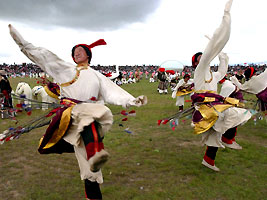
Tibetan is one of the ancient ethnic groups of China. Apart from those scattered in Qinghai, Gansu, Sichuan, Yunnan and other provinces, around half of Tibetans dwell in Tibet.
In addition to Tibetans, other ethnic groups, including Han, Hui, Moinba, Lhoba, Naxi, Nu, Derung, as well as Deng and Xiarba peoples, are found in Tibet.
|
Tibetan |
The principal inhabitants of Tibet, speaking the language that belongs to the Tibetan sub-group of the Tibeto-Burmese group of the Sino-Tibetan language family. There are three main dialects: U-Tsang, Kham and Amdo. Most Tibetans undertake farming and animal husbandry. Urban residents mostly engage in handicrafts, industry and commerce. They believe in Tibetan Buddhism. Tibetan people wear robes with waistcloth. Married women usually tie aprons with rainbow-like designs. Both men and women wear long hair and in plaits and like wearing ornaments. The style of dresses and ornaments varies more or less in different areas. The staple food is zanba (roasted qingke barley flour or pea meal). They like to drink tea with butter or milk and qingke wine. They also have a liking for beef and mutton, but do not eat perissodactyls. In ancient times, Tibetans buried their dead in the ground, but in modern times Tibetans practice celestial burial (by which bodies were all exposed to birds of prey), cremation and water burial. |
|
Moinba |
An old ethnic group living on the Tibetan Plateau mainly distributed in Moinyu in south Tibet, with some scattered in Medog, Nyingchi and Cona counties. The Moinbas speak the language that belongs to the Moinba sub-group of the Tibeto-Burmese group of the Sino-Tibetan language family. With complex dialects, they have no their own script of written language. Most Mionba people can speak and write Tibetan. Their livelihood is based on agriculture, supplemented by animal husbandry, forestry, hunting and handicrafts. Moinba people wear red robes and brown hats with orange margin, or black terais. Women wear ornaments while men wear saber at the waist. Both men and women like drinking and smoking. Rice, corn, buckwheat and jizhaogu (glutinous highland millet) are staple foods. Most Moinba people believe in Tibetan Buddhism, but in certain areas, some people practice traditional shamanism. The dead are generally given water burial, while burial in the ground, celestial burial and cremation are also practiced. |
|
Lhoba |
Mainly living in Lhoyu in the southeast of Tibet, with some scattered in Mainling, Medog, Zayu, Lhunze and Nang counties. The Lhoba language also falls into the Tibeto-Burmese group of the Sino-Tibetan language family. Having no scripts of their own, they normally use Tibetan for written communications. Mainly engaged in agriculture, Lhoba people are good at bamboo weaving. Men like wearing woolen sleeveless jackets and hats with brims made of animal leather or bamboo canes, while women wear short-sleeved shirts and sheathy skirts with leggings. Corn and Jizhaogu are staple foods. They also eat rice and buckwheat. |
|
Hui |
Most of the Hui people living in the Tibet Autonomous Region today are descendants of the Hui who moved to Tibet from Gansu, Shaanxi, Qinghai, Sichuan and Yunnan provinces during the Qing Dynasty. A small number of them came from Central Asia. Most live in cities and towns, notably Lhasa, Xigaze and Qamdo, doing business and handicrafts or working as butchers. They use both Tibetan and Chinese languages in daily life, and Urdu and Arabic in religious activities. They believe in Islam and mosques are found in Lhasa and some other places. |
|
Deng |
Commonly known as "Dengba people" and mainly living in Zayu County. The Deng population in China is around 1,450. They speak a language also included in the Tibeto-Burmese group of the Sino-Tibetan language family. Their dresses are very unique. Women usually wear silver, drum-shaped earrings and a string of beads or silver ornaments on the neck, while men wear black scarf on the head and sword on the waist. Having no written language, they keep records by notching wood, tying knots or arranging sticks or branches 50 years ago. After the Democratic Reform in Tibet, they started to move out from deep mountains and forests and settled in houses the government helped build for them. |
|
Xiarba |
Mainly living in Lixin Township in the vicinity of the Zham entry/exit port and Chentang in Dinggye County at the China-Nepal border. There are now over 1,200 Xiarba people in China. In Tibetan language, "Xiarba" means "oriental people." Having no scripts of their own, they use Tibetan in written communications. The Xiarba people in Lixin are divided into five surnames and those in Chentang into two. Marriage within the same surname is taboo. They believe in Buddhism. They mainly undertake agriculture and animal husbandry. Corn, potato, Jizhaogu, buckwheat and beans are staple foods. Men wear white, woolen, short-sleeved jacketing with black bands, sword on waist. Women wear black robe and colorful long-sleeved frock, gold earrings and long plaits with red string. |
Apart from the above-mentioned ethnic groups, there are some other ethnic groups, such as Naxi, Nu and Derung, who live in the southern area of Qamdo Prefecture. In history, some Mongolians inhabited in Tibet and were later assimilated into the Tibetan ethnicity. Han people began to move to Tibet during the Qing Dynasty and mainly lived in Lhasa, Xigaze, Qamdo, Zetang and other cities, where they built some Han-style structures. The descendants of these Han people were later also assimilated into the Tibetan ethnicity. Today, most Han people living in Tibet are technicians, workers, teachers, health workers and public servants coming from other parts of China to help with the construction of Tibet.
Birthrate, Mortality Rate and Natural Growth Rate of Tibetan Population
|
Year |
Birth |
Mortality |
Natural Growth Rate‰ |
|
Number(10000 People) |
Birthrate (‰) |
Number(10000 People) |
Mortality Rate (‰) |
|
1970 |
3.75 |
25.3 |
1.52 |
10.2 |
15.1 |
|
1980 |
3.93 |
21.4 |
1.51 |
8.2 |
13.2 |
|
1985 |
4.62 |
23.3 |
2.01 |
10.1 |
13.2 |
|
1990 |
4.91 |
22.6 |
1.61 |
7.4 |
15.2 |
|
1995 |
4.82 |
20.6 |
1.77 |
7.6 |
13.0 |
|
2000 |
4.42 |
17.6 |
1.65 |
6.6 |
11.0 |
|
2001 |
3.60 |
14.2 |
1.67 |
6.6 |
7.6 |
|
2002 |
3.47 |
13.6 |
1.57 |
6.1 |
7.5 |
|
2003 |
3.64 |
14.2 |
1.71 |
6.7 |
7.5 |
Population of Various Ethnic Groups Unit: Person
|
Ethnic Group |
1985 |
1990 |
1995 |
2000 |
2002 |
2003 |
|
Total Population |
1994808 |
2180520 |
2355540 |
2512300 |
2554423 |
2592113 |
|
Tibetan |
1909693 |
2095561 |
2268749 |
2421856 |
2449231 |
2464742 |
|
Han |
70932 |
67407 |
67772 |
72122 |
85166 |
105379 |
|
Hui |
1529 |
2269 |
2357 |
2123 |
2140 |
2513 |
|
Lhoba |
2036 |
2325 |
2690 |
2856 |
3461 |
3565 |
|
Moinba |
6445 |
7463 |
8084 |
8471 |
9308 |
9584 |
|
Naxi |
871 |
1260 |
1092 |
1024 |
1109 |
1139 |
|
Mongolian |
72 |
79 |
118 |
104 |
102 |
161 |
|
Nu |
227 |
378 |
394 |
430 |
52 |
468 |
|
Zhuang |
31 |
50 |
31 |
50 |
62 |
57 |
|
Dulong |
80 |
32 |
21 |
32 |
26 |
30 |
|
Lili |
62 |
15 |
23 |
41 |
18 |
18 |
|
Tu |
90 |
116 |
150 |
151 |
194 |
249 |
|
Manchurian |
81 |
168 |
171 |
213 |
215 |
243 |
|
Bai |
36 |
173 |
61 |
61 |
81 |
101 |
|
Boyi |
12 |
7 |
5 |
15 |
22 |
31 |
|
Uygur |
6 |
10 |
4 |
10 |
11 |
7 |
|
Miao |
42 |
70 |
82 |
89 |
134 |
170 |
|
Yi |
21 |
36 |
35 |
39 |
74 |
88 |
|
Sharpa |
1403 |
1819 |
2131 |
2152 |
1604 |
1645 |
|
Deng People |
1097 |
1248 |
1494 |
1395 |
1238 |
1514 |
|
Other Ethnic Groups |
42 |
34 |
76 |
98 |
175 |
409 |
Number of Households and Population
|
Year |
Year-end Number of Households
(10000) |
Year-end Population
(10000) |
Annual Average Population
(10000) |
Population Density
(Person/Sq.km) |
|
1959 |
24.32 |
122.80 |
121.71 |
1.00 |
|
1965 |
27.60 |
137.12 |
135.90 |
1.12 |
|
1970 |
29.11 |
151.20 |
149.63 |
1.23 |
|
1975 |
32.20 |
169.11 |
167.62 |
1.38 |
|
1980 |
34.42 |
185.28 |
183.99 |
1.51 |
|
1985 |
35.49 |
199.48 |
198.08 |
1.62 |
|
1990 |
38.29 |
218.05 |
216.98 |
1.78 |
|
1992 |
40.21 |
225.27 |
223.53 |
1.83 |
|
1993 |
39.78 |
228.88 |
227.08 |
1.86 |
|
1994 |
41.44 |
231.98 |
230.43 |
1.89 |
|
1995 |
42.31 |
235.55 |
233.77 |
1.92 |
|
1996 |
43.17 |
239.30 |
237.43 |
1.93 |
|
1997 |
45.42 |
242.74 |
241.02 |
1.96 |
|
1998 |
44.68 |
245.39 |
244.06 |
1.99 |
|
1999 |
47.23 |
247.72 |
246.55 |
2.01 |
|
2000 |
49.96 |
251.23 |
248.48 |
2.02 |
|
2001 |
55.81 |
253.70 |
252.47 |
2.06 |
|
2002 |
50.91 |
255.44 |
254.57 |
2.08 |
|
2003 |
54.33 |
259.21 |
257.33 |
2.14 |
Population of Various Areas Unit: 10000
|
Area |
1985 |
1990 |
1995 |
2000 |
2002 |
2003 |
|
Total |
199.48 |
218.05 |
235.55 |
251.23 |
255.44 |
259.21 |
|
Lhasa City |
32.39 |
35.66 |
38.33 |
40.37 |
40.95 |
42.08 |
|
Qamdo Prefecture |
46.39 |
49.72 |
53.06 |
57.33 |
58.22 |
58.34 |
|
Shannan Prefecture |
26.10 |
28.30 |
30.28 |
31.53 |
31.78 |
32.01 |
|
Xigaze Prefecture |
49.98 |
55.38 |
59.96 |
63.03 |
64.14 |
64.81 |
|
Nagqu Prefecture |
26.58 |
29.95 |
33.03 |
36.28 |
37.68 |
38.72 |
|
Ngari Prefecture
|
5.41 |
6.13 |
6.85 |
7.41 |
7.66 |
7.78 |
|
Nyingchi Prefecture |
12.63 |
12.91 |
14.04 |
14.38 |
15.01 |
15.47 |
|