It had been two weeks since Li Xuansheng returned to his home in Shanghai from an Antarctic expedition, but he was still feeling exhausted both mentally and physically.
On January 18, as the head of a 13-member expedition, Li led his team-mates to plant the Chinese national flag on the summit of Dome A, the highest icecap in Antarctica and 1,200 kilometers from China's Zhongshan Station.
It was the 21st expedition for the Chinese since 1984.
Once considered to be an inaccessible region for human beings, the peak of Dome A is in fact the most ideal place for scientists to study the dynamics of the environment and global warming.
Over the years members of China's Antarctic explorers have made a number of discoveries.
Pinpointing the peak
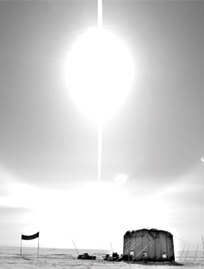
Standing in the snowfield, flat and vast, the researchers enjoyed an uninterrupted view. The sun had grown much larger than ever before.
The snow looked like a layer of frost, but in fact, it is the accumulation of ice crystals. "The first step on it feels quite soft, but the second in the same place feels really hard," said Li.
Even with their experience, the curious sight of exhaust smoke from the snowmobiles falling vertically instead of floating up, struck the team -- air in Antarctica floats down because of the pressure of movement of air currents passing the bottom of the Earth.
One of the major missions for the team was to locate the peak.
In fact, before they set out, the Polar Research Institute had invited glacier experts from Australia to do a preliminary measurement of the icecap by satellite telemetering, which marked out a raindrop-shaped area containing the highest point.
"Identifying the peak is a difficult and time-consuming job because the height variation on the icecap is very small," said Li.
The researchers adopted the most primitive measuring method, but one which they believe to be the most reliable and efficient. Standing on one spot, they looked around to see where was higher and then went there to repeat the same operation.
Finally, the researchers pinpointed the peak at 80:22:00 degrees south latitude and 77:21:11 degrees east longitude.
A lot of hardships were endured as Li's team sought to achieve their scientific goals.
The most obvious physical change for the 49-year-old team leader at the end of the 150-day expedition was his face had darkened and he had lost about 10 kilograms of weight.
But hardest was the emotional weariness.
The legacy endured after his return. "Any hobbies in the past, such as playing cards, could not hold my attention for more than 10 minutes. It is extremely hard now for me to concentrate on a particular thing," Li said, his voice uncharacteristically weak.
As an experienced polar explorer, he understands such mental states and that they tend to last for a few months.
This latest expedition is Li's fifth to Antarctica.
In 1995, then a fellow researcher at the Institute of Geochemistry, Chinese Academy of Sciences, in Guiyang, the Guizhou provincial capital, Li was transferred to the Polar Research Institute of China in Shanghai.
A year later, he was the only Chinese scientist to join the Japanese Antarctica research team. Before that, he had never even seen a glacier.
That expedition reached the second highest peak on the continent, Dome F, 3,810 meters above sea level.
For the Chinese observer, everything he experienced during the journey was fresh and exciting. Also, the days he slept and worked together with his Japanese team-mates greatly enriched his understanding of icecap exploration, he said.
When China organized its second Antarctic inland icecap expedition in February 1998, Li was selected to head the team.
This time, he and his Chinese team-mates advanced 500 kilometers from Zhongshan Station during their 16-day mission.
During subsequent expeditions, the research team extended the boundaries from their base towards Dome A.
"Climbing Dome A is a culmination of 10 years' preparation and attempts," said Li.
Inhospitable
During their 39-day trek to reach Dome A, the explorers advanced across the inhospitable terrain, with temperatures of minus 30 to 40 Celsius.
The daily meals were airline food. Rich in calories and fat, they provide the necessary nutritional needs for explorers living in an environment of high energy consumption and low oxygen.
The explorers had only two meals a day, breakfast and supper. The daily menu changed from Monday to Sunday, but the cycle was repeated the following week.
"During the first week, we felt the food was OK," Li recalled. "But as the days went on, everyone grew weary of the routine meal and lost their appetite, and later had to force themselves to gulp the food down."
Cooking was a big headache because all the food was frozen in the sub-zero temperatures.
Thawing alone took 30 to 40 minutes and heating even in a microwave oven at least an extra 15 minutes. As a result, simply heating ready meals took an inordinate amount of time.
Later they hit upon another method. They put steamers into two huge iron water barrels, which could hold five food packs and used gas stoves for heating.
But to reduce the load on the snowmobiles, 850 kilometers out from base, they dumped a gas bottle. This meant they ran out a day before leaving Dome A. "Again, our daily meals became a big problem," said Li.
The snowmobiles, specially designed for polar exploration, doubled as transport and living space, albeit very limited. The height of the cabins is quite low, so the explorers had to squat, kneel, or sit cross-legged. "No matter what kind of posture we adopted, quickly one's legs became numb. So we constantly had to shift around," said Li.
Boredom was a big enemy on the journey. Despite chatting and having meetings, there was little else to do inside the cabins.
As it was the Antarctic summer the sun never set and the only way of judging night and day was from the height of the sun, which was highest at noon and lowest at midnight.
Accordingly, Li and his team arranged their time of work and rest. Between 7-8 PM they stopped and set up camp placing all the snowmobiles at an angle of 45 degrees against the wind, "so that the snowmobiles would not get stuck in the snow in the next morning," explained Li.
Hazards
For the explorers, the biggest threat was when passing across an ice sieve, an area full of ice cracks. On the 1,200-kilometer expedition route, there are three such hazardous sections to negotiate.
The cracks mainly form in those areas where the underground glacier moves faster. The width of cracks can vary from scores of centimeters to dozens of meters.
What makes it more dangerous is that snow accumulates over the cracks and gradually covers it up.
"It looks like a solid flat area, but it is empty below. If a snowmobile falls through, there is almost no possibility of survival," said Li.
This meant their very lives dependent on carefully observing the terrain. One of the key things they looked out for was the snow surface looking different to other areas, for example, slightly sticking out, if it did they moved with extreme caution. "We would try to keep away from there, even though it might offer a shortcut," said Li.
At one time a white out -- when snow and clouds change the way light is reflected so only very dark objects can be seen -- occurred as they passed through an area of ice cracks.
"At that time, we could see nothing. It felt as if we were driving in a piece of white cloud," said Li.
In such circumstances explorers have one of two choices, either stop moving or use the satellite positioning system in the vehicles to locate a relatively safe path and avoid going off in the wrong direction.
Fire prevention is another major hazard. Even though they are in a world of snow and ice, the air is extremely dry. "The paper we used became so fragile that it would crumble in pieces as soon as we touched it," said Li, by way of an example.
Also, the wind was particularly strong, so a tiny spark could easily ignite anything flammable.
"And if vehicles catch fire, there is no water available to put it out. We wouldn't be able to do anything about it," he said.
Despite the foul weather and many other hazards, the team finally reached the north peak of Dome A.
The lowest temperature observed here was more than 40 C below zero. With the oxygen content in the air and the air pressure extremely low, the explorers had to draw on all their physical reserves to keep going.
"After every single step, we would have to stop and gasp for breath. Even taking a mouthful of water or food was an exertion which left us having to stop to take a breath," said Li.
But actually making it to the peak and some of the samples and findings they obtained there helped relieve the physical and psychological discomforts.
The team stayed on the peak for 13 days. All the tasks, from collecting ice samples to setting up an automatic weather observation system, were completed according to a strict timetable.
"The day for departure could not be later than January 22, the start of the Antarctic winter, when the sun disappears below the horizon and temperatures quickly fall to below minus 50 C," explained Li. "In such temperatures the iron material of our snowmobiles would become highly brittle."
The team moved out on January 21, leaving a commemorative mark formed by 13 empty oil casks and the Chinese flag at the peak.
The 21st Chinese expedition to Antarctica was the toughest Li has ever undertaken. But even during the most difficult moments it never crossed Li's mind that they would not make it back.
"Antarctica explorations do need courage, but they are absolutely not adventures. We are supported by the most advanced technical equipment and every single move is well conceived in advance," he said.
Reaching the peak of Dome A goes far beyond the satisfaction of mere human achievement. Its scientific value is incalculable, he added.
(China Daily April 11, 2005)