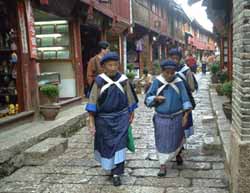
The miscellany is abundant. Bells, key rings and an assortment of other ornaments dangle by from walls or from ceiling hangers in the numerous small shops that line the narrow stone streets of the old town of Lijiang.
Woodcarvings, handbags, purses, scarves and clothes succeed in their purpose to attract the curious eyes of visitors touring the World Heritage site in Southwest China's Yunnan Province.
Among the ubiquitous bric-a-brac one distinctive design reigns throughout - Dongba pictographs. The pictorial writings adorn almost every item for sale. Like souvenirs found throughout the world, the scripts, when translated, offer the buyer good luck, best wishes, good health, safe travel. The list is endless and tourists love them.
But visitors may be misled. Locals rushing to cash in on the tourist boom are laying bare their ignorance about the history of their forefathers. And to proud, knowledgeable residents like former headmistress Yang Yihong, such benighted acts are mortifying.
Yang, 44, formerly of Renxin Primary School in old town of Lijiang picks up a blue wooden carving of a boy and a girl sailing in a boat with wind blowing through their hair. The Chinese translation of the pictograph reads: Tong Zhou Gong Ji, meaning husband and wife must pull together in times of trouble.
But Yang points at the three hairs standing on top of the boy's head. "This pictograph means a ghost, not a boy," explains Yang.
"How would you read good omen from this carving?" she asks.
"The misuse of the Dongba pictographs largely comes from ignorance."
But ignorance is not limited to the shop owners and manufacturers of the memorabilia.
It seems a lack of understanding about their ancestors' ancient, unique script, is widespread.
History lessons
War has now been declared on the town's ignoramuses.
Yang is among a band of like minded locals working at grassroots level to instill a stronger awareness of the ethnic Naxi culture among the children of today.
Their mission is both simple and urgent - ethnic cultural preservation in the face of creeping globalization.
They face grave challenges.
The Naxi people have a population of some 300,000 and a recorded history and culture dating back to the 6th century AD.
They have been thought of as very intelligent, good learners. Throughout the centuries, they have enhanced their own ethnic culture by absorbing the cream of other ethnic cultures, including influences from the Han, Tibetan and Bai peoples.
The ancient town of Lijiang began to evolve more than 1,000 years ago on the criss-crossing rivers and streams that trace the land like veins.
The Naxis created their own hieroglyphic script, known as Dongba pictographs. Recognized by world academics, the hieroglyphs can be compared to ancient Chinese pictographs found on tortoise shells and animal bones, Egyptian or Mayan hieroglyphs.
"The Naxi spoken language and the Dongba hieroglyphs have been the essential vehicles that carry and pass down the ethnic Naxi culture through the generations," says Huang Linna, 61, of Han origin and who married the Naxi scholar, Guo Dalie.
Huang has become an activist in preserving and promoting Naxi ethnic culture since her retirement five years ago. "It's the Naxi and other ethnic minority cultures that have made the multi-ethnic Chinese culture extraordinary," Huang says.
However, for centuries, teachings of hieroglyphs were restricted to the elite cultural and religious leaders known as the Dongbas.
They studied the Dongba religion as well as learned painting, sculpture and music.
They were regarded by common ethnic Naxis as the intelligentsia, able to communicate between the gods and the ordinary people, between the heaven and earth.
They were invited to host both rituals and ceremonies, such as weddings and funerals, and they were paid handsomely.
However, the Dongbas passed down their religious and cultural learning only to those who had the promise to become the next generation's cultural and religious leaders.
Their number has remained small, about 1 per cent of the Naxi population before 1949. The number of the Dongba masters, who had comprehensive command of the Dongba religious scripts, was even fewer, only about 10 per cent of the Dongbas.
As a result of the great changes China has experienced since 1949, fewer local Naxis engage with the Dongbas for the ritual and earthly celebrations. During the "cultural revolution" (1966-76), all the traditional ceremonies were banned.
Thus, few youths wanted, or had opportunities to become the Dongbas.
About a century ago, some 200 Dongbas were active in the Naxi-populated communities in Lijiang. In 1983, 80-plus participated the first local seminar, recalls Yang Yiben, 46, vice-mayor of the city Lijiang. Yang chief-edited the Lijiang Chronicle in 1997, which recounted the modern history of Lijiang and won a major book prize that year from Canada.
But today, there are only about 20 Dongba masters still active and most of them are in their advanced years, notes Yang Yiben, Yang Yihong's elder sister.
Meanwhile, Lijiang, like the whole of China, has opened to the outside world and has become a booming tourist resort. In addition to modern media like television and communication systems exposing the local people to the outside world, outsiders also have arrived and settled.
Frequent exchanges with the outside world tend to lead people to seek the easiest and most popular language for communication.
As more tourists poured into the ancient town and became interested in the ethnic Naxi Dongba culture, people like Yang Yiben began to become aware that the ethnic Naxi culture should no longer be kept among the small number of the cultural and religious elites.
The younger Naxis must also learn.
However, in quite a number of surveys, Yang and her colleagues discovered that even inside the old town of Lijiang, some 70 per cent of the school-age children no longer spoke their own Naxi tongue, even though more than 80 per cent of the children are of Naxi heritage.
The younger the children are, the less likely they are to speak in the Naxi tongue, Yang says.
"That's really worrying because without speaking our mother tongue, it is really hard for the young to learn the Dongba hieroglyphs and carry on and pass down our Naxi ethnic culture and history," Yang says.
"Only a few of us Naxis are proficient in the pictographs and we are unable to supervise their right application, as the souvenir-making businesses and trade soar," Yang Yihong says, especially after Lijiang was inscribed as a world cultural and historical heritage site in 1999.
Teaching programmes
With the problems thrown up by attempting to preserve a given ethnic culture in the face of globalization and uniformity, local people like the Yang sisters and Huang Linna have begun to take action to reverse the trend of ignorance at grassroot level
The Dongba Culture Museum, headed by Li Xi, founded the first School of Dongba Culture in 1995. Li says that more than 250 people have studied at the school and taken a great interest in the unique ethnic culture.
In 1999, Yang Yihong opened a Naxi language programme at Xingren Primary School, offering the students an opportunity to practice their mother tongue while learning both the Romanized letters of the Naxi language and Dongba hieroglyphics.
In the same year, Huang Linna, with support and help from her husband, started the experimental programme with one single class in Huangcun Primary School, a rural school on the outskirt of the old Lijiang town.
She and her husband invited the knowledgeable Dongbas and scholars to give classes.
He Shanghua, then 38 and with 20 years' teaching experience, took up the job of coaching the children hieroglyphics and the Naxi language.
She says that she was chosen because she could sing some of the classical Naxi songs which she had learned from her grandmother.
She speaks Naxi tongue but had to learn to read and write the Dongba pictographs from scratch. So she sat in the classroom with the children.
"I've been learning as much as I've been coaching," she says.
The classes, whether conducted in the town or in the rural school, turned out to be a success as the rich variety of activities - painting, music, writing and story-telling - kept the students interested.
"At first, parents expressed their worry that the new Naxi language class would steal the students' time away from the regular academic curricula like mathematics and Chinese," Yang Yihong says. But the children's love and progress helped dispel the worries.
The success of the experimental ethnic Naxi language class, pushed Yang Yihong, Huang Linna and other scholars to go further, especially when China kicked off a new round of curricula reforms that encourage provinces and regions to include materials of local cultural and historical legacy into the textbooks.
Beginning in September last year, primary schools in Gucheng (Old Town) District of Lijiang all started some kind of experimental programme to teach Naxi spoken language, mostly among the children between first to fourth grades, according to Yang Yihong, now an official working with Gucheng Education Bureau in charge of primary school curricula.
Over the years, some 80 primary and middle school teachers have received training in Naxi language and Dongba hieroglyphics.
In their schools, these teachers have tried various ways to enhance the children's awareness of the Naxi ethnic culture. In art classes, children learn to draw Dongba hieroglyph. They also learn to sew and create embroidery of traditional Naxi decorative patterns, such as seven-stars for the Naxi women.
All the school billboards, office or classroom plates, are inscribed with Dongba pictographs, along with the Romanized spoken Naxi words and Chinese characters.
Besides efforts at the level of the school education, Li Xi, now director of Lijiang Dongba Culture Museum, and his colleagues, have carried out more work to record and nurture the continuation of the Naxi ethnic culture at grassroots.
Li says that the city has designated six townships as original Dongba culture sites under the city's protection.
The museum offers support funds when the local Naxi households invite indigenous Dongbas and their successors to carry out religious rituals and host traditional ceremonies for weddings and funerals.
Elderly Dongbas are now encouraged to pass their knowledge down to young people. Li Xi says that the number of those with promise to become a new generation of Dongbas is about 200, the youngest being in their late teens.
Li is also proud that the Naxi-Dongba culture is now taught and studied not only in primary and secondary schools. Yunnan University in Kunming has recently opened a graduate study programme.
Yang Yihong admits that in the area with a multi-ethnic population like Lijiang, it is difficult to persuade all children to learn the Naxi language.
Also the overall environment is not conducive for children to practise their ancestors' tongue outside the school. She says there is a plan to open a Naxi language programme in the local children's television programme.
But more efforts are needed, says Yang Yiben, who is also a member of the national committee of the Chinese People's Political Consultative Conference. She says the country should figure out how to get back or copy some 20,000 volumes of Dongba religious scripts now kept in museums outside China.
Whatever is being done and still needs to be done, the determination is there among the scholars, professionals and officials.
To continue the ethnic Naxi culture is to prevent it from being misused and from becoming lost in this new, globalized century.
(China Daily August 6, 2004)
|