|
Life first appeared in Lupanshui, Guizhou Province, during the Permian and Triassic periods, around 200 to 300 million years ago. At that time, the entire area lay under the ocean. Then in the Paleolithic days, land emerged, and early man appeared on the scene. Still more time passed, and the kingdom of Yelang arose among the wooded mountains, more than two millennia ago. These days, many parts of China where ancient cultures once thrived are being buried under a sweeping wave of urbanization. Modern man, however, has left the wild landscapes of Lupanshui largely unchanged, and local ethnic groups still live their lives as they might have done in ancient times.
Site of Yelang Kingdom
Yelang was an ethnic tribe that made its home on the Yunnan and Guizhou Plateau. Its sudden demise around 26 B.C. remains a mystery to historians. But many ancient historians, including Sima Qian and Ban Gu, recorded the Yelang way of life. From their books, we know that the Yelang people practiced witchcraft, had strange hairstyles, and were an agricultural society with fierce warriors. Further studies show that the kingdom was actually composed of several ethnic tribes from southwestern Guizhou and the neighboring provinces of Sichuan, Hunan and Yunnan.
It's thought that the ancient capital of Yelang was located in today's Maokou Tounship in Lupanshui. Many curious tourists visit Maokou to discover the stories of its past. According to one, when the Yelang chief was selecting his capital he looked for a place with 100 peaks. He climbed nearby Jiuceng Mountain, and counted only 99, failing to include the peak he was standing on. So the disappointed chief went to Maokou, and set up his base there.
The decision turned out to be a good one. The Lang and Dai mountains flank the Datie Pass, which is the only way in to Maokou. They served as natural, impregnable fortifications, and helped to keep the peace within the foggy mountain ranges.
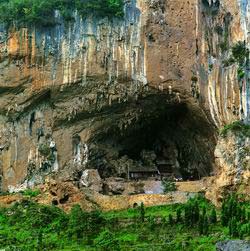
Lang Mountain is also known as the Old King Mountain. According to local legend, the Yelang King Duotong strolled out of the city one night and caught sight of a mystical crescent-shaped cave in Lang Mountain. The king was so awestruck by the cave that he wanted it as his final resting place. From then on, the locals called it the Old King Mountain, and the burial site became known as the Moon Cave.
Sitting on the northern bank of the Beipan River, this 2,127 meters high mountain is largely unexplored, other than by sure-footed mountain goats confident on its rugged terrain. Moon Cave on its eastern slope is perennially shrouded in clouds and mist. Legends say that it was the treasure house of ancient kings.
Jiucaiping
Standing 2,900 meters tall, Wumeng Mountain's Jiucaiping (chive peak)is the highest point of Guizhou. It is so called because it is covered in a sea of wild chives. Hundreds of millions of years ago, the entire area lay eneath a tranquil sea. Volcanic eruptions and crustal movements caused land to appear around 300 million years ago, and it underwent further transformations as the years passed. Different layers of soil have different colors, ranging from brownish to greenish gray, and russet to oyster clay.
The vegetation changes as the altitude rises. There are evergreens, coniferous forests, broadleaved forests and submontane brushwood. And covering the top 100 meters of the mountain is a chive prairie. Wild chives grow taller than most grasses, and fill the air with a strong aroma. The white stone forest, made up of large rock clusters, is another beautiful site on the mountain.
Panxian Great Cavern
Lupanshui is made up of three counties, Luzhi, Panxian and Shuicheng. In Panxian is a Great Cavern thought to be the earliest human settlement in the province. An excavation there in 1992 sent ripples of excitement through the world's paleoanthropoligical circles, and sparked off major research into early human existence in southern China. The cavern is also the world's largest early human dwelling site. Five human teeth that were found there link the evolution of man from Homo erectus to Homo sapiens. A stone shaping technique, called the Levallois technique, was also detected in the making of stone tools in the cavern and found to be the first time the technique had been used in Asia.
Another famous grotto called Biyun (Blue Cloud) lies south of Panxian's county seat. Its upper part, the Heavenly Cave, is about half way up the mountainside. The lower part, Earthly Cave, lies at the foot of the mountain. Rays of sunlight beam down from the Heavenly Cave to the Earthly Cave, bouncing off the limestone walls as they fall.
Beipan River Canyon
The Beipan River, downstream from the Kula and Kedu rivers, flows through the counties of Shuichen and Luzhi, and stretches for 100 kilometers. It crosses mountains, forests and limestone caves, and also passes historical sites including the ruins of Yelang city, ancient murals, old bridges and cliff carvings. The water runs strongest at the sections near Faer and Fadu. Flanked by cloud-kissing cliffs, the water gushes first to the east, then to the south, with sharp twists and turns. Spanning it are a few well-preserved chain bridges that date back to the Qing Dynasty.
The mountains on the riverbanks are home to 849 wildlife species. Among them are the endangered Black Leaf Monkey (Presbytis Francoisi), and dozens of animals under grade II state protection, including the Tibetan Stump-tailed Macaque (Macaca thibetana), and the Rhesus Macaque (Macaca mulatta).
Ethnic Culture
Lupanshui's population is a mixture of 30 different ethnic groups, including the Han, Miao, Yi, Bouyei and Gelo. Each has passed its culture and customs down through generations. With such a diverse population, it is little wonder that the area sees more than 1,000 different festivals every year. The best of these, from a tourist's perspective, are the Miao's Flower Dancing Festival (on the fifth day of the first lunar month), the Yi's Torch Festival (on the 24th day of the sixth lunar month), and the Bouyei's Langshan Festival (on the sixth day of the sixth lunar month).
However, the simplest way to learn about all these local ethnic groups is to visit the Suoga Ecological Museum in Luzhi Special District. Suoga Township is the only habitat of the Longhorn Miao, a branch of the Miao ethnic group that, with a population of just 6,000, is the smallest in China. Longhorn Miaos have survived the cold weather and barren soil in the 1,600-meter Daqing Mountains for centuries, and still live a self-supporting tribal lifestyle far removed from the modern world. Foreign researchers have dubbed them "living fossils of primitive society."
The Longhorn Miaos are so called due to their unique hairstyles and headdresses. Women wear wooden cones, around which they bind their hair, securing it up with white woolen cord. This headgear symbolizes the group's respect for nature. Today, men no longer wear these long horns, other than during important festivals, and cover their heads with black handkerchiefs instead. Women still don their long horns, but seldom wrap their hair around them.
The Longhorn Miaos have a number of traditional customs that persist to this day. One is known as 'wedding beating,' where the bride's family will playfully wrestle with the groom, the matchmaker, and his friends. Another is the Daga funeral rite, when the deceased's family receives a list of gifts from mourners carved onto bamboo which is read out before the grieving family. There are also many shamanistic sacrificial rituals.
Recommended spots, and how to reach them
-- Zhangke River Scenic Area, Luzhi Special District
This area consists of three parts --- the Zhangke River area, the Huilong Brook area and the Saer area. Together, these areas boast a total 112 scenic spots. In the Zhangke River area, tourists can visit the Tiger Leaping Rock, the Flower Rain Stone Alley, the Maokou Natural Barrier and the 10,000 Zhang Red Cliff (1 zhang = 3.3 meters). In the Huilong Brook area, you can see the Longhorn Miao community, the Skew Comb Miao community, the Huilong Brook and the Guanyin Cave. In the Saer area, you'll find stunning waterfalls at Dishuitan and the Bouyei village.
Transportation:
Take the train to Luzhi County. The Luzhi bus station is 1.5 km from the train station, and you can take a shuttle bus to Maokou for a fare of 12 yuan.
-- Suoga Ecological Museum, Luzhi
Suoga Township, 60 km from Luzhi Special District, is the home of Longhorn Miaos. There are 12 villages, and Longga Village is the best known.
Transportation:
All trains from Guiyang to Yunnan stop at Luzhi. The fare for both the train and the coach is about 30 yuan. You can also take a shuttle bus from Suoga Township in front of the train station for about 10 yuan, change to a pedicab to the Miao villages for 3 to 5 yuan.
The route from Luzhi to Guiyang, the provincial capital, is well serviced by trains and buses.
-- Dadong Sea of Bamboo
Lush bamboo forests are scattered around four townships in Panxian County, including Zhudong, Laochang and Dashan.
Transportation:
You can drive to Chengguan Town, Panxian, then take a bus to Laochang Town, at the center of the bamboo area. The fare is 10 yuan.
-- Panxian Plateau Scenic Area
The area lies in northern Panxian County, where two Yi ethnic townships of Sige and Pingdi border Shuicheng County. The landscapes include plateau prairies, the Gesuo River Valley, the Shahe limestone caves, the Changbu Grasslands, and the Changhaizi Lake.
Transportation:
Buses run between Panxian's county seat and Pingdi Township. The fare is 15 yuan.
-- Yushe Forest Park
Twenty kilometers from Shuicheng County, the park has a huge diversity of tree species. Among them are dove trees (Davidia involucrate), under grade I state protection, and Magnolia wilsonii, under grade II state protection, and different kinds of Rhododendrons. Its woods are home to the Chinese copper pheasant, which is under grade II state protection. In May dove trees are in full blossom.
Transportation:
You can take a shuttle bus to the park from Shuicheng bus station.
(China Daily September 30, 2005)
|