 The Chinese film Raise the Red Lantern made the Qiao family courtyard where it was shot into a famous tourism destination. There are over 4,000 such siheyuan (family courtyards surrounded by rooms) in the ancient city of Pingyao, just a few dozen kilometers away. It was only when the film went on release that the owners of these properties became aware of their architectural and cultural value, and it was Zhang Yimou's film of ten years ago that saved them, and the ancient city itself, from demolition. Pingyao would otherwise have been rebuilt in the contemporary style of so many other new Chinese cities.
This 2.25 square kilometer city and its population of 40,000 receive 800,000 domestic and foreign tourists who come to see a fragment of ancient China each year. To the people of Pingyao this influx of visitors is reminiscent of their town's former glory, and has renewed their civic pride. Last year, the city earned over 10 million yuan from tourism. This may seem a paltry amount to inhabitants of the more developed eastern Chinese provinces, but to residents of Pingyao, a relatively poor area, it is wealth beyond measure. As tourism is helping Pingyao citizens to emerge from poverty, it is in their interests to protect and conserve the old city. The local government has, therefore, taken the advice of experts, which is to relocate 20,000 Pingyao residents so that the crowded old city may retain its authenticity.
A City Well-Preserved since the Ming and Qing Dynasties
Located in central Shanxi Province, Pingyao is 100 kilometers from the provincial capital, Taiyuan. The city was first built in the Western Zhou Dynasty between 827 and 782 B.C. In 1370, during the Ming Dynasty, it was extended for military defense purposes. This was when it began to prosper.
In the early Ming Dynasty, Shanxi's Taiyuan and Datong were important military towns, to which the central government encouraged merchants to transport commodities from central and eastern China, thereby ensuring adequate material supplies for troops stationed there. This proved most lucrative for Shanxi merchants, and in 1823, during the Qing Dynasty, the Rishengchang Draft Bank, the first bank in China, opened in Pingyao. Early Pingyao dwellers thus made their fortunes, which they used to create a legacy of magnificent works of architecture.
The ancient city has an axis road at its center extending to its outskirts. The main city comprises 4 avenues, 8 streets and 72 lanes, in typical Han architectural style. South Street is the commercial district of the city. Most of the Ming and Qing businesses, including banks, pawnshops, armed escort bureaus, hotels and lacquer shops, converge on the street, although they are no longer functional. A visit to the city and a stroll along its streets conveys a true impression of the economic, social and cultural development of the Ming and Qing dynasties. Its oldest buildings are Wanfo Hall within the Zhenguo Temple, Shuanglin Temple, Qingxu Taoist Temple, and the Confucius Temple Dacheng Hall, all of which were constructed more than 1,000 years ago. There are still 3,797 old residences in Pingyao, 387 of which are in their original state.
In view of wars and other disasters that have occurred since the Ming Dynasty, it is a miracle that Pingyao city is still standing. After liberation in 1949, many family mansions and shops were adapted for use as office buildings and factory warehouses, but the architecture remained in its original state. During the "cultural revolution," Red Guards destroyed objects of architectural ornamentation and carvings, but none of the old houses was pulled down.
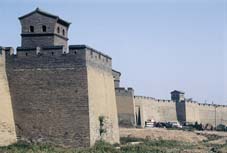
Pingyao's ultimate survival is partly due to the 12-meter-high city wall that protected the city and its architecture from damage and destruction at times of war. Another reason is, ironically enough, its poverty. Pingyao is one of the poorest counties in Shanxi Province, lacking the funds necessary to construct new buildings or change the city's appearance.
In any event, Pingyao city has been preserved, and in order to protect this world cultural heritage, a plan to relocate its citizens has been expedited.
Relocation to Protect the Old City
This move began in 1997, when the county government office moved out of the old government mansion. Later, 74 government organizations, and seven factories employing some 2,000 workers moved out of the city. The next stage will involve relocation of about half the city's residents, numbering more than 20,000, and the city's schools and hospitals.
The local government has designed a new city, complete with facilities and services, where Pingyao citizens are to be re-housed. Construction of a school, clinic, and a service office for the new residential area is complete, and to date 400 families have moved into 18 new buildings. A further three still larger residential areas are planned which, all being well, should be finished by 2005, when the main residential area will move to the city outskirts.
Pingyao Middle School in the southeast corner of the old city covers an area of 10 hectares, and has 4,900 students and more than 3,000 staff. It will move at the second stage of relocation, and crowding in the city will thus be alleviated. The one-thousand-year-old temple within the present school grounds is to be opened to the public. The school has purchased 15.5 hectares of land in the east of the city and construction of teaching and accommodation blocks has already begun. Students are scheduled to start their classes at the new school site next autumn. The school has not, however, received the funds originally promised by the government. Its 50 million yuan bank loan is a meaningless sheet of paper, as building costs are currently being met by the company doing the construction work. The uncertainty as to how this matter may be resolved is a great burden on the school principal.
It is no mean feat for an impoverished place like Pingyao to expedite a migration plan of such huge dimensions. Owing to a shortage of funds the government is unable to provide moving subsidies. Although residents fully support the relocation plan, their finances do not permit buying the more spacious houses in the new city.
County magistrate Li Dingwu says that the local government is considering issuing relocation compensation, as well as granting relocated residents a mortgage so that they can buy smaller, cheaper apartments. The local government is also looking for a sound investment group to help with this move, and withdevelopment and conservation of Pingyao city.
Zhao Changben's Relocation Story
Zhao Changben, now retired, formerly worked at the Pingyao Cultural Relics Bureau. He lives in the northern part of Pingyao city. His home, an old house, was purchased in 1874 by his grandfather, a local education officer at that time, who later extended the house into a two-courtyard mansion. Like many other Pingyao residents, Zhao was unwilling to leave his old house and move into a new building outside the city, and it was mainly concern for his wife, an arthritis sufferer, that made him consent. A specialist in cultural relics and ancient architecture, Zhao is fully aware of the attributes of his old house, and treasures the many antiques left by his ancestors. His wish is eventually to return and die in the house of his birth.
His eldest son, Zhao Pengtu, does not want to leave the old city either. An architect specializing in old style buildings, he is a great admirer of ancient cities and their architecture. He has an antique collection of exquisitely carved and engraved tables and chairs, and ancient shrines dating back hundred of years. The original window frames of his father's house, now over 100 years old, are still stacked up in his bedroom. After his parents have moved, he intends to restore the principal room to its original style, not just for tourists, but for his personal satisfaction.
Zhao Pengtu likes old architecture, but not the old life style. He plans to re-decorate his room in a more contemporary style, with comfortable furniture, and internet access. The government has ruled that the exterior and interior of key protected works of architecture must remain unchanged, but the interiors of houses outside this category may be altered according to the owner's needs.
Zhao Changben's youngest son, Zhao Penghuan, has quite a different outlook. He is looking forward to moving out of the old city and living in a modern house. The old house has no bathroom, and poor lighting and ventilation. It is, as far as he is concerned, inconvenient in every way. As he has invested all his available capital in business, he will also continue to live in the old house for a while.
Folk Residence Inn
We visited a small inn in the western part of the city. It is typical of the Pingyao residential courtyards built during the reign of Emperor Qianlong (1736-1785) of the Qing Dynasty. The original residents have moved out, and the premises have been renovated and adapted to work as an inn. Pass through a narrow door dating back more than 100 years, we entered a guestroom, containing a dark gray, rectangular wooden table dating back 200 to 300 years big enough to seat eight people, a wardrobe, and a dressing table. The ceiling was of woven reeds, and the floor was tiled in black. The bed, an adobe sleeping platform that may be heated from a central stove, had been used by the former house owner for over 100 years. It comprises a woven reed mat, blue patterned sheets, and quilts. Beside it is a chestnut bed table and a candlestick. Sitting here, in a room built 280 years ago, there is an indefinable sense of history as you imagine the lives, thoughts, and consciousness of the Pingyao forefathers.
Staying in an ancient and remote inn does not, however, mean being completely cut off. On taking a close look at the spaces between the bricks in the wall, or glancing inside a small corner cupboard, an Internet access plug comes to light. This simple inn from almost 300 years ago is now linked to the contemporary world.
There are no more than 100 folk residence inns such as this in Pingyao. The local government has restricted the number of tourism service facilities in the old city to 100, so as to prevent Pingyao from becoming an exclusively tourist site. The city is to preserve certain of its old residences and their basic living facilities in their original look. A number of residents will also continue to live and work in the old city. This is the only way Pingyao's folk customs and traditions can authentically continue and be passed on to following generations. The city will not, however, remain entirely unchanged or attempt to isolate itself from the rest of the world. The local government plans to enlarge residences in which the original owners are to continue living, adding kitchens and bathrooms and generally improving their living conditions. For those whose homes cannot be changed, new facilities will be added to the city so that these citizens may also enjoy the comforts of modern life.
The Pingyao government has adopted an active but prudent attitude towards relocation from the old city. Its guiding principle is not to preserve this cultural heritage city like a dusty museum relic inside a glass case, but to keep it alive and working
(China Today January 8, 2003)
|